
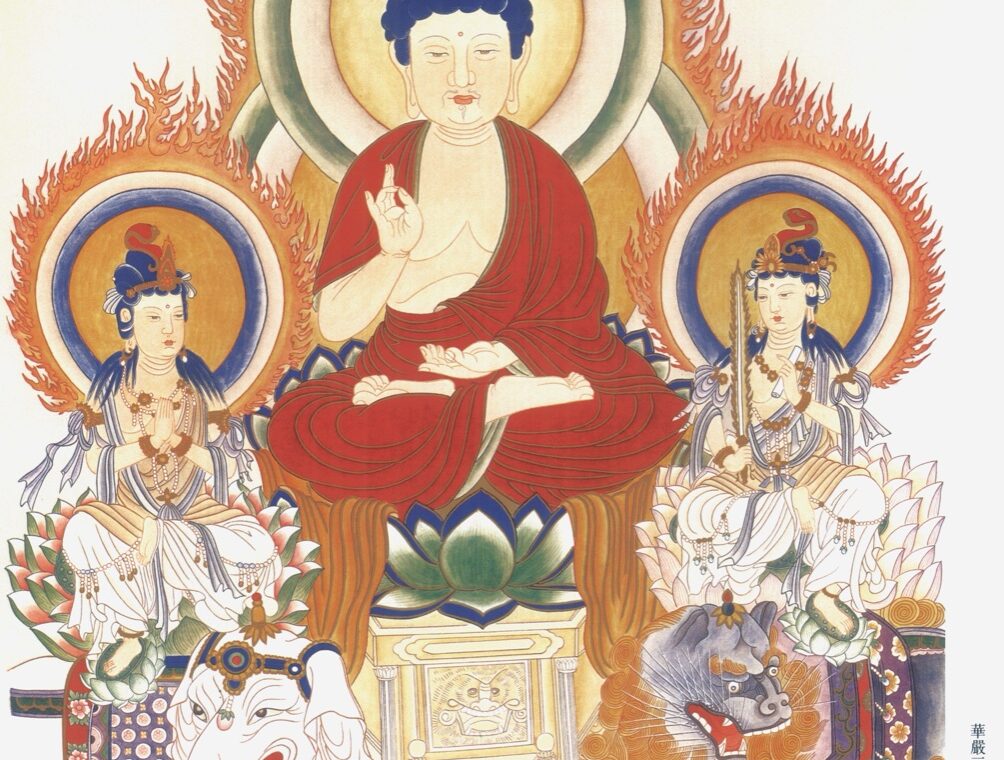
The Huayan Trinity brings three closely related figures into one devotional image: Vairocana Buddha at the center, Manjushri as the bodhisattva of wisdom, and Samantabhadra as the bodhisattva of practice and vows. In a crowded Buddhist painting, the fastest way to recognize this triad is not to rely on color or position alone. Look for a central Buddha framed by two bodhisattvas whose mounts—Manjushri’s lion and Samantabhadra’s elephant—make the relationship visible.
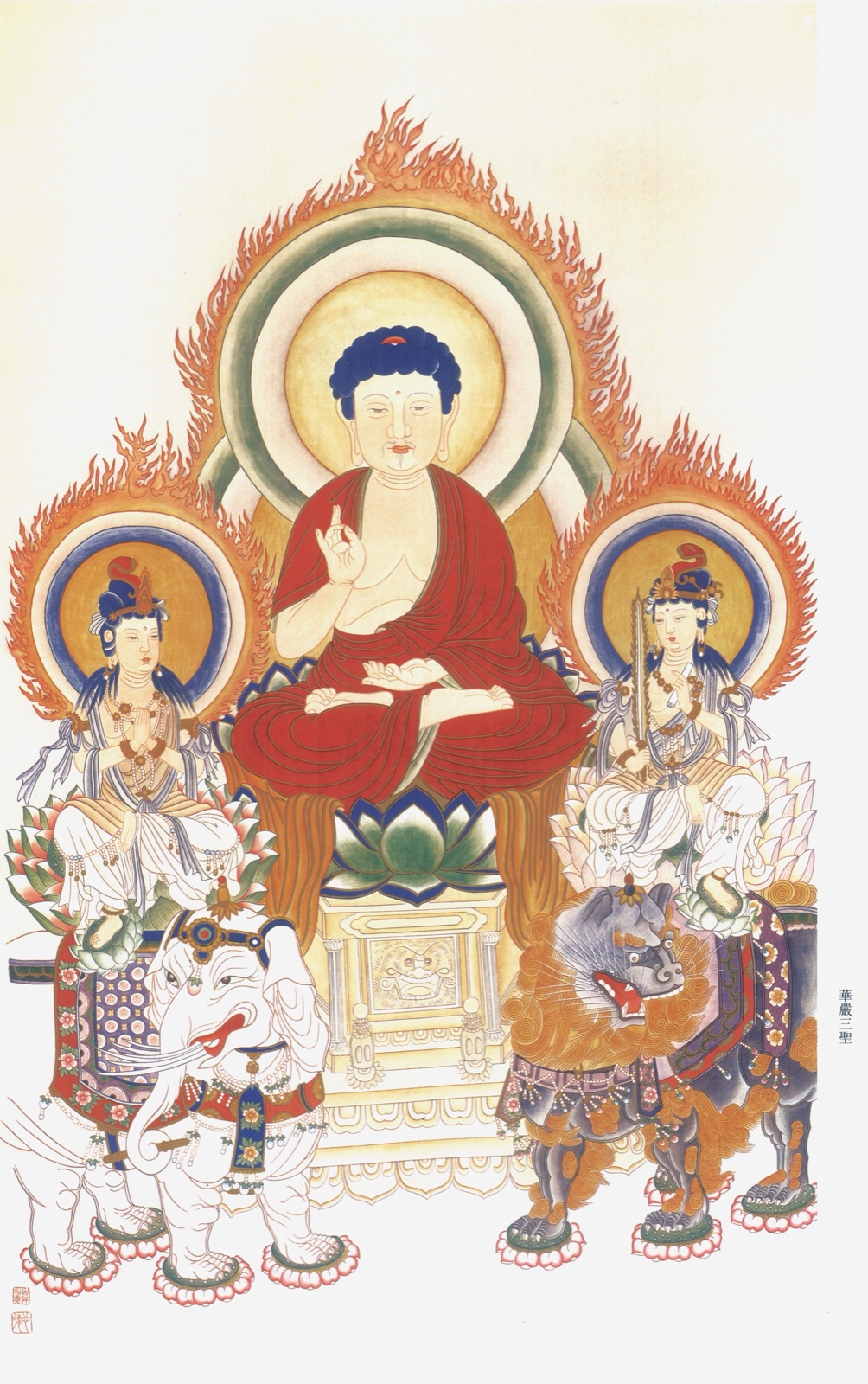
The museum-image record TK0207 is catalogued as Huayan Trinity. Its composition supports that identification: a Buddha occupies the dominant central axis; the bodhisattva at viewer left rides a white elephant; and the bodhisattva at viewer right rides a lion. The painting’s precise date, artist, workshop, collection history, and provenance are uncertain, so those details should not be inferred from the image alone.
What is the Huayan Trinity?
The Huayan Trinity is an iconographic grouping associated with the Huayan tradition of East Asian Buddhism. Vairocana represents the all-pervading or cosmic dimension of Buddhahood. Manjushri embodies wisdom, while Samantabhadra embodies vows, conduct, and the practice through which insight becomes action. Together, the three figures communicate more than a family-like grouping: wisdom and practice attend the Buddha at the center of an ordered sacred world.
This structure is especially useful for visual identification. Many Buddhist paintings include a Buddha with two attendants, but not every triad is the Huayan Trinity. The diagnosis becomes much stronger when the attendant figures are linked to their characteristic animal mounts. A lion suggests Manjushri; a six-tusked or white elephant suggests Samantabhadra. When both appear beside a central Vairocana, the combined evidence is far more reliable than any single feature.
How to identify the Huayan Trinity
1. Begin with the central Buddha
In TK0207, the central figure is substantially larger than the attendants and sits on a broad lotus throne within an expansive flaming halo. This scale difference establishes the visual hierarchy immediately. The central Buddha’s calm frontal posture and symmetrical placement give the image its stabilizing axis.
Vairocana can be represented differently across regions and periods, so one hand gesture, crown type, or body color should not be treated as a universal test. Instead, combine the figure’s central role with the identities of the two attendants. For a closer look at the Buddha’s broader visual tradition, see the guide to Vairocana Buddha in Thangka art.
2. Find Manjushri’s lion
Manjushri is one of the most recognizable bodhisattvas in Buddhist art, often associated with a sword of wisdom and a lotus supporting a book. Yet attributes can be small, obscured, restored, or adapted. In a Huayan Trinity, the lion is often the clearest supporting clue. In TK0207, the bodhisattva at viewer right is seated above a lion, strongly supporting identification as Manjushri.
The lion conveys fearless proclamation and the force of awakened understanding. It also separates Manjushri from visually similar crowned bodhisattvas. Our detailed Manjushri identification guide explains how the sword, lotus, book, and other attributes work together rather than functioning as isolated labels.
3. Find Samantabhadra’s white elephant
At viewer left in TK0207, a richly adorned bodhisattva is supported by a white elephant. This is the decisive sign of Samantabhadra in the context of the triad. The elephant symbolizes steady strength, disciplined practice, and the capacity to carry far-reaching vows. White also reinforces the animal’s sacred, purified character.
Some depictions show six tusks clearly, while others compress, obscure, or stylize that detail. A viewer should not reject an otherwise coherent identification because all six tusks are not visible. The mount, the triadic context, the bodhisattva’s position, and the central Vairocana should be considered together. Compare these cues with the separate guide to Samantabhadra and the elephant mount.
Reading TK0207 as a complete composition
The painting is organized vertically and symmetrically, but it is not static. The central halo rises like a field of fire behind Vairocana, while the smaller halos and lotus seats of the two bodhisattvas echo the central form. The elephant and lion anchor the lower corners and turn doctrinal relationships into recognizable visual signs.
The attendants face inward, directing attention toward the center. This creates a controlled visual path: the eye moves from the animals to the bodhisattvas, then upward and inward to Vairocana. Size, gaze, architecture, halos, and mounts all reinforce the hierarchy. That is why attendant figures in Buddhist art should be read relationally, not as disconnected portraits.
The Chinese inscription visible on the image reads “Huayan Three Saints,” matching the archive title. It is useful supporting evidence, but the visual iconography remains important. Inscriptions may be added later, translated loosely, or separated from their original cataloguing context. Here, inscription and imagery agree: the central Buddha and the lion-and-elephant pair form a coherent Huayan Buddhist art program.
A practical identification checklist
- Central hierarchy: Is one Buddha clearly larger and placed on the main axis?
- Lion mount: Is one attendant associated with a lion, supporting identification as Manjushri?
- Elephant mount: Is the other attendant associated with a white elephant, supporting identification as Samantabhadra?
- Triadic relationship: Do both bodhisattvas turn attention toward the central figure?
- Secondary attributes: Are a sword, lotus, book, ritual object, crown, or hand gesture visible?
- Multiple forms of evidence: Do composition, mounts, inscription, and catalogue title agree?
- Uncertainty control: Are date, artist, school, and provenance left uncertain unless documentation establishes them?
Common identification mistakes
The first mistake is identifying the triad from the central Buddha alone. Vairocana appears in many different configurations, including mandalas and assemblies without Manjushri and Samantabhadra. The second is using color as a fixed rule. Pigments age, photographs shift tones, and regional workshops use different palettes. The third is assigning the attendants by left-right position without checking their mounts. Orientation can be described from the viewer’s perspective or the central figure’s perspective, and conventions are not uniform.
A safer method is cumulative: central Buddha, lion, elephant, attributes, inward-facing relationship, and any reliable inscription should reinforce one another. This approach also guards against confusing the Huayan Trinity with other Buddhist triads whose attendant figures carry different emblems or serve different doctrinal roles.
Why this triad matters in Buddhist art
The Huayan Trinity expresses a complete path through visual form. Vairocana represents awakened reality; Manjushri represents the wisdom that understands it; and Samantabhadra represents the vows and practices that embody it. A viewer therefore encounters doctrine as a balanced composition: insight is not separated from conduct, and the Buddha’s centrality is revealed through the complementary work of both bodhisattvas.
TK0207 is valuable because its key signs remain legible at a glance. The dominant Buddha, elephant, lion, and inward-facing attendants make it a strong study image for Buddhist triad iconography. At the same time, responsible cataloguing requires restraint: the image supports the Huayan Trinity identification, but it does not by itself prove a specific date, workshop, artist, or provenance.
Conclusion
To identify the Huayan Trinity, look for Vairocana at the center, Manjushri with a lion, and Samantabhadra with a white elephant. Use the entire composition rather than a single color, gesture, or position. In TK0207, those features align clearly, making the work a practical example of how Buddhist triad iconography joins visual hierarchy, symbolic animals, wisdom, and practice.
Download the full Thangka image collection
Continue exploring and download the complete TANGKAWORLD image collection on our free downloads page. The library offers more Thangka and Buddhist art images for comparative study, visual identification, and research.