
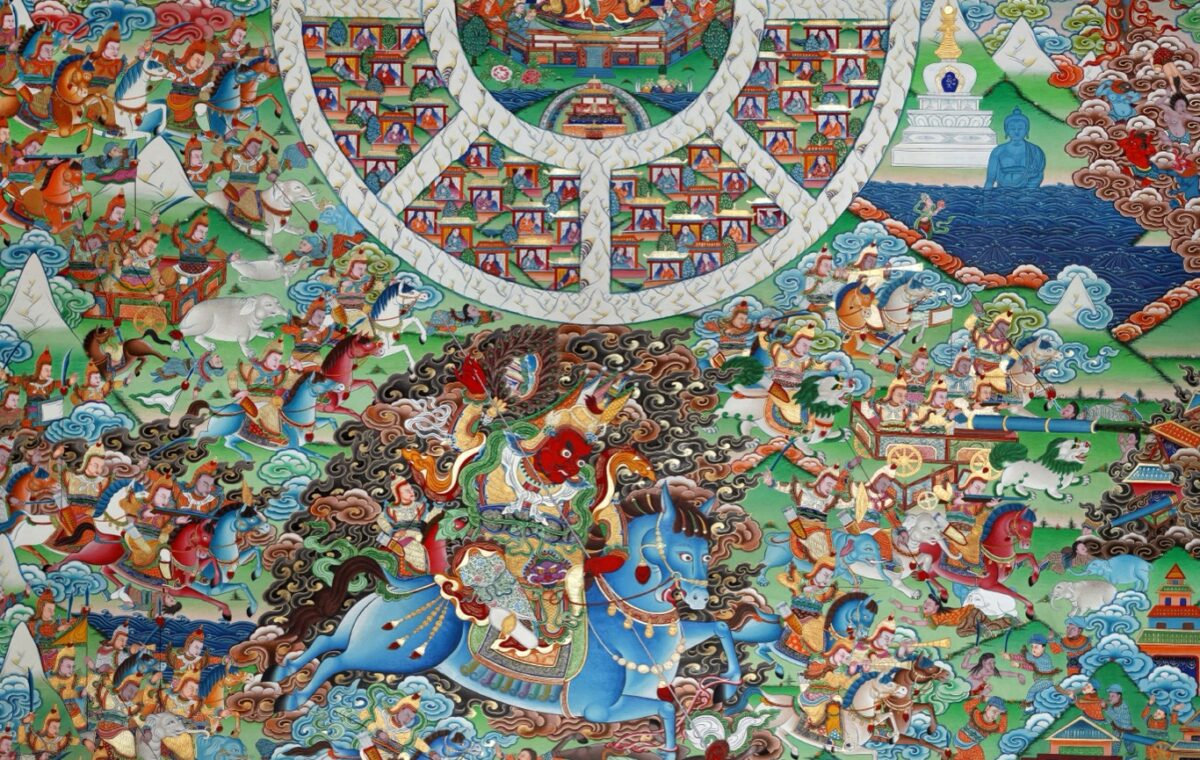
A Shambhala thangka can look overwhelming at first: a protected kingdom appears within a circular mountain system, while mounted armies, chariots, animals, clouds, water, and buildings fill the surrounding field. The key is not to identify every figure immediately. Begin with the large spatial divisions, then follow the changes in scale, movement, and density. This method turns a crowded painting into a sequence of readable zones.

What makes a Shambhala thangka visually distinctive?
Shambhala is a sacred kingdom associated with Kalachakra traditions. In painting, however, the subject is not always presented as a single calm palace or a simple map. It may combine sacred geography, a lineage-like arrangement of teachers or rulers, courtly space, and scenes of armed movement. These parts can occupy different scales and may not follow ordinary perspective.
TK1510 is organized around a strong contrast. The upper center contains a circular, mountain-divided realm. Around it, the picture expands into an active landscape of troops, animals, vehicles, smoke-like clouds, and waterways. The circular kingdom feels ordered and enclosed; the surrounding field feels mobile and unstable. That opposition is the first major clue to the image’s structure.
Do not treat the archive title alone as proof for every detail. It supports the general subject, but the names of the central ruler, surrounding teachers, commanders, protectors, and specific narrative moments are uncertain unless a reliable inscription or catalog entry confirms them.
Read the circular kingdom before the battle
Start with the white mountain divisions
The most legible organizing device is the white mountain system near the top. Its branching ridges divide the circular realm into repeated sectors. Each sector contains small architectural units and seated figures. The mountains are therefore more than landscape decoration: they act like borders, separating groups while preserving the unity of the whole kingdom.
Trace the circle slowly. Notice how the sectors repeat without being mechanically identical. Buildings, trees, and portraits create a rhythm around the center. This repetition gives the eye a route to follow and prevents the many small figures from dissolving into visual noise. Readers familiar with Mandala boundary rings may recognize a related principle of enclosure, although this painting should not automatically be classified as a Mandala.
Move inward to the central ruler and court
At the center of the mountain circle sits a large enthroned figure surrounded by attendants and architecture. The figure is much larger than the portraits in the outer sectors. This is a deliberate use of scale hierarchy in Buddhist art: size communicates visual priority rather than literal physical proportion.
The central enclosure also uses straight walls, a gateway, trees, and a small water feature to slow the eye. These stable horizontal and vertical forms contrast with the diagonal weapons, galloping horses, and curling clouds elsewhere. Before assigning a name to the central person, record the visible evidence: seated posture, clothing, throne, attendants, enclosure, and relationship to the surrounding sectors.
Read the surrounding portraits as a system
The numerous small figures housed in repeated architectural frames form a collective system. Their arrangement may convey succession, teaching, rulership, or another ordered relationship, but the exact identities remain uncertain here. A useful catalog description should state what is visible—seated figures in repeated buildings distributed across mountain-separated sectors—without inventing a complete lineage.
How the outer battle scene changes the composition
Once the central kingdom is clear, move outward and downward. The surrounding terrain contains several independent episodes rather than one continuous moment. Mounted groups travel in different directions. Chariots and elephants occupy separate clusters. Water channels, clouds, mountains, and buildings divide the action. The composition works like a visual field of related scenes, a method also discussed in our guide to Buddhist narrative painting.
Direction and movement
The eye reads speed through diagonals: horses lean forward, lances point across the field, banners stream, and wheels repeat circular motion. By contrast, the protected kingdom above relies on frontal seated figures and repeated architectural blocks. The painting therefore separates stable authority from active conflict through body direction as much as through geography.
Clouds, water, and mountains as scene dividers
Blue-green clouds and waterways thread between groups. White peaks interrupt the crowded field. These natural forms create pauses and help distinguish one encounter from another. They also connect distant areas: a line of cloud can lead from a mounted unit toward a deity in the sky, while a watercourse can guide the eye around a building or troop formation.
This is why landscape should not be treated as background filler. It is part of the painting’s visual grammar. The same principle applies when studying wave bands in Buddhist art: patterned water and clouds can organize movement, establish boundaries, and change how separate episodes relate.
Weapons and military technology
The lower field includes bows, lances, armor, chariots, elephants, horses, and cannon-like forms. These details deserve careful documentation, but they should not be used alone to assign a date. Artists may combine conventional, symbolic, historical, and later visual elements. Record each object, its location, and its relationship to nearby figures before proposing an interpretation.
A practical checklist for reading Shambhala paintings
- Confirm the source label: record the archive title and TK number, but distinguish a file label from a fully verified catalog attribution.
- Map the largest zones: note the circular kingdom, mountain sectors, central enclosure, sky groups, waterways, and outer battle field.
- Identify scale changes: compare the central seated figure, small sector portraits, mounted leaders, soldiers, animals, and architecture.
- Follow direction: mark where horses, chariots, weapons, banners, clouds, and waves lead the eye.
- Describe repeated units: count or group similar buildings and seated portraits rather than guessing every identity.
- Separate observation from interpretation: write “a large red-faced mounted figure” before assigning a specific name.
- Record uncertain information: date, artist, school, provenance, inscriptions, and the exact narrative episode should remain uncertain when documentation is absent.
- Inspect the full-resolution file: small weapons, faces, inscriptions, and architectural details may disappear in a web thumbnail.
Common mistakes when identifying a Shambhala thangka
One mistake is to focus only on the battle and miss the sacred geography above it. Another is to call every circular design a Mandala. A third is to identify every seated portrait as a named ruler without readable inscriptions or catalog evidence. Finally, viewers sometimes assume that all scenes occur at the same moment. The painting may instead compress several places, episodes, and symbolic relationships into one field.
A disciplined description begins with composition: an enclosed circular kingdom, mountain-separated sectors, a central court, repeated portraits, and an extensive outer zone of military action. Iconographic interpretation can then be added in layers, with each claim tied to visible or documentary evidence.
Conclusion
A Shambhala thangka becomes easier to read when the viewer moves from structure to detail. First locate the circular mountain kingdom. Then compare the central court with the repeated sector portraits. Finally, trace the armies, animals, vehicles, clouds, mountains, and water that animate the outer field. This approach respects the painting’s complexity while avoiding unsupported identifications. TK1510 provides a vivid study image, but its exact date, maker, individual figures, and episode remain uncertain without further catalog research.
Download the full Thangka image collection
Continue browsing and download the complete TANGKAWORLD image library on our free downloads page. Use the high-resolution files to compare Shambhala paintings, sacred landscapes, Buddhist narrative scenes, and fine iconographic details.