
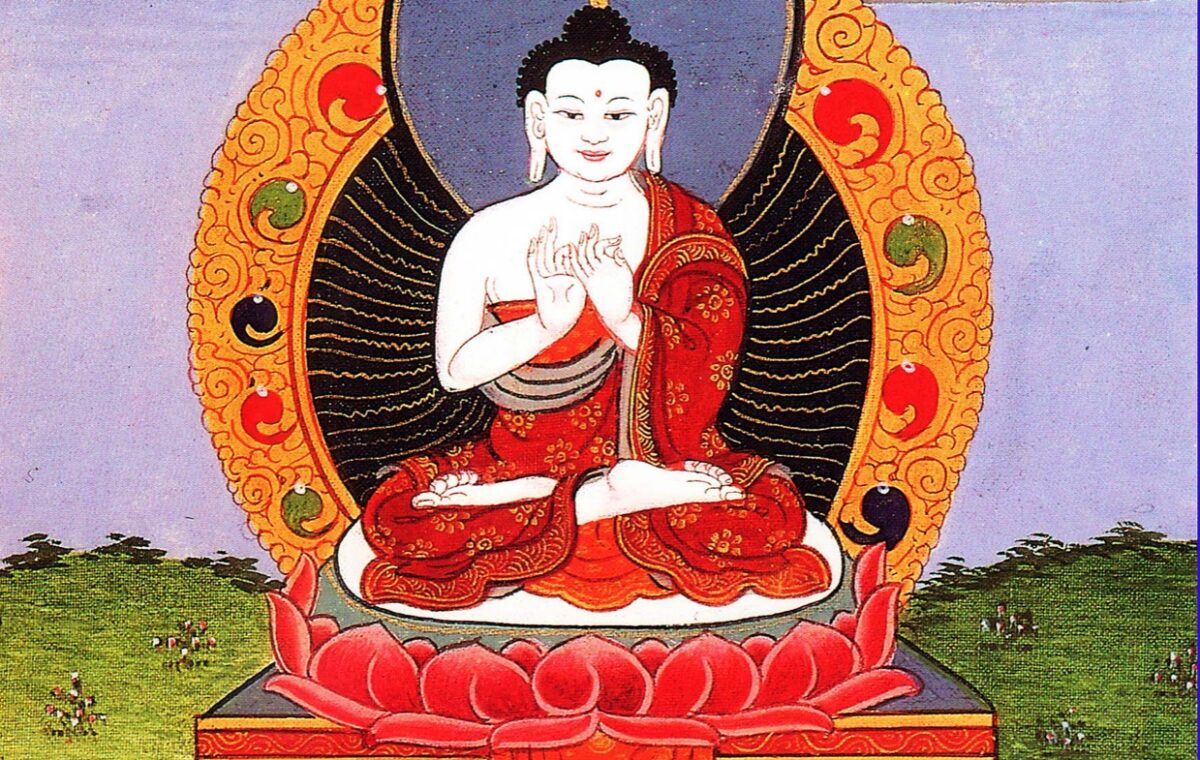
A Vairocana Buddha thangka can look deceptively simple: a white Buddha sits on a lotus, the hands meet before the chest, and the surrounding landscape appears calm. Yet the identity of Vairocana depends on a network of visual clues rather than color alone. His hand gesture, central cosmological role, relationship to the Five Buddha families, and the composition around him all matter. This guide explains how to read those features without turning a plausible identification into an unsupported certainty.
Who is Vairocana Buddha?
Vairocana is a cosmic or transcendent Buddha whose name is commonly associated with illumination. In many Vajrayana systems he occupies the center of the Five Buddha family arrangement. The other four Buddhas are assigned to the cardinal directions, while Vairocana expresses the all-encompassing center. This position is not merely geographic. It presents awakened wisdom as the field within which the directional families become intelligible.
That central role helps explain why Vairocana appears in mandalas, ritual crowns, sculpture, and paintings. His form is not identical in every region or textual tradition. He may wear monastic robes in one work and a jeweled crown in another. His hands may form a teaching gesture or a more esoteric wisdom-fist gesture. A responsible identification therefore begins with the visible form in front of us and then tests it against the larger iconographic system.
The teaching mudra is the strongest clue in TK0561
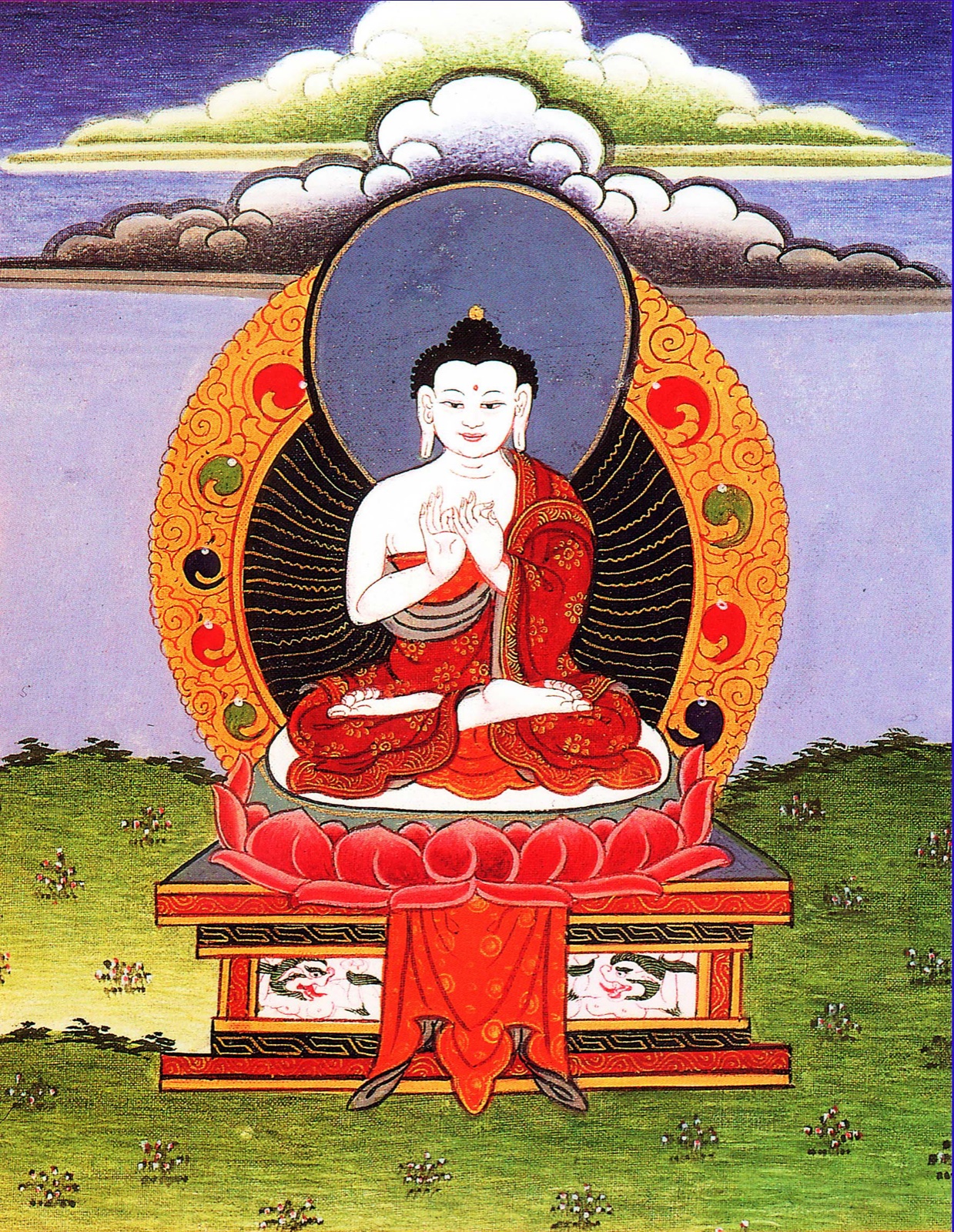
In TK0561 the Buddha holds both hands in front of the chest, with the fingers arranged in a compact teaching gesture. The placement is important. Shakyamuni is often recognized by one hand reaching toward the earth, while Amitayus rests both hands in meditation around a longevity vase. A Buddha whose hands actively meet at the chest invites a different reading.
Vairocana can be shown with dharmachakra mudra, the gesture of turning the wheel of Dharma, or with closely related teaching gestures. Other traditions use bodhyagri mudra, sometimes called the wisdom-fist gesture. The exact finger configuration must be examined closely; a low-resolution reproduction can hide the difference. It is safer to describe the hands as a teaching gesture unless the interlocking fingers are clearly visible enough to support a more specific term.
White color, lotus seat, and monastic appearance
The white body in this image agrees with a widespread color convention for Vairocana. White can suggest the integration of the spectrum and therefore suits a Buddha placed at the center of a five-family system. But white is not exclusive to Vairocana. White Tara, Vajrasattva, and peaceful forms of other deities also use a white body, so color should confirm an identification rather than create it by itself.
The figure wears Buddha-like robes rather than the elaborate jewelry of a bodhisattva. He sits cross-legged on a lotus throne, backed by a dark circular halo and a patterned aureole. These features establish peaceful enlightened status, but they are shared by many Buddhas. The teaching hands carry more diagnostic weight than the seat, halo, clouds, or robe.
How Vairocana fits the Five Buddha families
A Five Buddha composition provides one of the best contexts for identification. Vairocana is generally placed in the center, with Akshobhya, Ratnasambhava, Amitabha, and Amoghasiddhi occupying directional positions. Colors, gestures, emblems, and directions work together as a system. If a white teaching Buddha occupies the central cell of such a mandala, the identification becomes much stronger than it would be in an isolated portrait.
This is also why a single-figure painting should be compared with a broader composition. The Womb Realm is a distinct East Asian mandala tradition, but its emphasis on a central Mahavairocana helps readers understand how cosmic centrality can be made visual. See our guide to the Womb Realm Mandala and its central lotus for a structured example of center-and-court reading.
Vairocana, Shakyamuni, and other look-alikes
Vairocana versus Shakyamuni
Shakyamuni is commonly shown in monastic robes with the right hand touching the earth and the left supporting an alms bowl. When the hands meet before the chest instead, readers should examine Vairocana and other teaching Buddha possibilities. Our Shakyamuni Buddha identification guide shows how the earth-touching gesture changes the reading.
Vairocana versus Vajrasattva
Vajrasattva is also white, but he usually wears bodhisattva jewelry and holds a vajra at the heart and a bell near the hip. Those implements are more decisive than body color. Compare the attributes in our Vajrasattva thangka guide.
Vairocana versus an unidentified teaching Buddha
A teaching gesture does not guarantee Vairocana. The composition may belong to a regional program with another Buddha at its center. If the surrounding figures, inscriptions, reverse consecration text, or catalogue history are missing, record the result as “probably Vairocana” or “a Buddha identified in the archive as Vairocana,” not as an unquestionable attribution.
Practical Vairocana identification checklist
- Hands: Are they joined at the chest in a teaching or wisdom-fist gesture?
- Color: Is the body white, while recognizing that white is not unique to Vairocana?
- Position: Does the figure occupy the center of a Five Buddha or mandala arrangement?
- Dress: Is the figure monastic, crowned, or jeweled, and does that form match the relevant tradition?
- Comparisons: Are the earth-touching gesture, alms bowl, longevity vase, vajra, and bell absent?
- Documentation: Is there an inscription or reliable catalogue record supporting the name?
How to describe an uncertain Vairocana image
Museum-minded description separates observation from interpretation. Start with what is visible: “A white Buddha sits on a lotus and forms a teaching gesture at the chest.” Then add the reasoned identification: “These features are consistent with Vairocana.” Finally state the limit: “The artist, date, school, and provenance are uncertain.” This structure protects the record from false precision and makes later research easier.
TK0561 is visually consistent with a Vairocana Buddha thangka, especially because of the white body and chest-level teaching gesture. However, the local archive does not provide enough verified evidence to assign an artist, date, or lineage. The correct conclusion is a careful iconographic identification, not a full catalogue attribution.
Conclusion
To recognize Vairocana, begin with the hands, then test color and central placement against the Five Buddha system. Do not let a white body or lotus throne decide the answer alone. The strongest reading combines gesture, composition, comparison, and documentation. For a broader method that works across many subjects, continue with How to Read a Thangka.
Sources and further reading
- Himalayan Art Resources: comparative records for Vairocana Buddha
- The Metropolitan Museum of Art: Buddha Vairocana (object record)
These references support comparative iconographic study. The TANGKAWORLD TK number is an internal catalogue identifier; artist, date, collection history, and provenance remain uncertain unless separately documented.
Download the full Thangka image collection
Continue exploring and download the complete TANGKAWORLD image library through our Thangka image collection.