
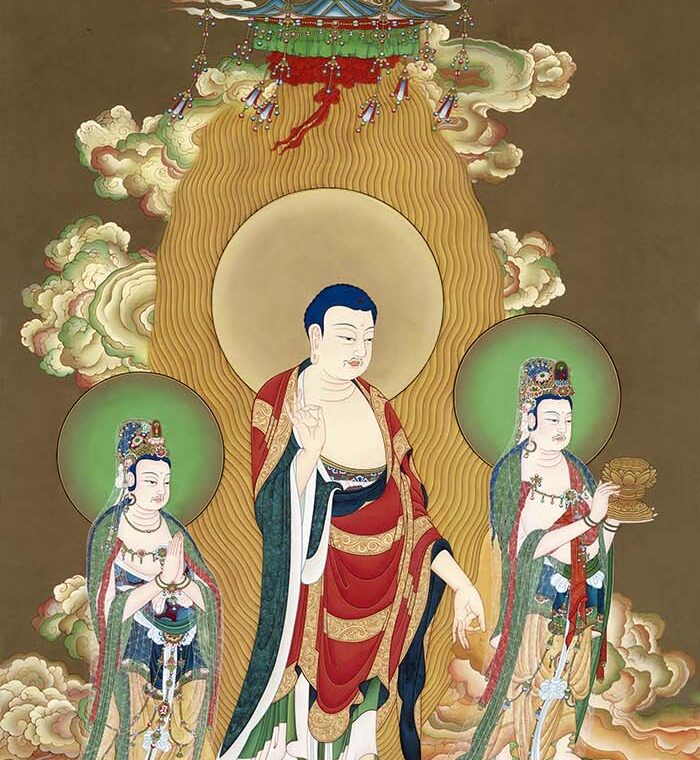
Head adornment in Buddhist painting is easy to notice and easy to overinterpret. A crown, jeweled band, loose hair, or bare head may help describe how a figure is presented, but none of these details identifies a deity on its own. In this guide, we compare the visible head arrangements in TANGKAWORLD image TK1111 and use them as evidence—not as a shortcut to uncertain names.
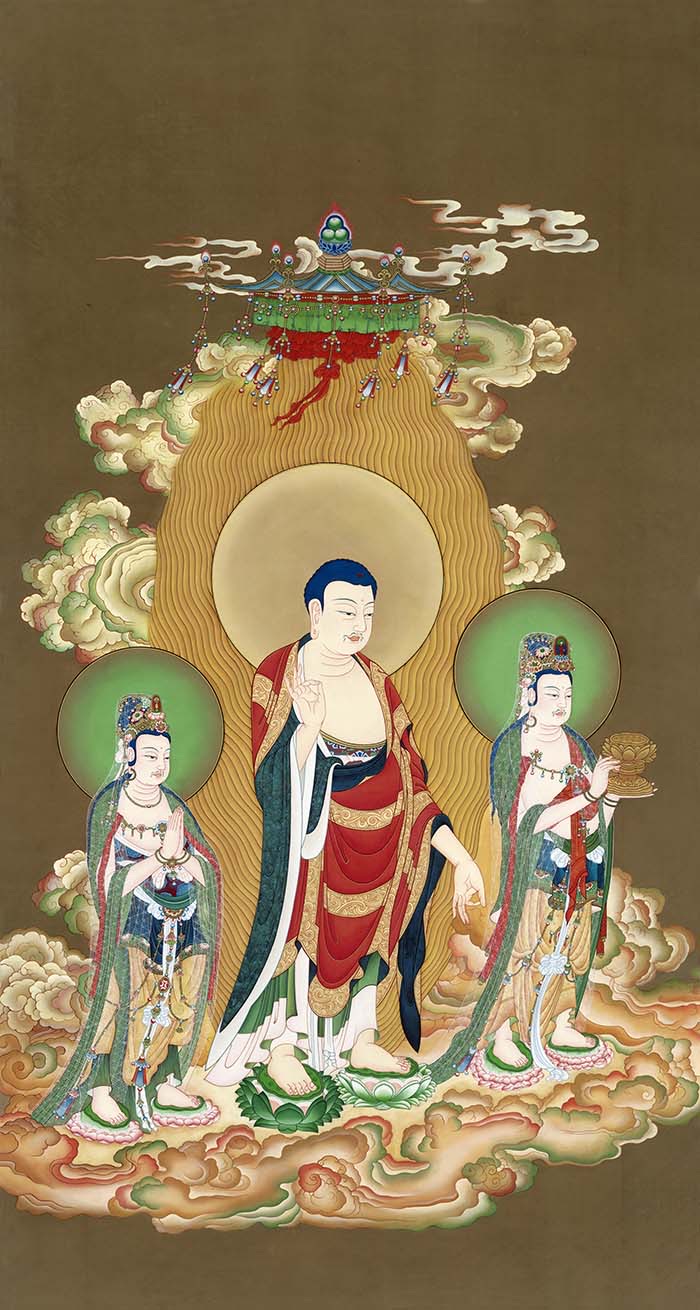
The central figure has short blue hair and no visible crown. The two flanking figures wear elaborate, jeweled headpieces. Each has a halo behind the head, while an ornate canopy rises above the group. These are distinct visual layers. Comparing them carefully shows how head adornment contributes to composition while keeping the limits of visual identification clear.
What is visible in TK1111?
Begin with a neutral inventory. At the center is a haloed figure with short blue hair, a high forehead, and no visible crown or jeweled headband. The figure wears layered robes. On either side stands a smaller haloed figure wearing an elaborate crown-like arrangement with colored details and hanging ornaments. The side figures’ clothing and jewelry are also more visibly embellished than the central figure’s monastic-looking robes.
That description separates observation from interpretation. “Crowned side figure” is a record of what appears in the image. A specific deity name, ritual role, or canonical grouping would be an attribution requiring additional evidence. The source filename and folder provide a useful retrieval clue, but a catalog label is not a substitute for an inscription, documented provenance, or a close iconographic comparison.
Notice scale and placement as well. The central figure occupies more visual space and stands in front of a large circular halo. The two flanking figures are positioned lower and to the sides. The canopy sits above the group rather than on any individual head. Size, position, and framing work together; headgear is only one part of this arrangement.
Crown, hair, halo, and canopy are different things
When comparing Buddhist figure crowns, first decide which visible marks belong to the head and which belong to the surrounding composition. A crown or headpiece rests on, encircles, or rises directly from the head. Hair is the figure’s own visible coiffure or hair mass. A halo is a luminous disc or ring behind the head or body. A canopy is an architectural or textile-like feature above a figure or group.
In TK1111, the central figure’s blue hair sits within the head silhouette, while the round halo begins behind it. The side figures have crowns in front of their greenish circular halos. Above all three is a jeweled-looking canopy with hanging details. Because these forms overlap in a compact area, a quick glance can blur their boundaries. At full size, trace the contour of the head first, then follow the halo and canopy separately.
This distinction matters beyond TK1111. A halo can appear to touch the crown, and a decorative band can resemble a small nimbus when an image is reduced. Do not call every circle or ornament a crown. Record the element’s location, shape, attachment, and relationship to the head before assigning a technical name.
How head adornment shapes the group composition
The contrast between the unadorned central head and the two elaborate crowns gives TK1111 a clear visual rhythm: plain, ornate, ornate. The central figure’s larger scale and robe create one kind of emphasis; the side figures’ colorful crowns and jewelry create another. The contrast directs the eye across the group without requiring us to decide who the figures are.
Head adornment can also help distinguish figures within a crowded painting. Differences in crown height, number of tiers, color accents, dangling elements, and visible hair may make adjacent heads easier to compare. But visual difference does not automatically mean difference in rank or identity. Artists can vary adornment to clarify roles, balance a composition, or distinguish figures according to conventions that depend on region, period, and subject.
Look at the whole figure before drawing conclusions from the crown alone. In this image, the flanking figures also differ from the central one in garment layering and jewelry. Their placement, gestures, hand-held objects, and relationships to one another may contribute evidence. A headpiece is strongest as one clue among several, not as a standalone label.
A close-looking method for comparing crowns and hair
- Map the heads. Count the visible figures and note their positions: center, left, and right. Avoid naming them at this stage.
- Describe the silhouette. Record whether each head appears bare, covered by hair, encircled by a band, or topped with a crown. Use “crown-like” if construction is unclear.
- Separate attached from surrounding forms. Trace the outer edge of the head, then the halo, then any canopy or hanging decoration.
- Compare details consistently. For each figure, note height, tiers, color, jewels, side ornaments, ribbons, and visible hair. Mark details as not visible rather than assuming they are absent.
- Check other evidence. Add posture, gesture, held objects, clothing, scale, inscriptions, and group relationships to the comparison.
- State confidence. Keep the visual description firm and the identity tentative unless multiple independent clues support a specific attribution.
This sequence works well with the broader beginner’s guide to reading a Thangka: move from central composition to individual attributes, then to contextual evidence. For another perspective on figures around a central image, see how Buddhist attendant figures are read in Thangka. These methods help compare visible features without turning a visual resemblance into certainty.
What the crown cannot prove
A crown alone cannot prove that a figure is a bodhisattva, identify a specific deity, establish a ritual role, or date a painting. Similar headpieces can appear across different Buddhist traditions and artistic settings. Conversely, a figure without a crown is not automatically a Buddha, monk, or historical person. In TK1111, the central figure’s blue hair and plain head are visible facts; a definitive identity remains uncertain from the image alone.
Likewise, the rich ornament does not prove that the two side figures belong to a particular named triad. Their crowns are evidence worth documenting, but the attribution needs corroboration from attributes, inscriptions, reliable catalog records, or close comparison with identified works. When those sources are absent, preserve the uncertainty instead of filling it with a familiar label.
A practical documentation checklist
For a collection note or image study, use a short record such as this:
- Image reference: TK1111; identify the specific crop or full image viewed.
- Position: center, left, or right; describe relative scale.
- Head: visible hair, bare scalp, band, or crown-like ornament.
- Adornment: color, tiers, jewels, side elements, ribbons, and condition or visibility.
- Surrounding forms: halo, canopy, textile, or other framing element, recorded separately.
- Other clues: garment, gesture, held object, inscription, and nearby figures.
- Interpretation: distinguish observed features from proposed identity; mark uncertain points clearly.
For conservation or catalog work, also note image resolution, cropping, surface losses, retouching, and whether the feature is clear enough to compare. A visual checklist is not a condition diagnosis. The site’s Thangka condition-report checklist offers a separate framework for recording visible condition. And when color is part of the comparison, the related warm-and-cool palette study shows how to describe color relationships without using them as proof of identity.
Conclusion: describe first, identify second
Head adornment in Buddhist painting can clarify how figures differ and how a group is organized. In TK1111, one larger central figure with short blue hair and no crown contrasts with two smaller, crowned figures; halos and a canopy frame the group but remain separate visual elements. That is already a useful reading. A careful study records these distinctions, compares them with posture and context, and leaves names uncertain when the evidence does not settle them.
Download the full Thangka image collection
Continue browsing and download the complete TANGKAWORLD image collection from the free Thangka downloads page.