
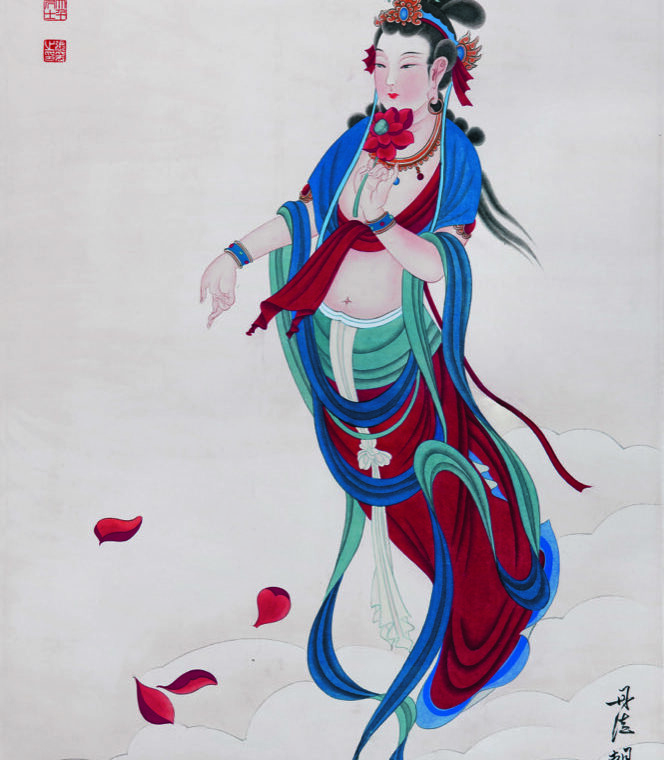
A paper Buddhist painting is more than an image on a pale background. The support, painted area, margins, seals, and mounting each belong to different parts of an object’s history. In the archive image TK0238, the catalog filename describes a bodhisattva hanging scroll on paper. That label is a useful starting point, not a laboratory finding or proof of date and authorship. This guide shows how to describe what is visible, separate the painting sheet from the mount, and record condition without turning appearance into certainty.
Start with the object, not the attribution
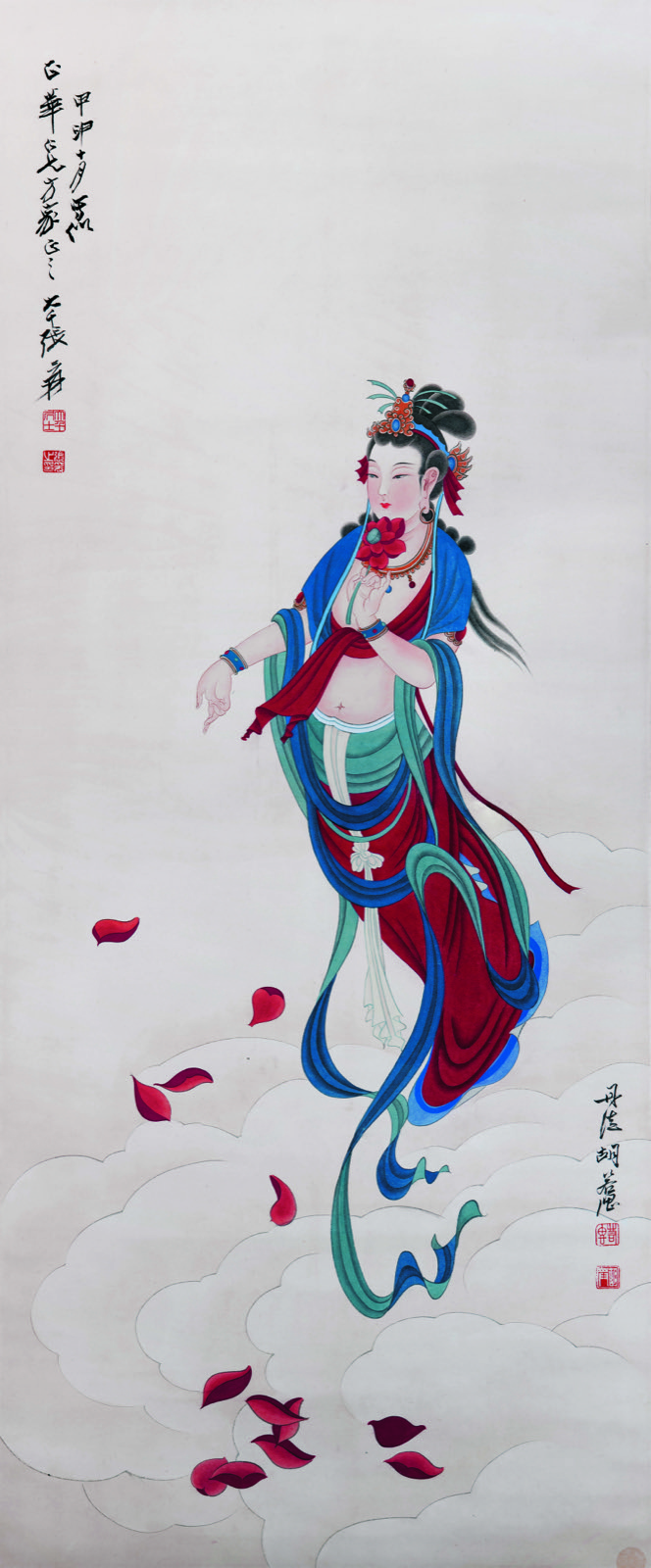
When examining a Buddhist painting, first separate direct observation from catalog language. TK0238 shows a vertical composition with a single richly dressed figure floating above layered cloud forms. A red seal appears near the upper left, with further inscription and seal marks near the lower right. Much of the field around the figure is light and open. Those statements describe the digital image. They do not by themselves establish the support’s fiber, pigment recipe, workshop, or historical date.
The source filename calls the image a hanging scroll and identifies Zhang Daqian. The file’s title is useful for retrieval, but it has not been independently corroborated through provenance or a technical examination for this article. We therefore refer to it as TK0238 and describe the attribution as uncertain. This distinction is especially important for collection research: a filename can preserve valuable context while still remaining a claim to verify.
Painting sheet and scroll mounting are not the same layer
A hanging scroll is a format, not a synonym for the painted support. The picture may be executed on paper or silk, then mounted with backing layers and decorative borders. Those materials can respond differently to moisture, handling, and tension. In a photograph or scan, the image sheet may occupy nearly the whole frame, while the silk borders and backing are cropped out. A plain digital background should never be treated as proof that the full mounted object is plain.
For TK0238, the archive label says “paper,” while the displayed image shows a pale ground and a vertical scroll composition. The mount is not documented in this reproduction. Avoid statements such as “the scroll has silk borders” unless those borders are visible or supported by a reliable catalog record. For a related discussion of the separate textile components, see our guide to Buddhist scroll-cover fabric and what it can reveal.
What paper can change in the visual reading
Paper is fibrous and can absorb moisture; its surface, sizing, thickness, and preparation vary. These properties influence how ink and color sit, spread, or appear in a photograph, but a compressed web image cannot reveal the full material structure. Paper may show texture, creases, cockling, stains, tears, or edge wear; lighting, image processing, and display quality can imitate or conceal some of these features. Record a visible clue as a clue, not as a diagnosis.
Paper and silk are both used as supports in East Asian painting, and different formats—including hanging scrolls and handscrolls—have distinct handling and mounting histories. The Metropolitan Museum of Art’s East Asian Painting Conservation Studio describes this range of formats and materials. For works on paper, the Canadian Conservation Institute advises minimizing handling, limiting light exposure, and avoiding unstable temperature and humidity conditions. Its basic care guide is a helpful starting point; treatment decisions should be left to a qualified paper conservator.
Do not decide between paper and silk by tone, shine, or color in a single web reproduction. Both materials can look pale, dark, glossy, or matte depending on lighting, surface preparation, age, and photography. A close view of an edge, a catalog description, or a conservator’s examination may provide stronger evidence than the overall color. Even then, record the source: “cataloged as paper” is not the same statement as “fiber identification confirmed by analysis.”
It also helps to distinguish the painting support from later additions. A scroll may include a primary image sheet, backing papers, textile borders, a roller, and cords. Each component can have been replaced or repaired at a different time. A digital crop that omits the edges cannot reveal those changes. When a complete object is unavailable, say “mounting not visible in this image” rather than describing the work as unmounted.
Describe surface and condition without overclaiming
Use neutral language and identify where a feature appears. “Light-toned field around the figure” is safer than “aged paper.” “Visible waviness in the lower margin” is more precise than “water damage.” A digital reproduction may have been cropped, sharpened, color-adjusted, or photographed under uneven lighting. If a spot or crease is visible only on screen, note that it needs examination in person.
Do not infer age from yellowing alone. Color can be affected by paper composition, light exposure, backing, stains, image capture, and later treatment. Similarly, a seam or edge may belong to a mount, a repair, or the digital crop. Avoid cleaning, flattening, unrolling, or applying pressure based on an online image. If an original is fragile, consult a conservator before moving or treating it.
A repeatable checklist for paper Buddhist paintings
- Identify the reference: record TK number, filename, image version, and whether you viewed a crop or the whole digital file.
- Separate components: describe the painted field, visible sheet edges, margins, backing, textile borders, and hanging elements independently.
- Record observable clues: note texture, folds, tears, stains, waves, abrasions, and seals, including their location and visibility.
- Mark the evidence source: distinguish direct viewing, archive filename, catalog record, inscription, and technical analysis.
- State uncertainty: leave support, artist, date, school, and provenance uncertain when the available evidence does not establish them.
- Set a safe next step: request a higher-resolution image or professional examination instead of attempting home repair.
This method pairs well with our visual condition-report checklist and guide to documenting Thangka borders. Both emphasize recording location and evidence before assigning an interpretation. When you need a larger study image, see how to study Thangka iconography with high-resolution images.
Conclusion: let the support inform, not dictate, the reading
A paper support affects how a Buddhist painting was made, mounted, handled, and preserved, but it cannot identify the figure or establish the object’s full history by itself. TK0238 provides a useful close-looking example: a vertical image, an open light field, cloud forms, and visible seal marks, paired with an archive filename that describes paper. Keep those observations separate from unverified attribution. Careful documentation preserves what is known—and makes uncertainty visible for the next researcher.
Download the full Thangka image collection
Continue browsing and download the complete TANGKAWORLD image collection from the free Thangka downloads page.