
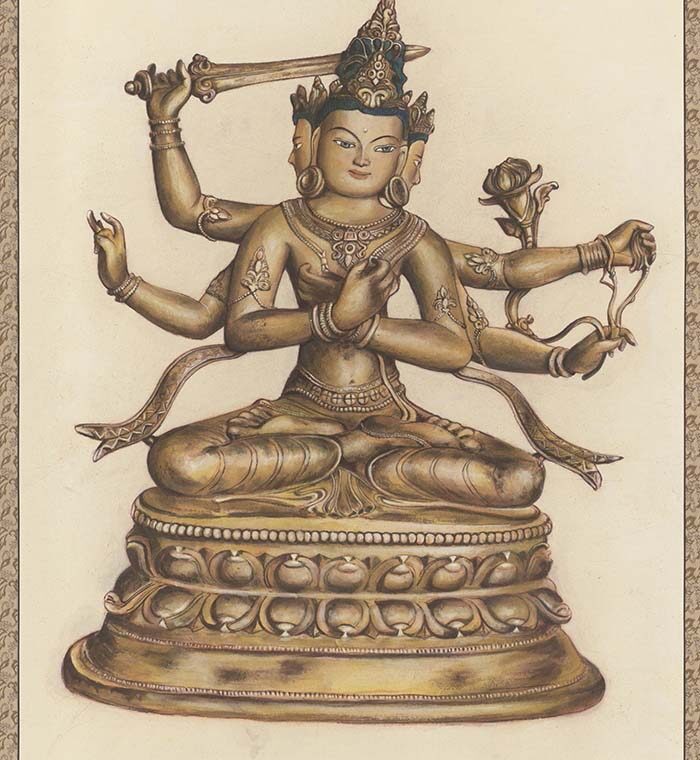
A figure with several faces and arms can tempt a viewer to jump immediately to a familiar deity name. TK0184 rewards a slower approach. The image shows a seated, crowned figure with a frontal face and side faces, crossed central arms, other arms extending outward, a long object raised above the head, and a flower-like stem at the right. Those details are observable; the archive label “Avalokiteshvara” is a lead, not independent proof. This guide shows how to read a multi-faced Buddhist figure by separating what the image displays from what its title, tradition, or history may suggest.
Begin with the visible arrangement, not the name
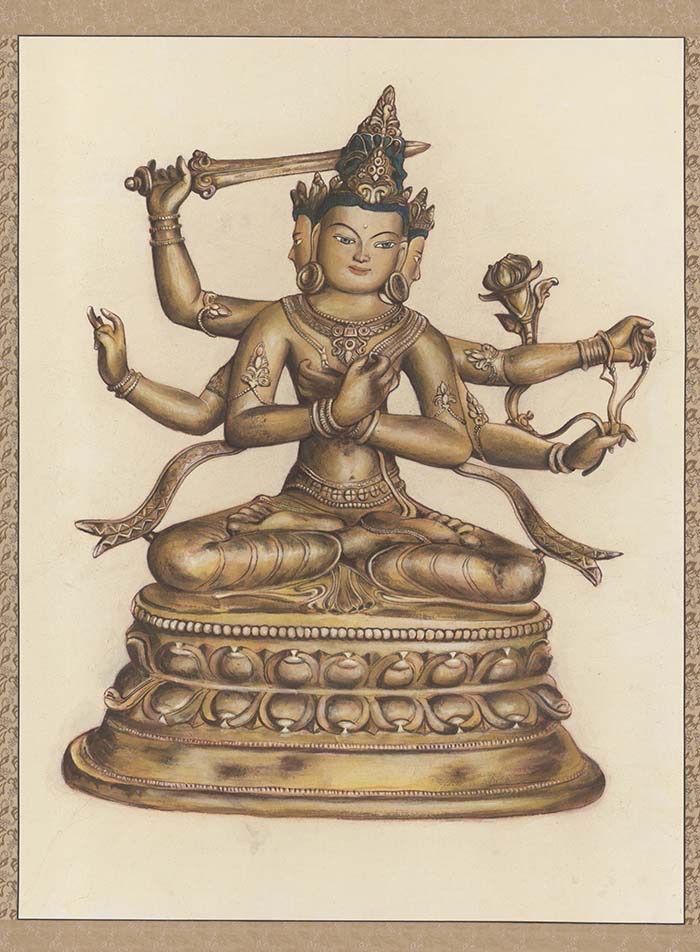
Before identifying a figure, describe its structure in plain language. In TK0184, the main body sits cross-legged on a stepped lotus base. The figure wears a tall crown and jewelry. One face looks forward while additional faces appear in profile at the sides. Several arms emerge around the torso: two cross near the chest, while others extend laterally or rise above the head. A long, narrow object is held overhead, and a branching flower-like form rises on the right.
This description is deliberately modest. It avoids deciding whether an object is a sword, staff, ritual implement, or another attribute before its details can be compared with a reliable catalogue or textual source. A careful visual record preserves the image’s information without turning resemblance into certainty.
How to read a multi-faced Buddhist figure
Count and map the faces
First note how many faces are clearly visible and how they relate to the central axis. Are they stacked above the crown, turned to the sides, or arranged in several tiers? Do they share a direction, or does each look outward? Record what is visible rather than forcing a complete count when profiles overlap or disappear behind the central head.
TK0184 is useful because its side faces are presented alongside the frontal face, not merely as a small upper register. That arrangement changes how the viewer experiences the image: attention is directed beyond a single frontal gaze. It is a compositional fact. What the additional faces mean in a particular ritual system remains a separate question requiring comparative evidence.
Trace each arm back to the shoulder
Multiple arms are easiest to misread where hands cross the body or overlap. Follow each forearm back toward its shoulder, then note whether it holds something, forms a gesture, or rests against the body. A quick sketch or numbered annotation can prevent counting the same arm twice. Mark uncertain connections with a question mark instead of silently filling in a missing limb.
In this image, the crossed central arms form a compact knot at the chest. The lateral arms open the composition, while the raised arm creates a strong horizontal line above the crown. This balance between a dense center and an extended perimeter is more reliable to discuss than an assumed symbolic meaning for every hand.
Describe attributes before interpreting them
Write down the shape, orientation, and location of each object. Is it straight or curved? Does it have a blade-like end, a grip, leaves, petals, or a finial? Is it held upright, across the head, or beside the shoulder? Then compare the object with securely identified examples. A slender form may resemble an attribute used by more than one deity, and painted details can be difficult to distinguish at web resolution.
For TK0184, the object above the figure is long and nearly horizontal. On the right, a flower-like stem rises beside the upper hand. These observations help a researcher search for comparable images, but neither item alone establishes a name.
Separate iconographic clues from attribution
In Buddhist art, identity is normally established through a combination of features: face and body count, posture, hand gestures, attributes, color, ornaments, accompanying figures, inscriptions, and the image’s ritual or narrative setting. One striking feature is rarely enough. Multiple forms of a deity can share attributes, while different traditions may arrange related imagery in distinct ways.
The archive filename places TK0184 in an Avalokiteshvara group and calls the maker anonymous. Both statements should be reported as archive information, not as verified history. The visible image can be described independently; confirming the deity may require an inscription, a documented collection record, a close comparison with established examples, or specialist review. The artist, date, workshop, lineage, original use, and provenance remain uncertain from the image supplied here.
This distinction is not a refusal to interpret. It is a useful hierarchy of confidence: “the image shows” for direct observation; “the archive labels” for cataloguing information; and “may represent” for a reasoned but unconfirmed interpretation. Clear wording lets later research improve the identification without losing sight of the original evidence.
Compare forms without collapsing them together
Other Buddhist images demonstrate why the number of arms should not become a shortcut. The Thousand-Armed Avalokiteshvara guide discusses a composition built around a radiating field of hands and eyes. The Four-Armed Avalokiteshvara guide examines a more compact arrangement. Both are useful comparisons for studying how multiplicity is organized, but their titles do not prove that TK0184 belongs to either form.
Likewise, the recent TK0182 seated bodhisattva hand-gesture study offers a method for describing hand position while keeping identity cautious. Compare features, not presumed identities: the number and direction of faces, the paths of the arms, the placement of objects, the posture, and the surrounding composition.
A practical checklist for looking closely
- Record the image identifier and the exact archive title separately.
- Describe the body posture, crown, clothing, and seat before naming the figure.
- Map faces by position and direction; mark any obscured or uncertain face.
- Trace arms from shoulder to hand so crossed limbs are not counted twice.
- Describe each hand gesture and object by shape and location before interpreting it.
- Note what the crop, scan resolution, or image condition prevents you from seeing.
- Compare the whole cluster of features with documented images, not one attribute alone.
- Keep artist, date, school, lineage, and provenance marked uncertain unless supported by records.
Conclusion: let the image keep its uncertainty
TK0184 offers a rich study in how multiple faces and arms shape a Buddhist image. Its frontal and side faces broaden the figure’s visual presence; its crossed hands concentrate attention at the chest; its extended arms and overhead object create a horizontal rhythm. These are strong observations even when the exact deity is not confirmed. Reading a multi-faced Buddhist figure responsibly means describing that visible system first and treating the archive name as a hypothesis to test—not a conclusion to repeat.
Download the full Thangka image collection
Continue browsing and download the complete TANGKAWORLD image library from the full Thangka image collection page.