
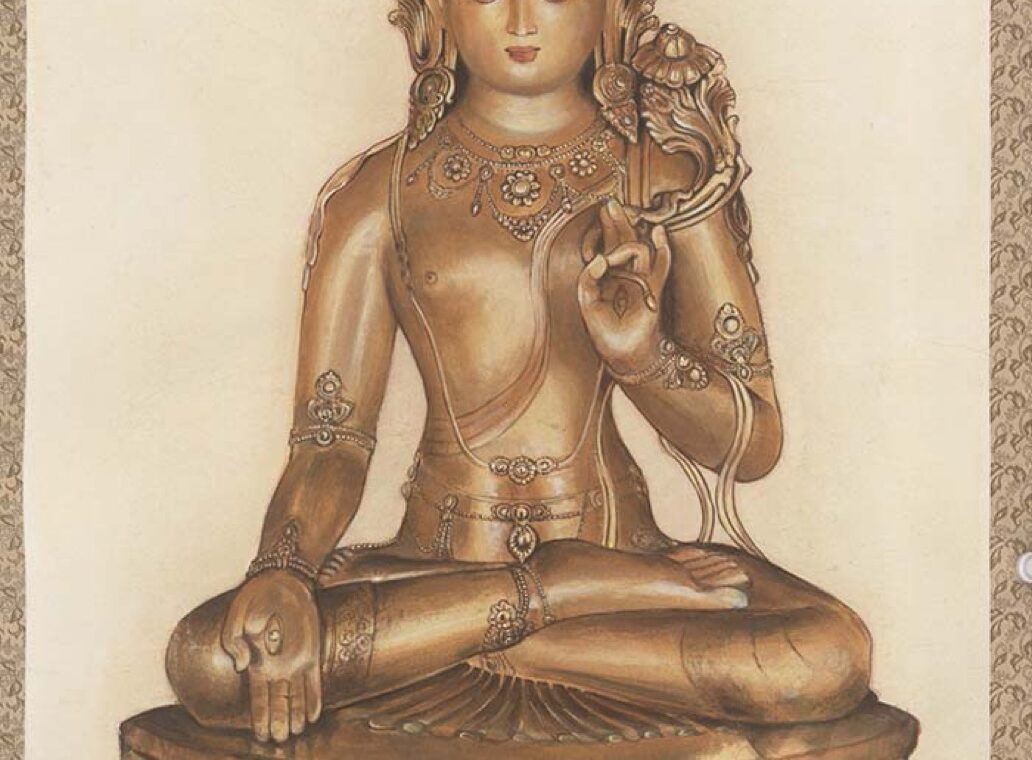
In Buddhist painting, a hand can look like a clear symbol at first glance and become less certain when examined closely. TK0182 offers a useful case: a crowned, seated bodhisattva lowers one hand over the knee while raising the other beside a small flower-like form. The archive filename identifies the figure as Avalokiteshvara, but that label is not independently confirmed by the image alone. This guide reads the visible hand gestures first, then weighs the attribute and surrounding clues without turning a plausible identification into a fact.
Begin with what the hands visibly do
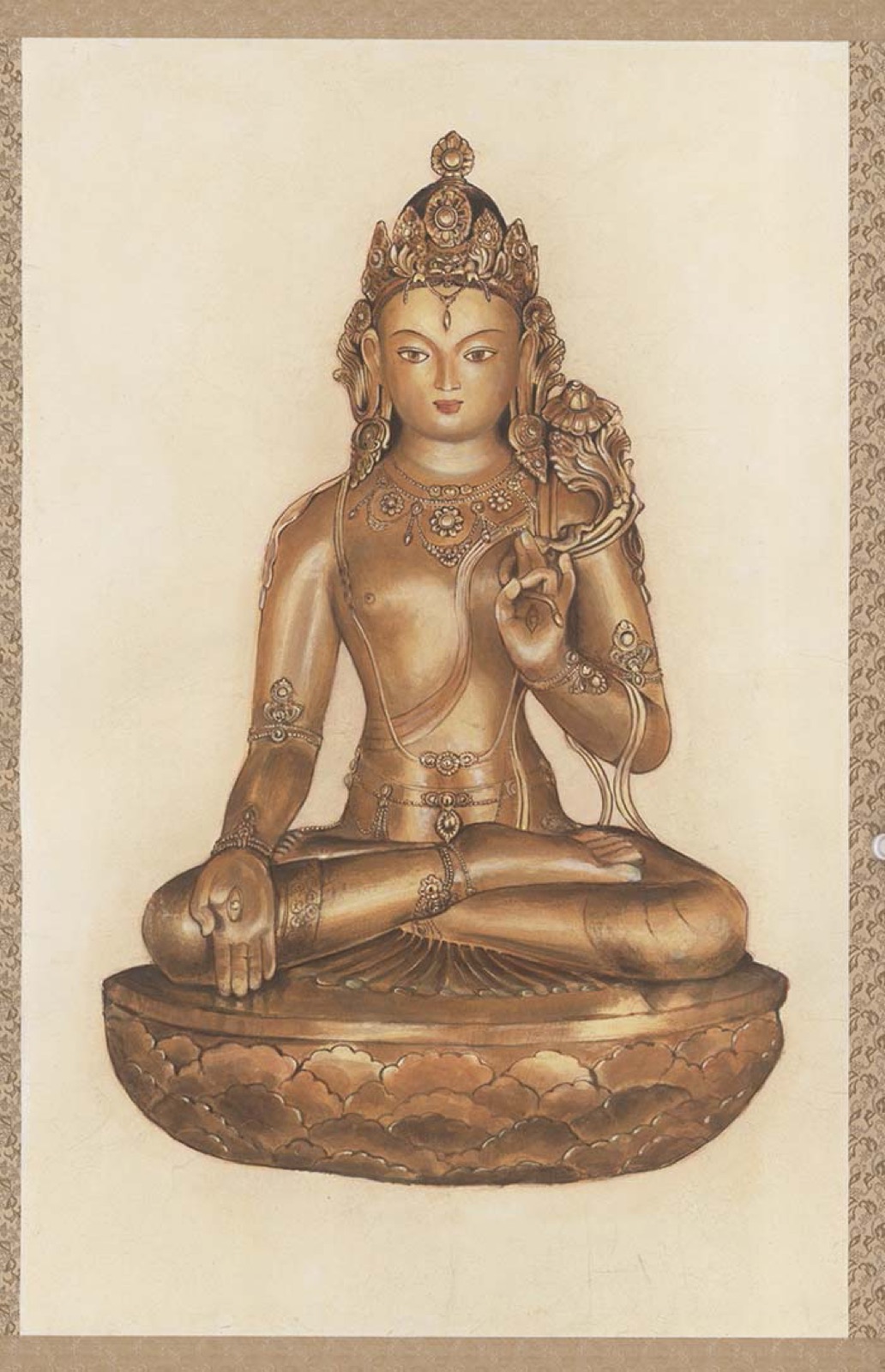
Before naming a mudra, describe the pose in plain language. In TK0182, the figure’s right hand—on the viewer’s left—hangs over the knee, with the fingers directed downward. The left hand—on the viewer’s right—is raised near the chest and holds or touches a small flower-like form. The two arms therefore create a strong vertical contrast: one descends toward the lotus seat, while the other brings an attribute up toward the face.
This description is deliberately modest. A hand gesture is not identified by direction alone. The angle of the palm, the arrangement of each finger, whether the hand touches the ground or rests on the leg, and the relationship to a held object all matter. At a reduced image size, those details can merge into outlines. A close reading starts by recording them, not by supplying a familiar label.
When is a hand gesture a mudra?
In Buddhist art, mudras are conventional hand gestures that can communicate teaching, meditation, reassurance, offering, or other meanings. Yet “mudra” should not become a catch-all for every bent wrist. Some figures hold ritual implements or stems; others make gestures whose meaning depends on a specific iconographic program. A painter may also adapt a standard pose to fit a composition, and surviving images can obscure the original finger or palm details.
For that reason, a useful identification has three layers: first, the visible mechanics of the hand; second, the attribute or object it engages; and third, the figure’s wider context. If one layer is missing, describe the uncertainty. For broader context, compare this method with the site’s beginner’s guide to reading a Thangka.
Read the lowered hand without overnaming it
The lowered hand in TK0182 may invite comparison with familiar gestures of giving or earth contact. But the image does not clearly show the figure touching the ground, so it should not be called an earth-touching gesture on posture alone. Nor should a downward hand automatically be labeled varada, the gesture of generosity: that identification depends on the palm and finger arrangement, which are not secure enough here for a confident reading.
A careful catalogue note would say that the right hand is lowered over the knee, with the palm and precise finger configuration not fully legible in this reproduction. This wording preserves the observation and leaves room for a higher-resolution examination. It also prevents a common chain of error: once a gesture is named, the label can be used to “confirm” a deity, even though the gesture itself was never securely identified.
Examine the raised hand and its uncertain attribute
The raised hand is especially important because the figure appears to touch or hold a small flower-like object. A lotus is a frequent attribute in Buddhist imagery, and lotus stems are associated with several bodhisattvas, including Avalokiteshvara in many traditions. Still, the object’s outline in TK0182 is not detailed enough to establish that it is a lotus, much less to identify the figure from it. Record the visible shape as a flower-like form and mark the proposed lotus reading as uncertain.
Then ask what evidence would strengthen the reading: a distinct stem, recognizable petals, a bud or blossom, a repeated attribute elsewhere in the composition, an inscription, or a reliable catalogue record. The site’s visual guide to lotus stems shows why the hand, stem, blossom, and context should be read together rather than as isolated symbols.
Use posture, crown, and seat as supporting evidence
TK0182 shows a richly adorned figure with a tall crown, jewelry, a bare upper torso, and a seated posture on a broad lotus-like base. These details support describing the figure as bodhisattva-like rather than as a simply robed Buddha. They do not, by themselves, prove a specific identity. Crowns, ornaments, and lotus seats occur across multiple Buddhist figures and artistic settings.
Compare these features systematically: Does the crown contain a miniature figure or another identifying emblem? Are there attendants, a halo, a vase, a rosary, or a second lotus? Is there a text panel or donor inscription? Are the proportions and attributes consistent with the proposed deity? Our article on head adornment in Buddhist painting explains how crowns can be recorded as evidence without being treated as identity labels. For an example where several attributes contribute to a stronger reading, see the four-armed Avalokiteshvara guide.
A practical checklist for identifying hand gestures
- Record which hand is raised or lowered, using the figure’s left and right rather than the viewer’s.
- Describe palm direction, finger position, wrist angle, and contact with the body or seat.
- Name a held object only when its shape is legible; otherwise use a neutral description such as “flower-like form.”
- Separate visible details from interpretation: write “hand lowered over knee” before considering “gesture of giving.”
- Compare the hands with the crown, clothing, seat, attendants, inscriptions, and any repeated symbols.
- Check whether the proposed identity fits the whole image, not only one attribute.
- Note image limits, cropping, damage, glare, or low resolution that could hide decisive details.
- Use “uncertain” when the image or its documentation does not support a firm identification.
What TK0182 can—and cannot—support
From the visible image, we can state that TK0182 depicts a seated, crowned, richly ornamented figure with one hand lowered over the knee and the other raised beside a small flower-like form. The composition is asymmetrical, and the contrast between the hands guides the viewer’s attention through the figure. The source archive names Avalokiteshvara, a plausible lead for further comparison, but this single reproduction does not establish the attribution. The exact object, hand gestures, date, artist, school, original setting, and provenance remain uncertain unless supported by additional records or a clearer image.
That distinction matters for students, collectors, and anyone documenting Buddhist art. A precise visual description remains useful even when an iconographic identification is unresolved. It gives future researchers a stable record to compare with inscriptions, related works, and better photographs rather than forcing an early guess into the catalogue.
Download the full Thangka image collection
Continue browsing and download the complete TANGKAWORLD image collection from the free downloads page. Use high-quality source images to compare hand positions, attributes, crowns, and lotus seats across Buddhist art, while keeping each identification tied to the evidence visible in the work.