
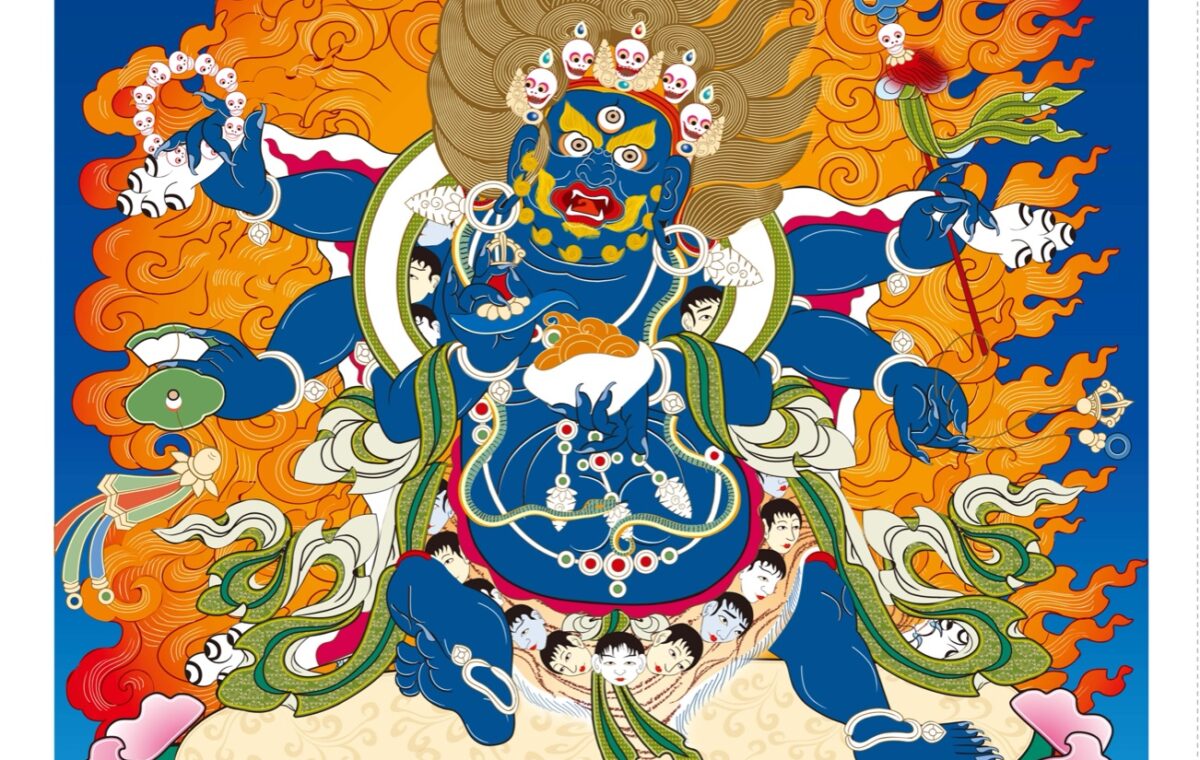
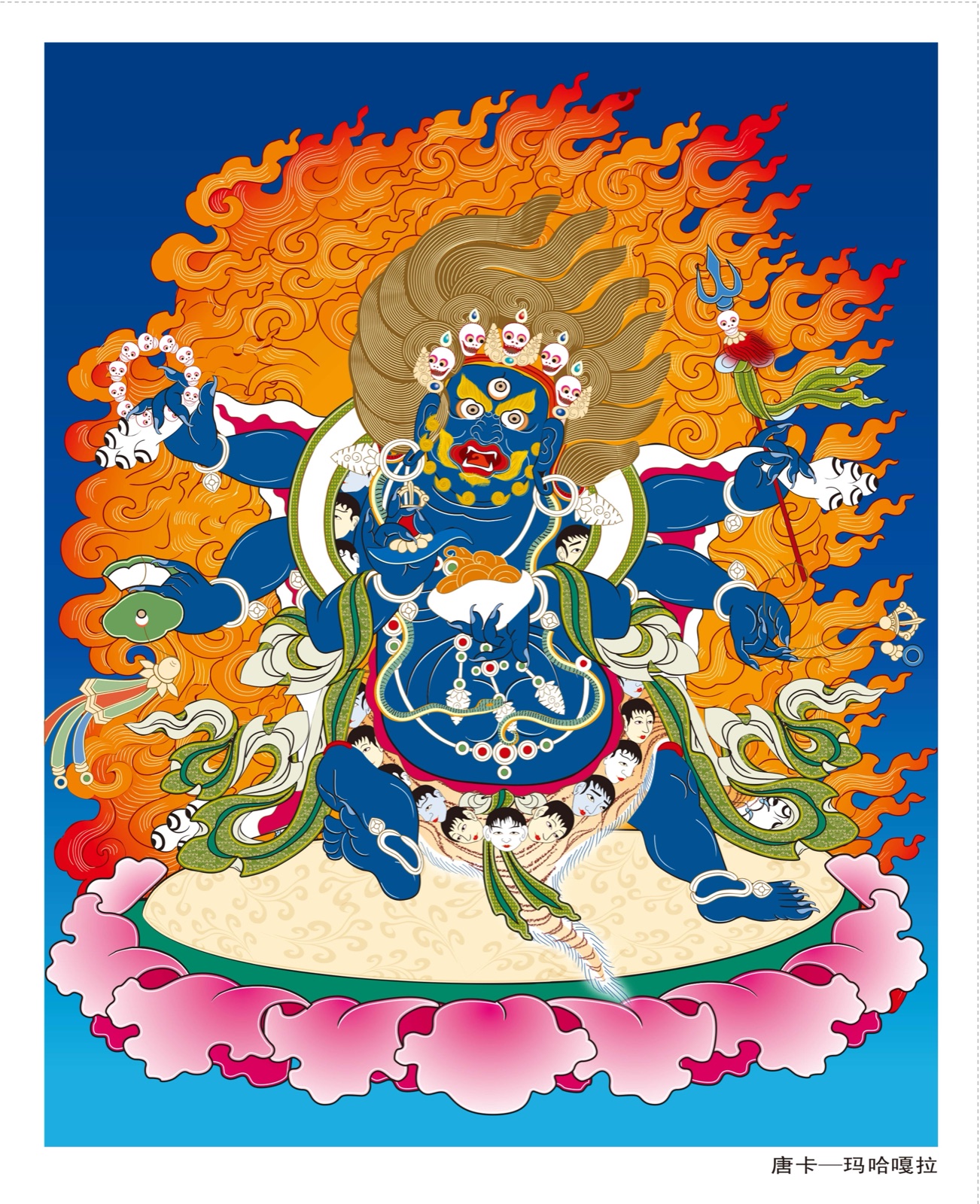
A Six-Armed Mahakala thangka confronts the viewer with blue-black skin, glaring eyes, flames, skull ornaments, and a dense field of ritual objects. The image is deliberately forceful, but its visual language should not be reduced to “evil” or “demonic.” Mahakala is a protector in Vajrayana Buddhism, and wrathful imagery represents the fierce removal of obstacles, ego-clinging, and forces that obstruct awakening.
Who is Mahakala?
Mahakala is one of the most prominent protector figures in Tibetan Buddhist art. Different forms have two, four, or six arms and belong to distinct ritual and lineage contexts. His Sanskrit name is often translated as “Great Black One.” In Buddhist settings his terrifying appearance serves protective and transformative purposes rather than celebrating violence.
The Metropolitan Museum of Art’s Six-Armed Mahakala record describes Mahakalas as powerful Buddhist protector deities whose wrathful manifestations remove internal and external impediments to enlightenment. That distinction is essential: the image externalizes what determined compassion looks like when it confronts destructive forces.
How to recognize the six-armed form
Count the arms before naming the form
Begin with anatomy. Six-Armed Mahakala has three pairs of arms spreading around the body. In crowded paintings, scarves, flames, and objects can hide elbows or hands. Count from the shoulders outward and trace each limb to its hand. Do not rely on the number of objects, because one implement may overlap another or be missing due to damage.
TK0480 clearly presents six arms. The front pair occupies the central body, while the middle and upper pairs extend laterally. This allows a secure description of the arm count even though the exact ritual lineage is not established by the current catalogue.
Three eyes and a wrathful face
Mahakala commonly has three round, glaring eyes. The third eye occupies the forehead. Fangs, a tense mouth, flaring brows, and upward-rising hair amplify the wrathful expression. These marks signal intensified awareness and power. They are iconographic conventions, not a portrait of uncontrolled anger.
Flames and dynamic hair
A flame aureole surrounds the body, setting the protector within a field of blazing energy. Hair may rise into the halo and merge visually with the fire. This border separates sacred wrathful space from the calmer blue ground outside it. In painted and printed reproductions, orange and red flames can dominate the composition, but the central figure’s posture and arms should remain the identification anchor.
Ritual implements and what they mean
Six-Armed Mahakala may hold a curved flaying knife and skull cup in the principal hands, while the remaining hands carry objects such as a drum, rosary, trident, noose, or other implements. Exact combinations vary by form and lineage. A damaged or stylized image can make small objects difficult to distinguish, so name only what is visually clear.
The curved knife symbolizes cutting through obstacles and attachment. The skull cup transforms substances associated with death into a ritual vessel, reversing fear into a path of realization. A damaru drum can signal ritual summons and activity. A rosary suggests uninterrupted action. A trident or staff can express mastery across layered realms or poisons, although interpretations should be tied to the specific tradition when possible.
In TK0480, several hand-held forms are visible, but the modern graphic treatment simplifies some details. It is reasonable to describe “ritual implements” in the ALT text and catalogue, while reserving a hand-by-hand inventory for higher-resolution study.
Skulls, severed heads, and the defeat of ego
Mahakala may wear a crown of skulls and a garland of severed heads. These are among the most frequently misunderstood details in Buddhist protector imagery. Within the iconographic system, they point to impermanence, the transformation of afflictions, and the cutting away of ego. Their meaning is not established by shock value alone.
Bone ornaments and animal skins can add further charnel-ground associations. A protector may stand or sit on a subdued figure representing obstacles. Because the identity of the trampled form changes across traditions, do not name it without clear attributes or a documented source.
Mahakala and Avalokiteshvara
Some six-armed Mahakala traditions understand the protector as a wrathful manifestation connected with Avalokiteshvara. This relationship explains why fierce form and compassion are not opposites. The protector’s activity is interpreted as compassion acting without hesitation against what blocks liberation.
That doctrinal connection should not be used to relabel every Mahakala image as Avalokiteshvara. Catalogue the visible protector as Mahakala and then describe the relationship in the appropriate lineage context. For peaceful Avalokiteshvara imagery, compare Four-Armed Avalokiteshvara Thangka.
Identification checklist
- Count three pairs of arms by tracing them from the shoulders.
- Look for three eyes, fangs, flaring brows, and rising hair.
- Confirm a blue-black wrathful body surrounded by flames.
- Inspect the central hands for a curved knife and skull cup.
- Describe other implements only when their shapes are clear.
- Note skull crown, head garland, bone ornaments, and dynamic scarves.
- Keep lineage, date, artist, and provenance uncertain without documentation.
Cataloguing wrathful imagery responsibly
A strong record separates observation from interpretation. Observation includes arm count, body color, eye count, posture, crown, garland, flames, implements, attendants, inscriptions, support, and condition. Apply the high-resolution Thangka iconography method to inspect these features in a repeatable order. Interpretation includes ritual function, lineage, symbolic reading, and historical attribution. Both are valuable, but they should not be presented at the same confidence level.
Use respectful vocabulary. “Wrathful protector” is more accurate than “monster” or “demon.” Avoid sensational titles that strip the image from its religious context. If the exact form is uncertain, “Mahakala, possibly six-armed form” is better than selecting a lineage-specific name from resemblance alone.
Conclusion
Six arms, three eyes, wrathful expression, flames, skull imagery, and ritual implements make Six-Armed Mahakala one of the most visually distinctive protector forms. Read these elements as a coordinated iconographic system and preserve uncertainty around the exact lineage or historical origin. Compare the Padmasambhava thangka guide for shared ritual objects, the Vajrapani iconography guide for another wrathful protector, and the Yama vs Yamantaka visual guide for a careful method of separating similar fierce forms.
Sources and further reading
- Himalayan Art Resources: comparative records for Six-Armed Mahakala
- The Metropolitan Museum of Art: Six-Armed Mahakala thangka (object record)
These references support comparative iconographic study. The TANGKAWORLD TK number is an internal catalogue identifier; artist, date, collection history, and provenance remain uncertain unless separately documented.
Download the full Thangka image collection
Continue exploring TANGKAWORLD and browse and download the full Thangka image collection, including protectors, tantric deities, Buddhist masters, Mandalas, and related visual-identification resources.