
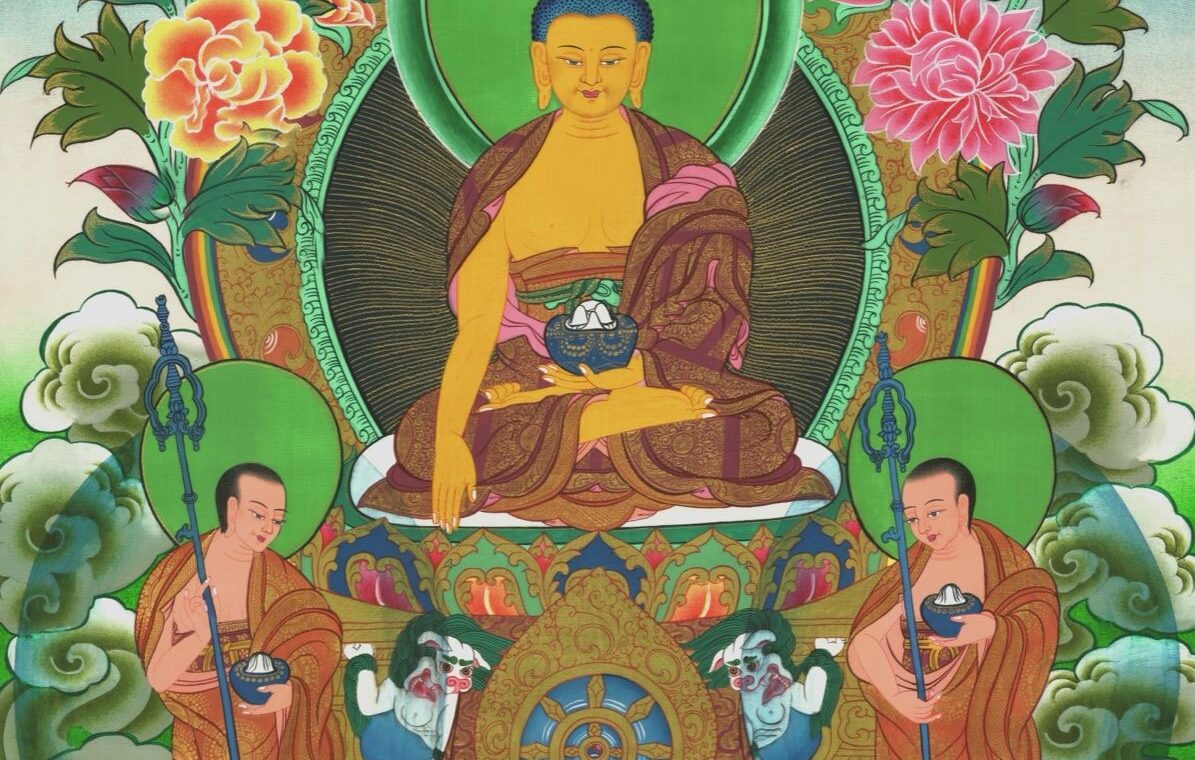
A Shakyamuni Buddha thangka represents the historical Buddha, the teacher whose life and awakening stand at the foundation of Buddhism. The most familiar iconic form combines two decisive features: the proper right hand reaches toward the earth, while the left hand rests in meditation and often holds a monastic alms bowl. Robes, bodily marks, throne, and disciples support the identification.
Because many Buddhas share a calm face, seated posture, long earlobes, and an ushnisha, identification should never depend on “looking like the Buddha.” The hand gestures and surrounding narrative context provide stronger evidence.
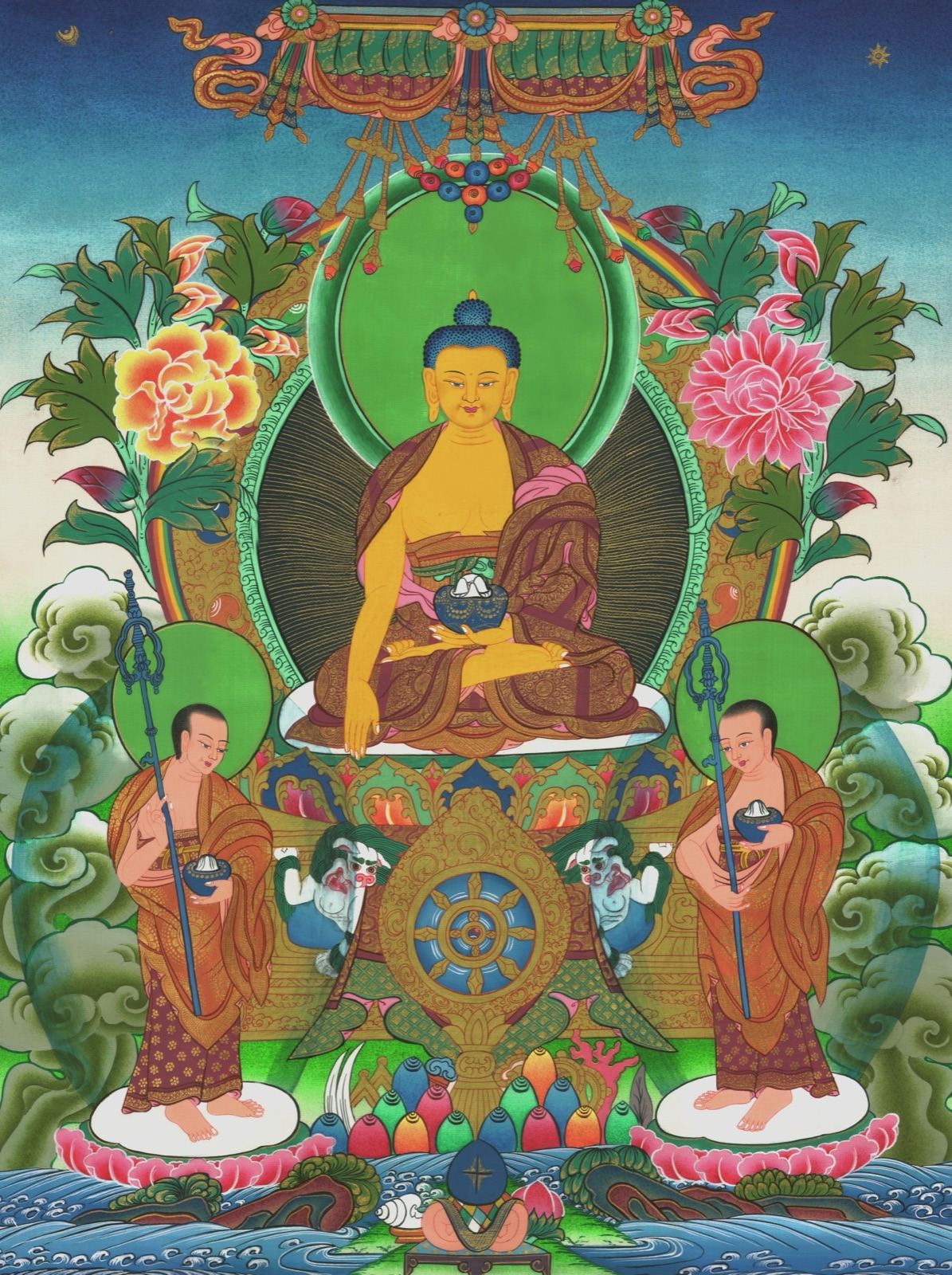
Shakyamuni Buddha thangka identification at a glance
The earth-touching gesture
The proper right arm extends over the knee, with the fingers directed downward to touch or approach the ground. This is the bhumisparsha, or earth-touching, mudra. It refers to the moment when Shakyamuni called the earth to witness his awakening after overcoming Mara’s challenge. The gesture anchors the image in a specific life event while also functioning as a standard iconic identifier.
Check orientation carefully. “Proper right” means the figure’s right, which appears on the viewer’s left. Mirrored scans, reproductions, or printing errors can reverse an image. If direction matters to a catalog record, confirm the original orientation.
The alms bowl in meditation
The left hand rests palm upward in the lap, often supporting a dark bowl. This pairing of earth-touching right hand and meditating left hand is characteristic of Shakyamuni. The bowl connects the awakened teacher with monastic discipline and the life of a mendicant. Decoration inside or around the bowl varies and should be described only when visible.
Monastic robes and Buddha marks
Shakyamuni normally wears monastic robes rather than a crown and bodhisattva jewelry. The robe may leave the proper right shoulder bare. Common Buddha marks include the ushnisha on the head, a small urna between the brows, elongated earlobes, and three curved lines at the neck. Artists select and stylize these marks rather than illustrating every feature named in texts.
How TK0579 builds a Shakyamuni composition
In TK0579 the golden central Buddha touches the earth and holds a dark bowl. A green halo, floral canopy, and elaborate throne frame the body. Two monks stand below, each holding a staff and bowl. These figures are commonly identified in Shakyamuni assemblies as his principal disciples Shariputra and Maudgalyayana, but a precise caption should rely on a collection record or inscription when available.
The lower register contains a Dharma wheel and offerings, while water and lotuses form a visual base. These details enrich the religious setting but are not unique to Shakyamuni. The hand gesture, bowl, robes, and disciple arrangement together produce the strongest identification.
Shakyamuni versus other seated Buddhas
Shakyamuni and Medicine Buddha
Medicine Buddha is normally blue and holds a medicinal plant in the extended right hand, with an alms bowl in the lap. Shakyamuni typically has a golden body and uses the right hand to touch the earth. Pigment color can vary, so compare the fingers and any plant carefully. See the Medicine Buddha thangka identification guide.
Shakyamuni and Amitayus
Amitayus is red, crowned, and jeweled, with both hands supporting a longevity vase in meditation. That princely appearance differs sharply from Shakyamuni’s monastic robes. The Amitayus guide explains why Amitayus should not be casually confused with Amitabha or another seated Buddha.
Shakyamuni and Akshobhya
Akshobhya can also use an earth-touching gesture and may be blue. Context, directional Buddha sets, a vajra symbol, inscription, and surrounding figures become important. An isolated image with the shared gesture may require an uncertain label rather than a forced choice.
Iconic images and narrative images
An iconic Shakyamuni centers a single timeless-looking Buddha. A narrative painting depicts episodes from his life, such as birth, renunciation, enlightenment, first teaching, miracles, or passing into parinirvana. Some thangkas place small narrative scenes around a large central icon. Read these scenes in registers, circular sequences, or paths defined by architecture and landscape.
The earth-touching gesture refers to enlightenment even when no narrative episode is painted around it. This makes the central icon both a portrait type and a condensed life story. The gesture links the still seated figure to a moment of decisive action.
Throne, halo, and disciples
A lotus, moon disc, lion-supported throne, or decorated textile can elevate the Buddha. A head halo and larger body aureole organize sacred space. These devices occur widely in Buddhist art and should not be treated as unique identifiers. Their shapes and ornament can, however, support stylistic comparison when date and region are studied carefully.
Shariputra and Maudgalyayana often flank Shakyamuni in monastic form. Each may carry a khakkhara staff and alms bowl. Larger assemblies can add Arhats, bodhisattvas, guardian kings, lineage teachers, donors, or scenes from the Buddha’s life. The Arhat paintings guide helps distinguish individualized elders from the central Buddha.
A practical Shakyamuni checklist
- Does the proper right hand extend over the knee in the earth-touching gesture?
- Does the left hand rest in meditation and support an alms bowl?
- Is the figure dressed in monastic robes without a jeweled crown?
- Are the ushnisha, long earlobes, urna, or neck lines visible?
- Do two monastic disciples flank the throne?
- Are surrounding scenes connected to the life of the historical Buddha?
- Could the image be Akshobhya or another Buddha sharing the gesture?
- Are museum, date, artist, and provenance claims documented or uncertain?
Provenance and responsible captions
The TK0579 filename includes a Museum of Fine Arts, Boston reference. A filename is not enough to confirm current ownership, accession number, date, or attribution. Until a reliable collection record is matched, describe the provenance as unverified. This protects the distinction between what the picture shows and what its history is claimed to be.
For a broader sequence of looking, use How to Read a Thangka. Begin with the central figure, gestures, and objects; then move outward to seat, attendants, registers, inscription, material, and documented history.
Conclusion
A Shakyamuni Buddha thangka is most securely identified by the earth-touching right hand paired with the meditating left hand and alms bowl. Monastic robes, Buddha marks, disciples, and life-story scenes strengthen the reading. Shared gestures and uncertain provenance require caution, but a structured visual checklist keeps the identification clear and useful.
Sources and further reading
- Himalayan Art Resources: comparative records for Shakyamuni Buddha
- The Metropolitan Museum of Art: Buddha Shakyamuni in the earth-touching gesture (object record)
These references support comparative iconographic study. The TANGKAWORLD TK number is an internal catalogue identifier; artist, date, collection history, and provenance remain uncertain unless separately documented.
Download the full Thangka image collection
Continue browsing and download the complete TANGKAWORLD image library from our Thangka downloads. Use the wider collection to compare Buddha gestures, thrones, disciples, and narrative structures.