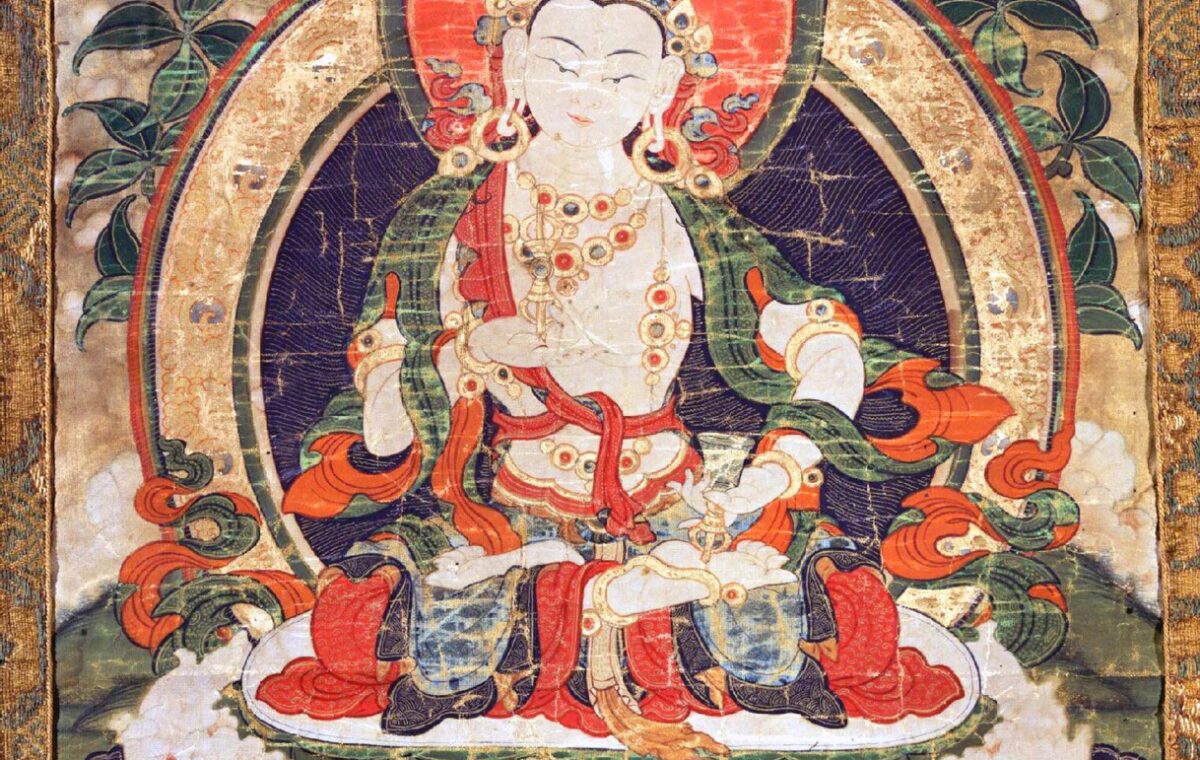
A Vajrasattva thangka often appears serene and comparatively simple: a white figure sits on a lotus, holding a vajra near the heart and a bell beside the left hip. Yet this apparently clear formula can be confused with Vajradhara, Vajrapani, Vairochana, or other peaceful Vajrayana figures. Accurate identification depends on the hand positions, implements, body color, ornaments, and surrounding context working together.
This visual guide focuses on the solitary peaceful form represented in TK0589. It does not attempt to instruct religious practice or assign the painting to a specific lineage. The image file provides no verified date, artist, school, or provenance, so those details remain uncertain.
The central visual formula of a Vajrasattva thangka
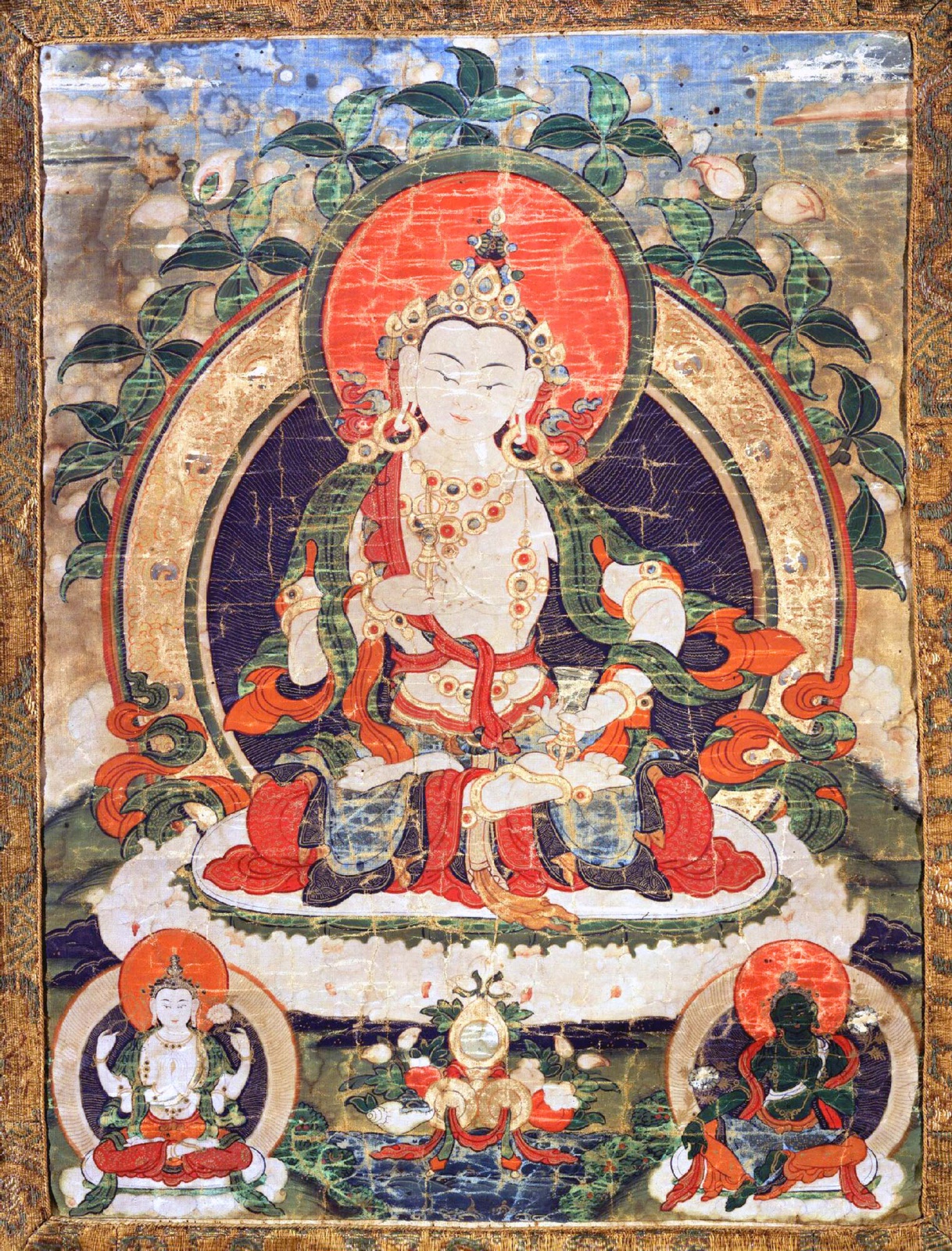
Vajrasattva is commonly shown white in color, with one face and two hands. The right hand holds a vajra upright near the heart. The left hand holds a bell at or near the hip, often with the mouth of the bell facing upward. A jeweled crown, earrings, necklaces, armlets, bracelets, silks, and a lotus-and-moon seat establish the peaceful sambhogakaya appearance.
The white body is significant for recognition but is not sufficient by itself. White Tara, White Chakrasamvara, certain forms of Avalokiteshvara, and other deities can also be white. The decisive clue is the coordinated vajra-and-bell pose.
How to read the vajra and bell
The vajra at the heart
Look first at the figure’s right hand. In the standard solitary form, the vajra is held upright close to the chest. It may be small, partially hidden by jewelry, or simplified by the artist. A vajra raised aggressively above the head, brandished to the side, or combined with a wrathful blue body points toward another figure, such as the form discussed in the Vajrapani Thangka guide.
The bell at the left hip
The left hand usually holds a ritual bell near the hip. In worn paintings, the bell can blend into robes or lotus petals. Trace the left forearm and hand rather than searching the whole composition. The paired implements are often interpreted as complementary aspects of method and wisdom, but exact explanations can differ by tantra, lineage, and teaching context.
Why the pair matters
Many Buddhist figures hold one vajra, and many ritual scenes include bells. Vajrasattva’s distinctive identification comes from how the two objects are held in relation to the body. A database label should be tested against this pose before being accepted.
Other identifying features
White body and peaceful expression
The face is calm, youthful, and symmetrical. The eyes may be partly lowered. There are no bared fangs, bulging eyes, or surrounding flame aureole. This peaceful appearance separates Vajrasattva from wrathful vajra-bearing deities even when both belong to a Vajrayana context.
Crown, jewelry, and silk garments
Vajrasattva is not dressed as an ordinary monk. A five-part crown and abundant jewelry present an idealized celestial body. Long scarves and patterned garments curve around the torso and legs. These features are shared with other peaceful deities, so they support but do not determine the identity.
Lotus and moon-disc seat
The figure commonly sits in vajra posture on a moon disc above a lotus. The moon disc may be visible as a pale circular or oval plane directly beneath the body. In TK0589, age, abrasion, and dense ornament make some seat details less distinct, but the lotus-based sacred throne remains readable.
Vajrasattva versus similar figures
Vajrasattva and Vajradhara
Vajradhara is typically blue and often crosses the vajra and bell at the chest. Vajrasattva is usually white and holds the vajra at the heart while the bell rests at the left hip. Some paired or consort forms complicate this distinction, and particular texts can produce very close visual parallels. When color has faded or hands are damaged, use inscriptions and documented comparisons.
Vajrasattva and Vajrapani
Wrathful Vajrapani is often blue, muscular, standing, surrounded by flames, and raising a vajra. Peaceful forms of Vajrapani exist, however, so the contrast is not absolute. The white seated body and vajra-and-bell pairing remain stronger evidence for Vajrasattva.
Vajrasattva and Vairochana
Vairochana may also be white and crowned. Hand gestures are crucial: Vairochana forms can display teaching or wisdom gestures rather than the vajra-and-bell combination. Do not identify a white crowned figure before checking what each hand actually holds.
Reading the secondary figures in TK0589
TK0589 includes smaller figures below the central deity. A white four-armed figure at lower left appears consistent with Four-Armed Avalokiteshvara, while a green seated figure at lower right appears consistent with Green Tara. These readings are plausible because their colors, arm counts, postures, and attributes align with familiar forms, but the small scale limits certainty.
Use the dedicated guides to compare Four-Armed Avalokiteshvara and Green Tara. The lower central object may be an offering or ritual emblem; it should not be assigned a precise identity from this reproduction alone.
Condition and conservation clues
The surface of TK0589 shows visible abrasion, creases, losses, and darkening. These condition features can obscure the vajra, bell, facial details, and inscriptions. They should not be “corrected” by guessing what the missing paint once showed. A conservator would distinguish original pigment, later retouching, support damage, and surface deposits through direct examination rather than a compressed digital image.
Practical identification checklist
- Is the main figure white and peaceful?
- Does the right hand hold a vajra upright near the heart?
- Does the left hand hold a bell beside the hip?
- Is the figure crowned and richly ornamented?
- Does the figure sit in vajra posture on a lotus and moon disc?
- Are wrathful flames, fangs, and a dynamic standing pose absent?
- Could the hand position instead indicate Vajradhara or Vairochana?
- Are the date, artist, school, and provenance documented or uncertain?
Conclusion
A secure reading of a Vajrasattva thangka begins with the white peaceful body and is confirmed by the vajra at the heart and bell at the left hip. Crown, jewelry, lotus seat, and calm expression reinforce the identification. Because several deities can share one or more of these features, the complete pose matters more than color or filename alone.
For a broader method of testing a central figure against surrounding deities, gestures, and attributes, return to How to Read a Thangka.
Sources and further reading
- Himalayan Art Resources: comparative records for Vajrasattva
- Rubin Museum of Himalayan Art: Vajrasattva with vajra and bell (object record)
These references support comparative iconographic study. The TANGKAWORLD TK number is an internal catalogue identifier; artist, date, collection history, and provenance remain uncertain unless separately documented.
Download the full Thangka image collection
Continue browsing and download the complete TANGKAWORLD image library on the Downloads page.