
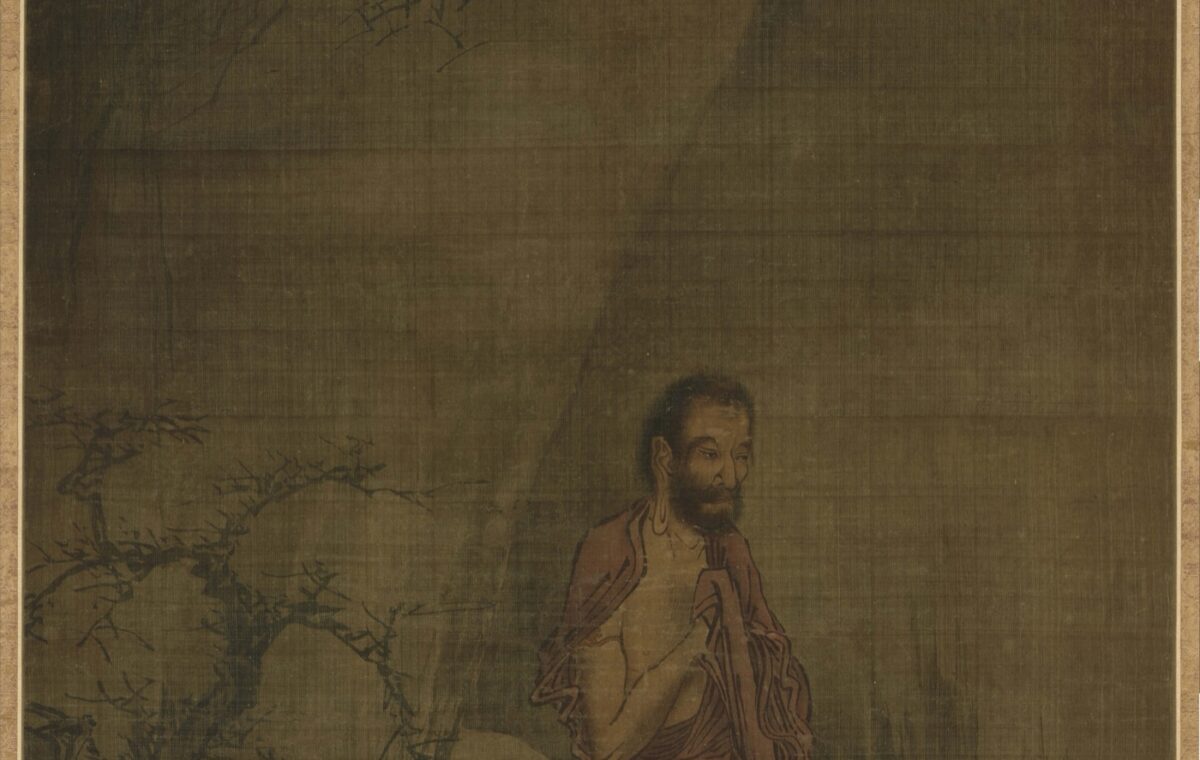

Buddha emerging from the mountains is a useful image type for learning how a religious figure can be defined by landscape as much as by attributes. A tall cliff, sparse trees, open space, and a solitary body create an experience of withdrawal and return. Before trying to establish an attribution or a precise episode, begin with what the image visibly presents: a standing ascetic figure, exposed torso, red drapery, joined hands, dark rocky forms, and an unusually large field of empty space.
TK0235 offers a focused example. The figure stands low in the vertical composition, while cliffs and thin branches rise above him. This contrast gives the image its force. The archive filename may offer a research lead, but it does not independently prove the sitter’s identity, the work’s date, its artist, or a specific historical setting. A careful visual reading keeps those questions open until they can be supported by a reliable catalogue, inscription, or documented comparison.
Start with the figure, not the label
When an image is called “Buddha emerging from the mountains,” it is tempting to treat the title as a finished identification. Instead, record the visible figure first. In TK0235, the subject is an adult male ascetic in a long draped garment, with the chest exposed and hands brought together at the body. The body is slender rather than richly ornamented; no crown, throne, or halo is clearly visible at this scale. Those observations are stronger than an inherited label because another researcher can check them directly.
Then describe the figure’s placement. The figure is not centered in a symmetrical shrine-like field. He occupies the lower portion of a very tall landscape, set between irregular rock forms. That placement makes the human form appear vulnerable and deliberate rather than monumental. It also changes how the viewer reads the blank upper area: it is not unused space, but part of the picture’s rhythm.
How the mountain setting shapes meaning
Scale and vertical distance
The mountain occupies far more of TK0235 than the figure. A viewer’s eye travels downward through dark stone and pale gaps before meeting the standing body. This scale difference can suggest isolation, difficulty, or a movement from seclusion into view, but it does not prove a particular narrative. Use language such as “may suggest” when interpretation depends on composition rather than a securely identified text or scene.
Empty space as an active element
Large blank or lightly painted areas are often essential to a Buddhist figure-in-landscape image. In TK0235, the open middle field separates the top cliff from the solitary figure. It slows visual movement and prevents the subject from being swallowed by the rocky setting. When documenting an image, note where empty space lies, whether it is bounded by ink, and how it affects the figure’s scale. Do not mistake open space for damage or an unfinished passage without physical examination.
Trees and rock contours
Sparse branches and angular rock lines can frame a figure without functioning as a literal map of a site. Trace how they point, overlap, or leave room around the body. In TK0235, branches and rock edges form a loose enclosure rather than a regular architectural border. This makes the natural setting part of the visual structure. It does not, on its own, identify a monastery, mountain, region, or school.
Reading ascetic appearance carefully
An exposed chest, lean body, and simple drapery can be associated with ascetic practice, but those features are not a substitute for identification. Buddhist art includes many forms of renunciation imagery, as well as later portrayals that use ascetic appearance for different religious figures. In TK0235, the clasped hands, robe folds, and bare torso should be described before assigning a title.
This approach also prevents a common cataloguing error: treating every solitary male figure in a mountain setting as the same person. Compare posture, head shape, garments, hand gesture, companion figures, inscriptions, and context. If a distinctive attribute is absent or unclear, say that it is uncertain. If a source supports a traditional identification, cite that source separately from what is visible in the photograph.
A practical checklist for a mountain-figure image
- Record the figure’s posture, gesture, exposed or covered body, and garment color.
- Map the figure’s location within the image: low, central, offset, or near an edge.
- Describe cliffs, trees, paths, water, clouds, and open space as visible forms.
- Note whether the landscape frames the subject, separates scenes, or dominates the scale.
- Look for inscriptions, seals, mounting details, or catalogue references before making attributions.
- Keep identity, date, artist, school, collection, and provenance uncertain when evidence is missing.
- Compare whole compositions before relying on a cropped figure or a filename alone.
What to compare with other Buddhist paintings
Comparison is most useful when it is specific. Start with the relation between figure and landscape: is the body small against a high cliff, placed in a cave, seated on a platform, or surrounded by attendants? Next compare the handling of robe folds, trees, and empty areas. These are visual questions that can be answered from an image, even if the historical attribution is unresolved.
For a broader method of separating observation from interpretation, see How to Read a Thangka. The guide to Buddhist patchwork robes is useful for recording garments without over-reading them, while the Thangka condition report checklist helps distinguish visible marks from conclusions about their cause.
From a named work to a research question
The archive title for TK0235 connects the image with a familiar “emerging from the mountains” theme. That title can guide research, but a responsible record still separates the supplied name from verified evidence. Ask: is there a legible inscription? Is the image linked to a museum catalogue? Does a reliable publication document the artist, period, medium, and collection? Until those questions are answered, the image remains a valuable case study in ascetic figure, mountain scale, and visual space—not a license for unsupported certainty.
This distinction is especially important for digital collections. A filename may preserve useful cataloguing history, but it can also be abbreviated, translated, inherited, or incomplete. Keeping uncertainty visible makes later corrections possible and preserves the difference between an observation, a collection label, and a scholarly attribution.
Conclusion
A Buddha emerging from the mountains is best read through the relationship between solitary figure and landscape. In TK0235, the low-standing ascetic, rising cliff, sparse trees, red drapery, and large open field create a composition of scale and withdrawal. Describe those elements precisely, compare them carefully, and let questions of attribution or biography remain uncertain when the evidence does not reach that far.
Download the full Thangka image collection
Continue browsing and downloading the complete TANGKAWORLD image collection to compare mountain settings, ascetic figures, robes, borders, inscriptions, and other details at closer scale.