
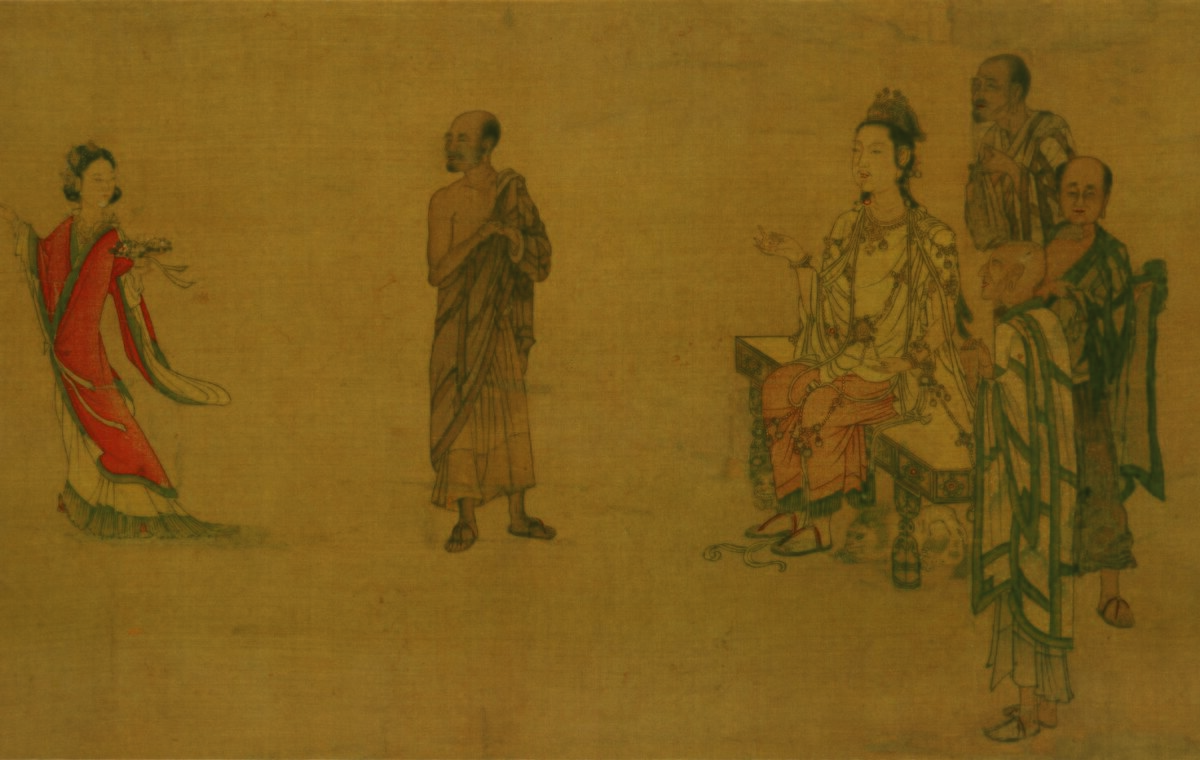
Flower offerings in Buddhist art are small actions with large visual consequences. In TK0234, a woman in a red robe approaches from the left carrying blossoms, while a standing monk occupies the middle of the composition and a richly adorned seated figure receives attention at the right. Four additional attendants gather behind and beside the seat. The broad areas of unpainted ground make the offering feel deliberate: the flowers, hands, glances, and intervals between bodies guide the viewer across the scene.
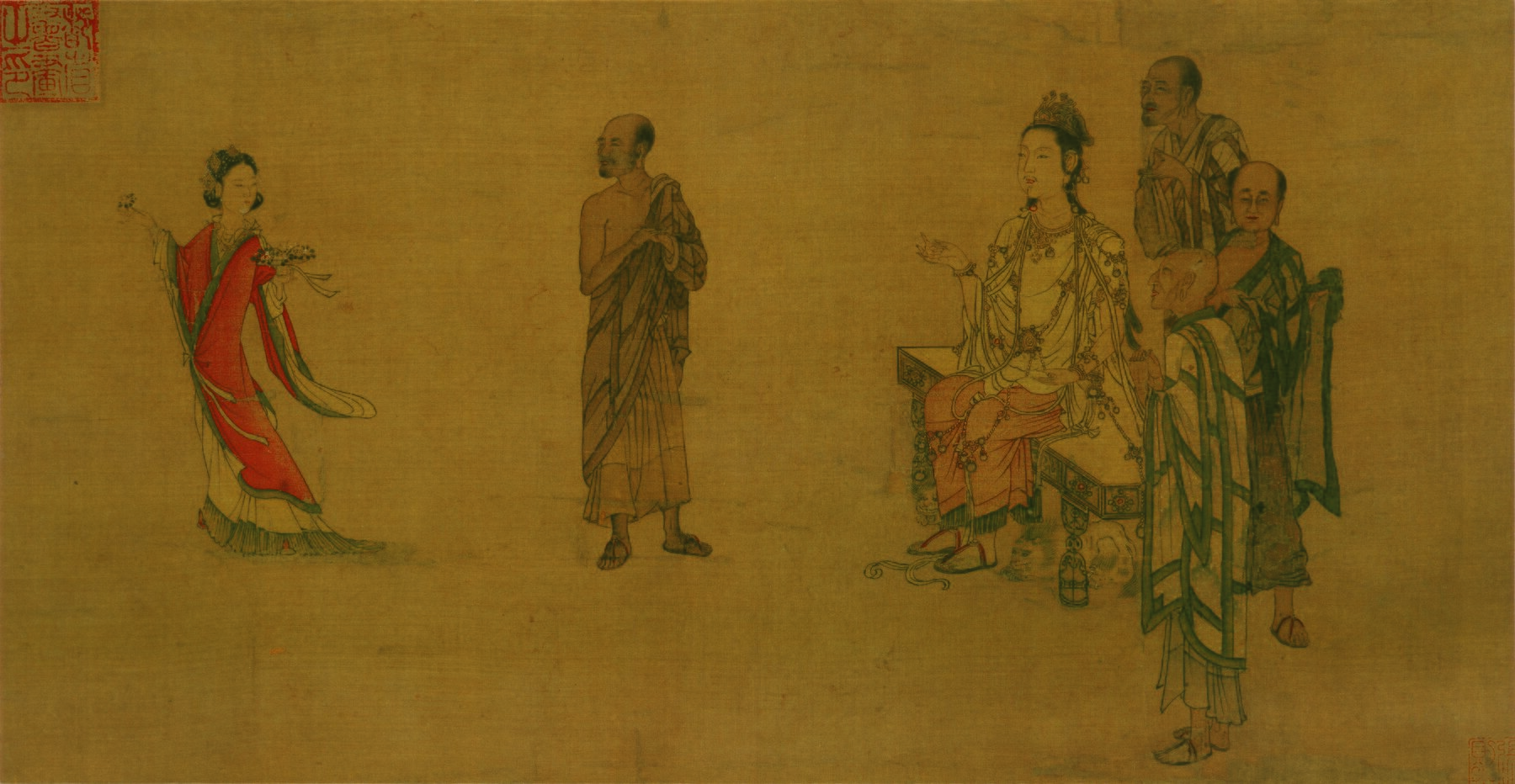
The archive filename identifies the work as Celestial Maiden Offering Flowers and associates it with the Song dynasty and Liu Songnian. Those details are useful catalogue clues, but the digital image alone cannot authenticate the artist, date, subject identities, seals, provenance, materials, or conservation history. This guide therefore begins with visible evidence and marks the exact attribution as uncertain.
Why do flowers appear as offerings in Buddhist art?
Flowers can represent respect, generosity, beauty, impermanence, and the transformation of an ordinary object into a devotional gift. Their meaning depends on context. A blossom placed near a Buddha or Bodhisattva may signal homage; a figure carrying flowers may mark the beginning of an encounter; scattered petals can suggest a miraculous or celestial response. The viewer should not assign one fixed meaning before examining who holds the flowers, who receives them, and how the surrounding figures respond.
In a narrative image, the offering is also a compositional device. It creates a direction of movement and a relationship between giver and recipient. TK0234 does not crowd the flower bearer against the seated figure. Instead, the painting stretches the approach across open space, allowing the gift to become the scene’s central action. This is a useful comparison with the broader guide to Buddhist narrative painting, where embedded actions help explain the importance of a main icon or encounter.
How to read TK0234 from left to right
Start with the flower-bearing figure
At the left, a woman advances toward the group while holding blossoms in both hands. Her red outer garment creates the strongest block of color in the painting. Long ribbons or scarf ends trail behind and below her arms, reinforcing forward movement even though her step is restrained. One hand lifts a small cluster while the other supports a fuller spray. The difference between the two gestures prevents the flowers from reading as a single flat bundle.
The archive title calls her a celestial maiden, but clothing and flowers alone do not prove a precise identity. A responsible description can say that she is a flower-bearing woman presented as the active giver. Whether she represents a named celestial being, an idealized donor, or a figure within a specific story remains uncertain without inscriptions or a documented catalogue record.
Use the standing monk as a visual bridge
A shaved-headed monk stands near the center with hands joined before the chest. His robe exposes one shoulder and falls in long, dark folds. He is not placed directly beside either group. Instead, he occupies the interval between the offering bearer and the seated figure, turning empty ground into a sequence: approach, witness, reception.
His scale is close to that of the woman, while the seated figure gains importance through ornament, elevation, and a surrounding group. This shows why hierarchy cannot be measured by height alone. The guide to scale hierarchy in Buddhist art explains how throne, placement, attendants, halo, gesture, and costume work together to establish status.
Examine the seated figure and attendants as one unit
At the right, an adorned figure sits on a decorated chair or throne. The body faces slightly left toward the approaching gift, and one hand opens outward in a measured gesture. Jewelry, a crown or headdress, layered garments, and the elevated seat distinguish this person from the monastics nearby. Yet the exact identity cannot be confirmed from the image alone, so it is safer to describe a seated sacred figure rather than name a specific Bodhisattva.
Four attendants form a compact cluster around the seat. Their shaved heads, draped robes, overlapping bodies, and varied viewing angles give the group depth. One figure stands behind the throne; another appears at upper right; a foreground attendant turns toward the seated figure; and a fourth is partly enclosed by the others. These relationships reward comparison with the guide to Buddhist attendant figures, especially when identities are uncertain but visual roles remain legible.
How empty space controls the offering scene
The largest feature in TK0234 is not a person or object but the open field between them. The flower bearer, central monk, and seated group occupy separate islands of activity. This spacing slows the viewer’s eye and makes each transition readable. The woman does not appear to have completed the offering; she is still approaching. The monk witnesses or mediates the encounter, while the seated group waits in a stable arrangement.
Open space also separates social roles. The giver has room to move, the monk stands independently, and the recipient’s attendants form a dense boundary around the seat. Cropping the image too tightly would weaken this structure. When documenting a work, preserve the complete width before making detail crops. The related article on negative space in Buddhist art shows how blank ground can carry direction, hierarchy, and narrative time.
Gesture, dress, and gaze: three evidence groups
Gestures should be read in groups rather than as isolated signs. The woman extends flowers; the monk joins his hands; the seated figure opens one hand; and several attendants turn their faces toward the central interaction. Together, these actions define giving, reverence, reception, and attention. A single hand position may be ambiguous, but the sequence becomes clearer when compared across the scene.
Dress provides another layer of evidence. The giver’s colored robe and ornaments distinguish her from the plainly robed monk. The seated figure’s jewelry and headdress mark a different status, while the surrounding figures wear variations of monastic dress. These contrasts help separate roles without confirming names. Gaze provides a third layer: note who looks toward the gift, who addresses the seated figure, and who appears to observe from behind.
What can the red seals tell us?
A large red seal appears at the upper left, and another impression is visible near the lower right. Their placement frames the composition diagonally, but color and position alone cannot identify an owner or prove a date. Seals may record collection history, appraisal, institutional custody, or later handling. They can also be difficult to read when impressions are incomplete or when a digital reproduction alters contrast.
For a careful record, photograph each seal at high resolution, note its dimensions and location, and check whether it overlaps the painted surface, a border, a repair, or another mark. Compare the impression only with securely documented examples. The archive attribution to Liu Songnian and the Song dynasty should remain uncertain until handwriting, seals, materials, and provenance are examined together.
A practical checklist for flower offerings in Buddhist art
- Identify the action: Record who carries, presents, receives, or observes the flowers.
- Map the direction: Follow feet, sleeves, hands, blossoms, and glances to determine how movement crosses the image.
- Separate visible fact from interpretation: Describe costume, posture, objects, and placement before assigning named identities.
- Preserve the full composition: Keep open ground in the record; it may explain sequence and hierarchy.
- Compare figure groups: Note differences in scale, elevation, dress, jewelry, gesture, and the number of attendants.
- Document flowers closely: Record color, number, stem arrangement, container, and whether the blossoms are held, scattered, or placed on an altar.
- Map seals and repairs: Photograph impressions, creases, losses, stains, retouching, and later mounting evidence separately.
- Keep attribution uncertain: Treat filenames and inherited catalogue titles as leads, not final proof.
Conclusion
Flower offerings in Buddhist art are best understood by connecting object, gesture, spacing, and social role. TK0234 uses a restrained procession from giver to monk to seated recipient, while attendants and open ground clarify the hierarchy of the encounter. The flowers are visually small, but they organize the entire narrative. The archive title and attribution offer useful research leads; exact identities, authorship, date, and provenance still require documentary and material evidence.
Download the full Thangka image collection
Continue exploring and download the complete TANGKAWORLD image collection on our free downloads page. The collection includes Thangka, Buddhist narrative paintings, museum works, murals, sutras, and comparative images for visual research.