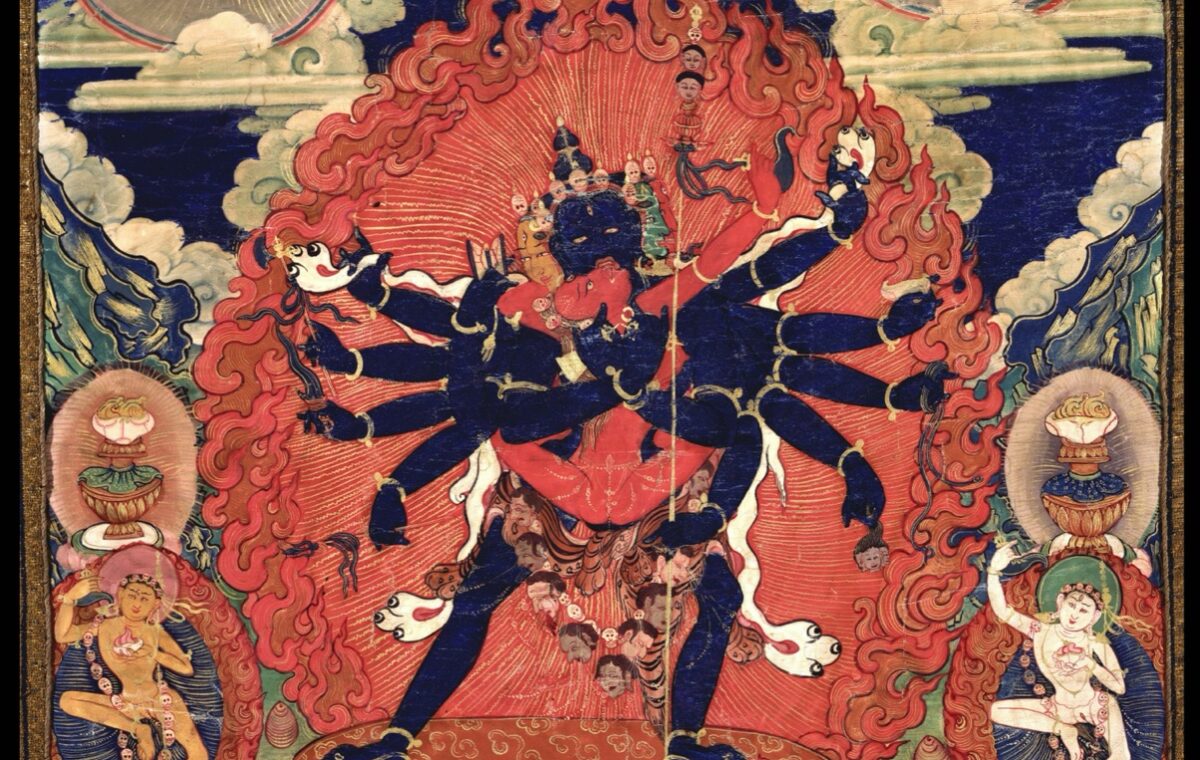
A complex Chakrasamvara thangka demands slow looking. Four faces, twelve arms, an embracing consort, flayed skins, skull ornaments, flames, and surrounding figures can initially merge into visual noise. The solution is not to memorize every implement at once. Begin with bodily configuration, identify the central pair, then map the arms and retinue. This method reveals a coherent iconographic program while leaving room for uncertainty about lineage, date, and provenance.
Who is Chakrasamvara?
Chakrasamvara is a major tantric meditation deity in the New Translation traditions of Tibetan Buddhism. The name is also rendered in Tibetan contexts as Demchok, while “Heruka” may be used in some traditions for a simplified or related wrathful form. Many lineages preserve different configurations, ranging from two-armed forms to complex four-faced, twelve-armed forms with Vajravarahi and a retinue.
That variety makes overconfident identification risky. A dark embracing couple in flames could belong to Chakrasamvara, Hevajra, Guhyasamaja, Kalachakra, or another tantric system. Faces, hands, objects, consort posture, and surrounding deities must be compared as a group.
Four faces and twelve arms
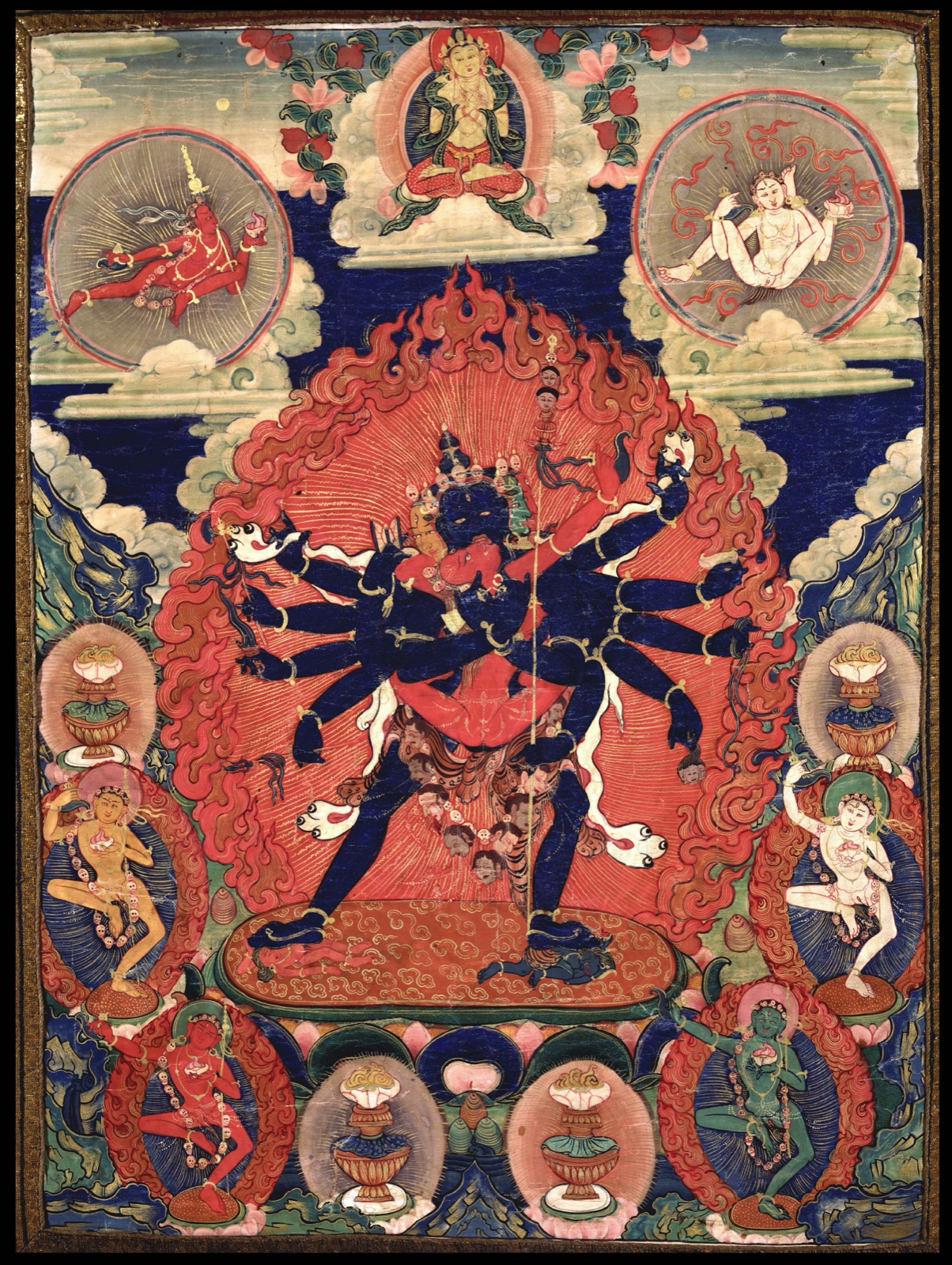
In TK0466 the central male figure is dark blue-black and has multiple faces. The main face looks forward while additional faces turn toward other directions. Twelve arms radiate around the body. Counting is easiest if readers begin with the central embracing pair of hands and then work outward from upper right to lower right, followed by upper left to lower left.
The main hands commonly hold a vajra and bell while embracing the red consort. Other hands may carry a damaru drum, curved knife, skull cup, axe, trident, lasso, severed head, or other tantric implements, and may stretch an elephant hide behind the body. Damage, overlap, and dark pigment can obscure individual objects. When an implement is not visually resolved, write “ritual object” rather than forcing a specific name.
Vajravarahi and the meaning of sacred union
The red female consort is Vajravarahi or a closely related Vajrayogini form, depending on the textual tradition. She embraces the central deity with her legs and holds her own curved knife and skull cup. The union is not a genre scene. In tantric visual language it expresses the inseparability of method and wisdom, compassion and insight, or bliss and emptiness.
Because the consort’s body overlaps the center, casual viewing can make the figure count difficult. Start by locating the red face and torso, then trace her legs and arms separately from the blue figure. This approach also helps distinguish paired forms from solitary complex Chakrasamvara images.
Flames, trampling, skins, and skulls
The central pair stands within a red-orange aureole of flames. Beneath the feet are subdued figures. Around the body appear skull crowns, head garlands, bone ornaments, animal skins, and other charnel-ground imagery. These features signal a semi-wrathful or wrathful tantric context. They represent transformation of fear, attachment, and fixed identity rather than moral evil.
Wrathful imagery is shared across many deities. Vajrakilaya also stands in flames and carries skull ornaments, but the phurba-shaped lower body and dagger symbolism define that figure. Compare our Vajrakilaya iconography guide.
Reading the surrounding composition
TK0466 contains peaceful and wrathful secondary figures arranged above, beside, and below the central pair. Some sit in circular aureoles, while offering vases occupy lower positions. A complete identification would require matching the retinue to a specific Chakrasamvara tradition. The local file alone does not provide verified inscriptions or a current catalogue record, so the narrow lineage should remain uncertain.
At the top center is a peaceful teaching figure; additional figures appear in roundels. Their presence may encode lineage, Buddha-family context, or retinue structure. Describe their position and visible attributes before assigning names. A composition can securely be “Chakrasamvara with consort and retinue” even when several secondary figures remain unidentified.
Chakrasamvara versus related tantric figures
Versus Vajradhara
Vajradhara is normally peaceful, blue, seated, and holds vajra and bell crossed at the heart. Chakrasamvara is dynamic, multi-armed in this form, embraces a red consort, and stands in flames. See our Vajradhara thangka guide.
Versus Vajrayogini
Vajrayogini may appear alone as a red dancing female deity with curved knife, skull cup, and staff. In this painting the red female figure is part of the central union and must be read with the multi-armed blue deity. Our Vajrayogini guide explains solitary forms.
Versus Kalachakra
Kalachakra can also have many faces and arms and embrace a consort. Its color arrangements, implements, leg configuration, and mandala context differ. Count and map rather than relying on the general impression of complexity.
Practical identification checklist
- Look for a dark blue-black central male figure with four faces and twelve arms.
- Separate the red embracing consort from the central body.
- Find the central vajra-and-bell pair and then map the remaining hands.
- Check for elephant hide, skull ornaments, head garland, bone jewelry, and flames.
- Observe the figures trampled beneath the feet.
- Record the number and colors of surrounding retinue figures and offering vases.
- Do not assign a specific lineage from the central pair alone.
Provenance and the TK0466 archive label
The bilingual filename associates TK0466 with Mongolia and the Rubin Museum of Art. A filename is a useful research lead, not a verified museum record. Collections can change, records can be revised, and local labels can contain earlier assumptions. Without confirming the current object record and accession details, this article treats the precise provenance, collection status, date, and production place as uncertain.
A responsible description is therefore: “Four-faced, twelve-armed Chakrasamvara embracing Vajravarahi, surrounded by flames, retinue figures, and offering vases; archive label mentions a Mongolian and museum association, not independently verified here.” This preserves both the visual evidence and the research trail.
Conclusion
The best way to read a Chakrasamvara thangka is structural: count faces and arms, isolate the central couple, map implements, examine the feet and flame aureole, then study the retinue. Sacred union and wrathful imagery communicate tantric transformation, not ordinary aggression. Narrow lineage and provenance claims should wait for inscriptions or a verified catalogue record.
Sources and further reading
- Himalayan Art Resources: comparative records for Chakrasamvara
- Rubin Museum of Himalayan Art: Chakrasamvara with Vajravarahi (object record)
These references support comparative iconographic study. The TANGKAWORLD TK number is an internal catalogue identifier; artist, date, collection history, and provenance remain uncertain unless separately documented.
Download the full Thangka image collection
Continue exploring and download the complete TANGKAWORLD image library through our Thangka image collection.