

Scale hierarchy in Buddhist art is one of the quickest ways to understand a crowded sacred image. When one figure is much larger than the surrounding teachers, monks, protectors, or attendants, the difference is usually meaningful rather than accidental. Size directs attention, establishes a devotional center, and helps the viewer move through a complex assembly.
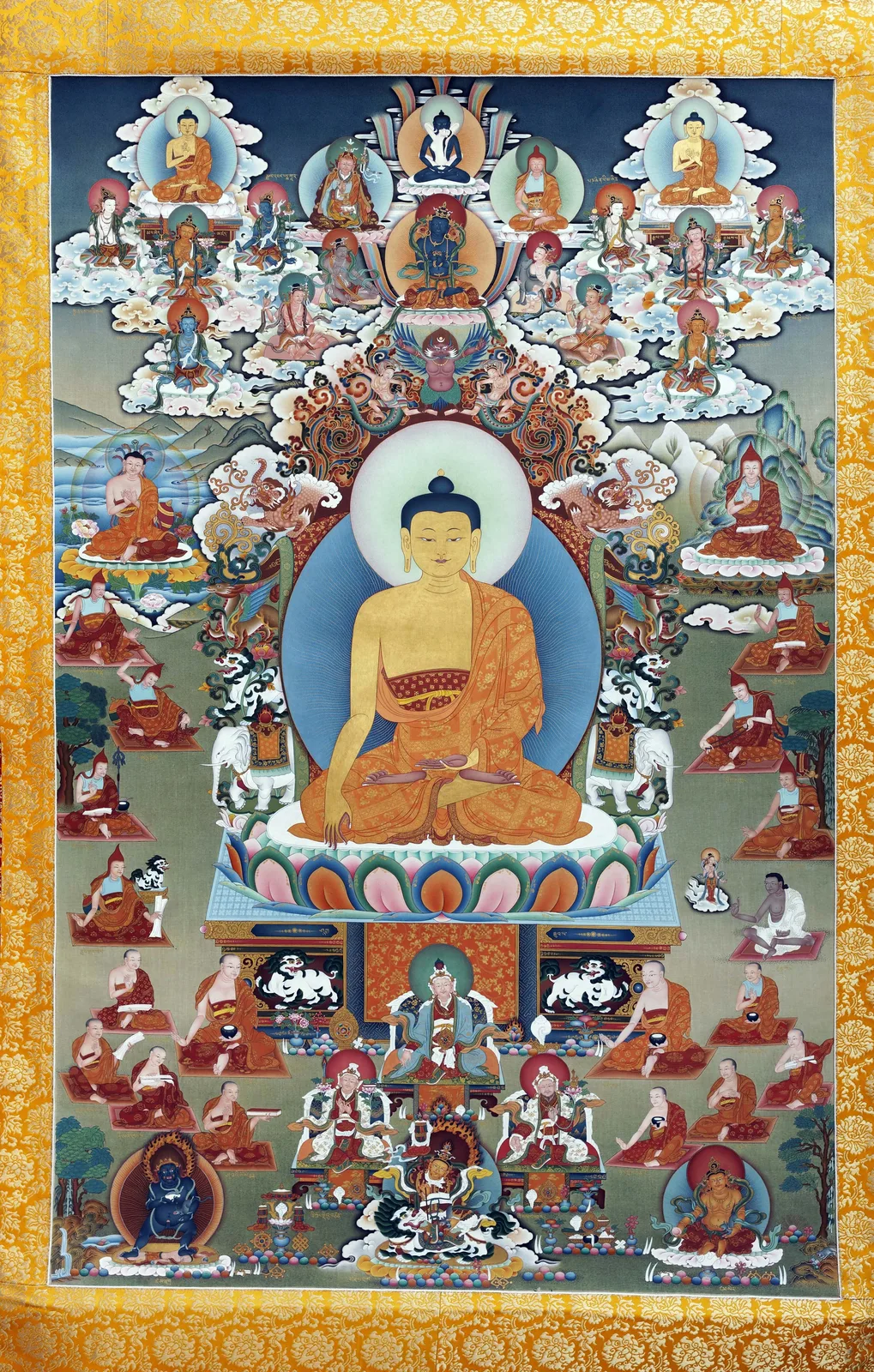
The TANGKAWORLD image TK0582 offers a clear study. Its local gallery title identifies the large central figure as Shakyamuni Buddha. Around him are many smaller figures arranged above, beside, and below. The painting therefore rewards a reading based on relative size, placement, symmetry, and visual sequence. The filename does not establish the date, workshop, region, or the identities of every surrounding figure, so those details remain uncertain without a fuller catalog record or legible inscriptions.
What scale hierarchy means in Buddhist art
Hierarchical scale is the deliberate use of different figure sizes to communicate relative importance. A sacred figure may appear larger than attendants even when all occupy the same pictorial space. The larger body does not mean that the subject was understood as physically gigantic. It is a visual statement: this is the figure around which the image is organized.
This principle has a long history in Buddhist art. A National Museum of Asian Art catalog entry, for example, describes a Buddhist painting in which the principal figure occupies the center while subordinate figures appear symmetrically and at smaller scale. Scale works together with position. A large figure placed at the center, framed by a halo and supported by a throne, receives several overlapping signals of prominence.
That combination matters. Size alone cannot prove identity or doctrinal rank. A conservation loss, later remounting, cropped photograph, or unusual regional convention may distort what we see. Readers should compare scale with attributes, gestures, inscriptions, color, halos, seats, and the relationships among neighboring figures.
How TK0582 builds a visual hierarchy
1. The central Shakyamuni figure sets the primary scale
The main seated Buddha occupies most of the middle register. His body is far larger than the nearby monks and teachers, while his pale circular halo and blue mandorla expand his visual field even further. The lotus throne, decorated platform, and framing creatures create a strong architectural base. Together, these elements make the central image readable before the eye begins to examine individual details.
The earth-touching gesture also supports the Shakyamuni identification given by the gallery filename. For a focused introduction to that gesture and its associated features, see our guide to the Shakyamuni Buddha Thangka.
2. Medium-sized figures form secondary zones
Above and below the central Buddha, several figures are larger than the numerous monks but smaller than Shakyamuni. They form intermediate levels rather than a single undifferentiated crowd. At the top, haloed figures occupy cloud-supported seats. At the bottom, richly dressed teachers and fierce guardian-like figures create another concentrated zone. The identities of these figures cannot be confirmed from scale alone, but their size and placement indicate that the painter expected viewers to distinguish them from the smaller monastic groups.
This is an important reading habit: do not reduce a multi-figure Thangka to “large Buddha plus background.” Secondary figures may carry lineage, ritual, protective, or narrative functions. Their visual rank comes from several coordinated choices, not merely from being close to the center.
3. Small monks create rhythm and community
Rows of smaller seated monks flank the large Buddha and continue into the lower register. Their repetition establishes rhythm, while variations in posture, books, bowls, gestures, and orientation keep the group from becoming a decorative pattern. Collectively, they enlarge the social and devotional setting of the image. Individually, however, the image gives them less visual weight than the central icon.
Our article on Buddhist attendant figures in Thangka explains how small surrounding figures can support the main subject without becoming visually unimportant. TK0582 extends that problem across a much denser assembly.
Scale is only one part of the hierarchy
A reliable reading combines figure size with at least four other cues:
- Centrality: the main Buddha sits on the dominant vertical axis, while many surrounding figures balance one another to the left and right.
- Framing: the halo, mandorla, throne, lotus, and paired ornamental creatures separate the principal icon from the surrounding field.
- Elevation: upper figures occupy clouds and stacked seats, while lower figures gather around offerings and protective forms. Height suggests zones, but it should not be treated as a simple top-to-bottom ranking.
- Repetition: repeated monks and attendants create a shared category. The less frequently repeated, more elaborately framed figures become easier to notice.
- Color and contrast: the large gold body, pale halo, blue mandorla, and red-orange robe distinguish the central Buddha from the green ground and the many smaller robes.
These cues can reinforce one another, but they can also complicate a first impression. A small fierce figure at the lower edge may be visually intense because of dark color and flames even though it occupies less space. A figure high in the composition may be important, yet not necessarily more important than the central icon. The purpose of visual analysis is to describe those relationships before assigning names or doctrinal conclusions.
A practical checklist for reading figure size
Use this checklist when examining a complex Buddhist painting, mural, manuscript illustration, or Thangka:
- Find the largest complete figure. Record where it sits and how much of the picture field it controls.
- Trace the main axis. Look for stacked figures, thrones, halos, offering tables, or architectural forms above and below the center.
- Group figures by approximate scale. Separate primary, secondary, and repeated small figures before trying to identify anyone.
- Compare attributes within each group. Note mudras, ritual objects, books, bowls, crowns, robes, seats, and mounts.
- Check symmetry and exceptions. Paired figures often share a role; an unmatched figure may require closer attention.
- Read inscriptions if they are actually legible. Do not invent names from blurred labels or decorative marks.
- Document uncertainty. If the date, lineage, school, or figure identity cannot be verified, label it uncertain rather than converting a visual guess into catalog data.
For a broader sequence that starts with the whole composition and then moves to attributes, consult How to Read a Thangka. When the painting contains multiple episodes rather than a single static assembly, our guide to Buddhist narrative painting provides a complementary method.
Common mistakes to avoid
The first mistake is assuming that every size difference encodes a precise doctrinal rank. Artists also use size to maintain legibility, fill registers, adapt a composition to a cloth, or emphasize a patron’s requested subject. The second mistake is identifying every small figure by resemblance alone. Repeated robes or seated poses may indicate a monastic community, but they do not supply individual names.
A third mistake is measuring only the body. Halos, mandorlas, thrones, clouds, and canopies extend a figure’s effective visual scale. Finally, avoid treating digital image size as the same thing as pictorial scale. Zooming a detail changes its screen dimensions but not its relationship to the rest of the original composition.
Conclusion
Scale hierarchy in Buddhist art turns figure size into a map of attention. In TK0582, the large central Shakyamuni Buddha anchors the composition; medium-sized haloed and teacher-like figures establish secondary zones; and smaller monks, attendants, and guardian-like figures build rhythm, community, and protection around the center. The strongest interpretation comes from combining scale with axis, framing, color, gesture, and repetition while keeping unverified identities and historical details explicitly uncertain.
Download the full Thangka image collection
Continue browsing and download the complete TANGKAWORLD image library on our free downloads page. The full collection supports close comparison of figure scale, composition, iconography, materials, and preservation details across many Buddhist images.