
Mahamayuri Buddhist art is often recognizable by one spectacular visual clue: a sacred figure associated with a peacock, its feathers, or a peacock throne. Yet that clue is only the beginning. Peacocks also appear with Manjushri, Amitabha, Amitayus, and other figures, while the appearance of Mahamayuri changes across Indian, Himalayan, Chinese, and Japanese traditions. A responsible identification therefore combines the bird with the figure’s posture, ritual objects, surrounding composition, and documentary evidence.
Who is Mahamayuri?
Mahamayuri means the “Great Peacock” or “Great Peahen” and is widely known in East Asian Buddhism as the Peacock Wisdom King. The Japanese name Kujaku Myoo is commonly used for Japanese images. Texts and ritual traditions connect the figure with protection from poisons, illness, danger, and harmful forces. In art, that protective identity is expressed through a peaceful, richly adorned figure rather than the visibly wrathful body seen in many other Wisdom Kings.
The title does not guarantee one fixed appearance. Some traditions show Mahamayuri with one face and several arms; others use multiple faces, more hands, different colors, or a different arrangement of attributes. Himalayan examples often place Mahamayuri within the Five Protective Goddesses, or Pancha Raksha, instead of presenting the figure alone. East Asian images may emphasize the peacock mount so strongly that the bird and its opened tail dominate the composition.
Why the peacock is the central visual clue
The peacock is connected with the idea of confronting poison without being destroyed by it. Buddhist explanations often use the bird as an image for transforming physical or spiritual poison into wisdom and beauty. The Metropolitan Museum of Art describes this protective meaning in relation to a Japanese sutra box decorated with the Peacock Wisdom King, while comparative Himalayan sources distinguish Mahamayuri from other deities who merely use a peacock-supported throne.
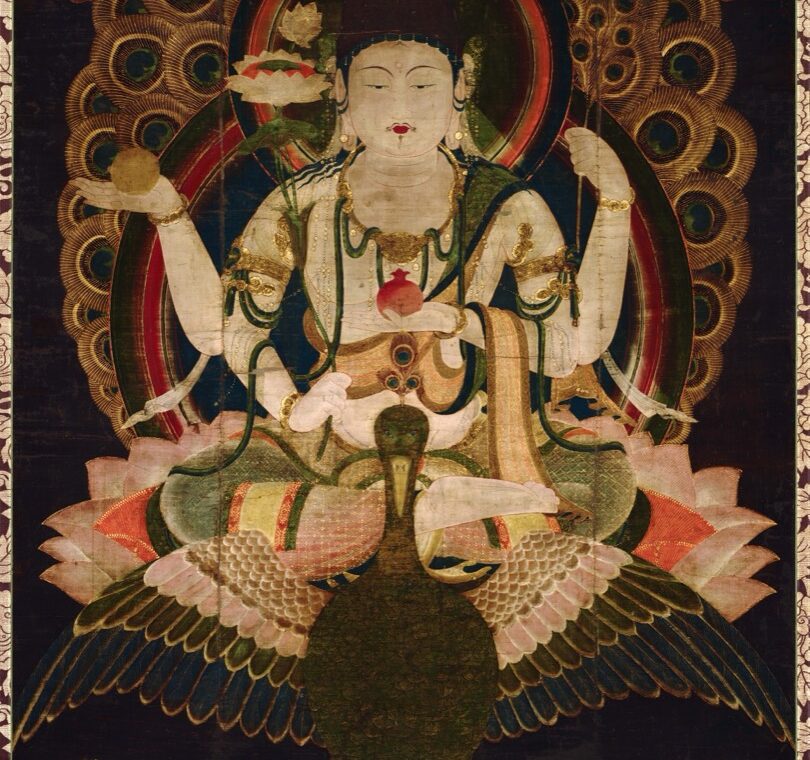
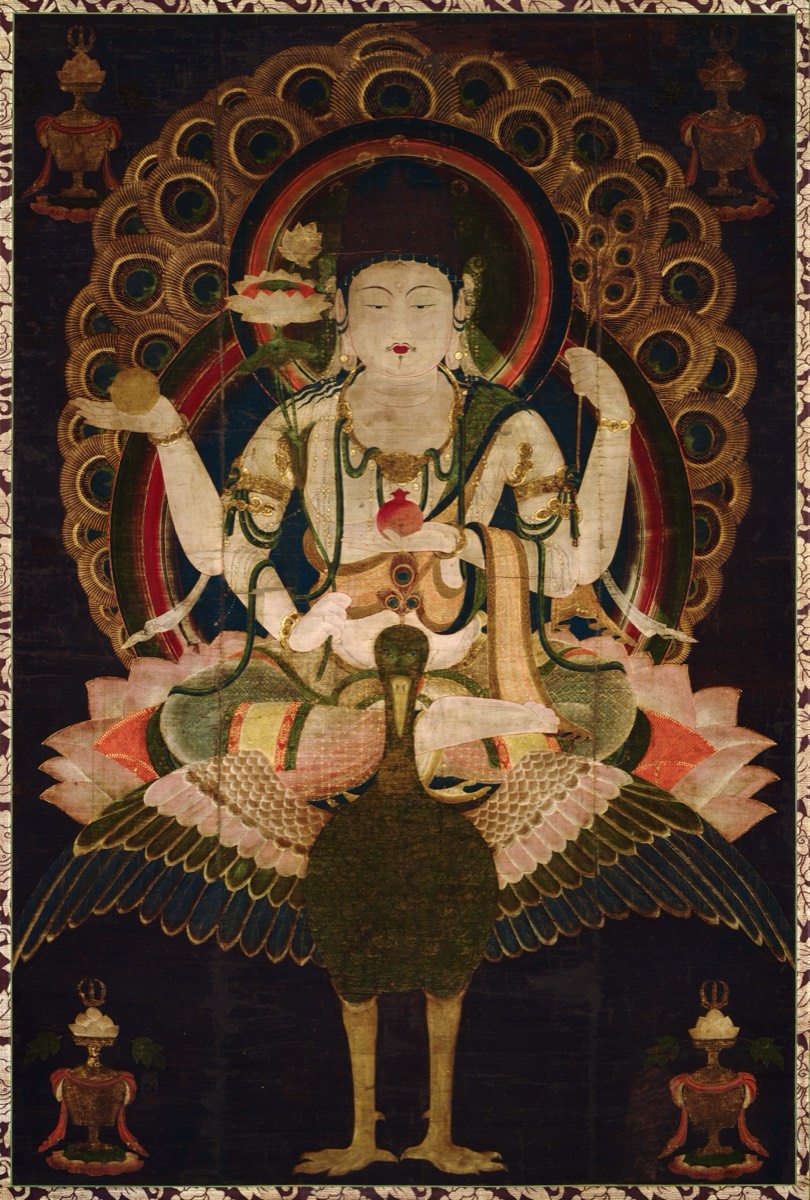
In TK0654, the bird is not a minor ornament. Its long neck rises through the center, its body supports the seated figure, and the opened tail forms an enormous patterned field behind the halo. The many “eyes” of the feathers create a visual enclosure that functions almost like an aureole. This integrated relationship between deity and bird is more persuasive than a single isolated feather.
How to read TK0654
The peaceful central figure
The figure has a calm face, jeweled ornaments, layered textiles, and a seated posture. This peaceful presentation matters. It separates the image from a conventional wrathful protector surrounded by flames, skulls, and a forceful stance. The jewelry and silk garments also indicate a bodhisattva-like sacred form rather than a Buddha in simple monastic robes.
Multiple arms and ritual objects
Several arms extend symmetrically around the torso. Visible objects include floral forms, a round object, a vessel-like form, and long implements whose exact identification is difficult at web resolution. Because Mahamayuri iconography varies, the number of arms should be recorded rather than forced into a single formula. A museum record, inscription, or ritual description would be needed to name every object with confidence.
Peacock, lotus, and offering vessels
The figure sits on a lotus above the peacock. Four offering vessels occupy the corners, creating balance around the large central bird. These details turn the composition into a complete devotional image. They are not sufficient to prove a date or workshop, but they help explain how the painter organized the protective figure as a serene focus of worship.
Mahamayuri forms across Buddhist traditions
Variation is normal. Himalayan Mahamayuri images may be green or blue and can have one or several faces, with hands holding peacock feathers, a bow and arrow, a vase, or other ritual attributes. In Pancha Raksha compositions, identification also depends on position within the five-goddess group. A cropped detail can remove that crucial context.
Japanese Peacock Wisdom King images often emphasize a beautiful, ornamented figure seated on a peacock with the tail spread behind. Chinese and Central Asian examples can use different hand attributes or a standing pose. These regional differences should not be flattened into a universal checklist. Start with what is visible, then compare it with evidence from the relevant culture and period.
Important look-alikes
Manjushri on a peacock
Some forms of Manjushri use a peacock mount or throne. Look for the flaming sword and the book of transcendent wisdom, then compare the complete composition with our Manjushri Thangka guide. A peacock by itself does not override Manjushri’s better-known attributes.
Amitabha or Amitayus with peacock support
Amitabha and Amitayus may appear with peacocks as throne animals. A Buddha in monastic robes, or Amitayus holding the vase of longevity, points away from Mahamayuri. See the Amitayus identification guide for the longevity vase, jeweled crown, and meditation posture.
Karttikeya or other peacock-riding figures
Peacock mounts also occur outside Mahamayuri iconography, including with Karttikeya or Skanda in South Asian art. A spear, princely male form, consorts, or a non-Buddhist ritual context changes the identification. Catalogue the visual evidence before assigning a Buddhist title.
A decorative peacock motif
A bird in a border, textile, throne base, or paradise landscape may be symbolic decoration rather than the vehicle of the central figure. Ask whether the composition makes the peacock structurally essential, as it does in TK0654.
Mahamayuri Buddhist art identification checklist
- Confirm that the bird is a peacock, not a phoenix, garuda, goose, or generic celestial bird.
- Check whether the figure rides the bird, sits above it, holds peacock feathers, or belongs to a peacock-centered composition.
- Record the number of faces and arms without assuming one standard form.
- List visible ritual objects cautiously; do not name damaged or indistinct forms from guesswork.
- Look for a peaceful jeweled figure, lotus support, halo, and balanced offerings.
- Compare Manjushri, Amitabha, Amitayus, Karttikeya, and other peacock-associated figures.
- Check whether the image belongs to a Pancha Raksha set or a larger ritual group.
- Verify the title through an inscription, museum catalogue, or reliable specialist record whenever possible.
- Keep artist, date, school, and provenance uncertain when the evidence is only a local filename.
Cataloguing uncertain Mahamayuri images
A useful catalogue entry separates observation from attribution. For TK0654, a careful description could read: “Peaceful multi-armed figure seated on a lotus above a peacock, with a large spread tail forming the background; local archive title identifies Mahamayuri and associates the image with Japan; date and provenance uncertain.” This preserves searchable information without converting an unverified label into fact.
Record the TK number, file dimensions, crop, color adjustments, and source history separately. If a later museum record confirms the object, update the catalogue with the institution, accession number, materials, date range, and a link to the authoritative entry. Our beginner’s guide to reading a Thangka provides the same observation-first method for other sacred images.
Viewing and preservation notes
TK0654 contains dark passages, fine gold lines, textile patterns, and delicate feather details. A small thumbnail can hide implements and surface condition, while aggressive brightening can distort the relationship between pigments and gold. For research, keep the untouched source file, create a separate web derivative, and document any resizing or color correction.
Physical paintings on silk or cloth should be assessed by a qualified conservator before cleaning, flattening, or reframing. Digital viewers should avoid treating cracks, stains, losses, or darkened areas as iconographic features. Condition and sacred imagery must be described as separate layers of evidence.
Conclusion
The strongest identification of Mahamayuri combines a peacock-centered composition with a peaceful adorned figure, regional iconographic comparison, and reliable documentation. TK0654 presents the bird with unusual clarity: its body supports the deity and its opened tail becomes the visual field behind the figure. The subject label is persuasive, but the local claims about date and origin remain uncertain until matched to an independent record.
Sources and further reading
- Himalayan Art Resources: Mahamayuri iconography and Pancha Raksha context
- The Metropolitan Museum of Art: Sutra Box with the Peacock Wisdom King
- Metropolitan Museum Journal: Mahamayuri, the Great Peacock Wisdom King
Download the full Thangka image collection
Continue exploring and download the complete TANGKAWORLD image library from our full Thangka image collection, with high-resolution files organized for close viewing, comparison, and research.