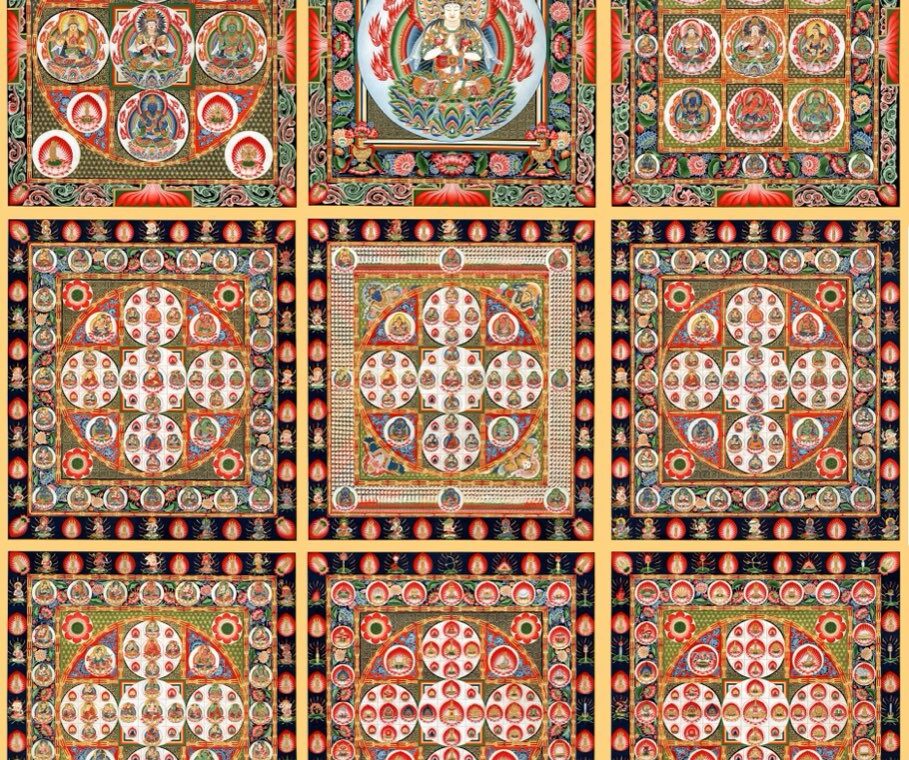
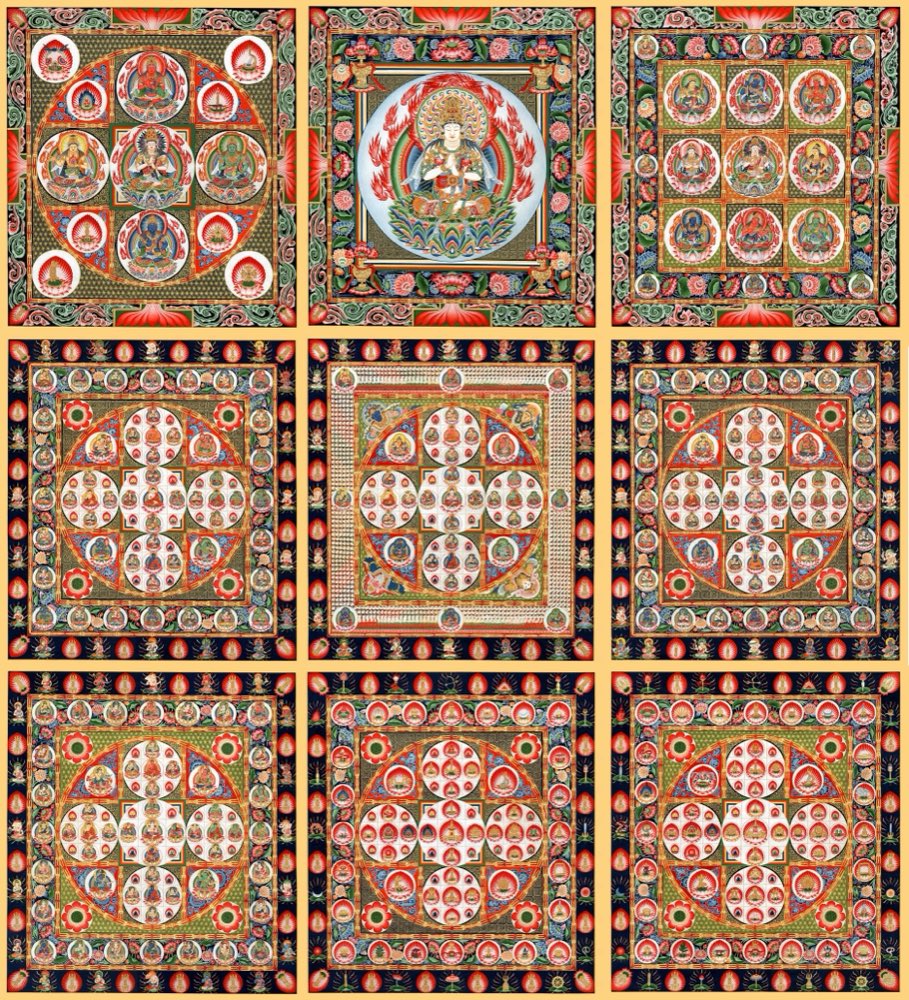
A Vajra Realm Mandala can look overwhelming at first: nine square worlds, hundreds of sacred figures, repeated lotus circles, ritual emblems, and carefully ordered colors fill a single image. The complexity is deliberate. This is not a decorative grid or a literal map of a temple. It is a structured presentation of awakened wisdom in which each assembly reveals a different way of understanding Mahavairocana and the wider Buddhist cosmos.
Read the image from overall structure to individual detail: confirm the nine-part arrangement, locate the central and top-center assemblies, then compare figures and symbols. TK0587’s artist, date, school, and provenance remain uncertain.
What is a Vajra Realm Mandala?
The image is also called the Diamond World Mandala, the Vajradhatu Mandala, or, in Japanese, the Kongokai Mandala. “Vajra” can refer to a diamond or thunderbolt and conveys an awakened wisdom understood as lucid and indestructible. In Japanese Esoteric Buddhist traditions, the Diamond World is commonly paired with the Womb World, or Taizokai. Together they form the Mandala of Both Worlds, known as Ryokai Mandara.
The Metropolitan Museum of Art describes the Diamond World as manifesting absolute wisdom and the Womb World as representing great compassion. The pair presents complementary approaches to Mahavairocana through wisdom and compassion. For the companion composition, see our Womb Realm Mandala guide.
Why the Vajra Realm Mandala has nine assemblies
The most recognizable Shingon form divides the field into nine equal square assemblies arranged three by three. Each square is a complete mandala, but all nine belong to one coordinated program. A viewer should therefore resist treating the image as nine unrelated paintings. Repeated Buddhas, bodhisattvas, lotus seats, mudras, and ritual implements show how one enlightened principle can be expressed through different visual systems.
In the standard Shingon arrangement discussed by the Metropolitan Museum, reading begins with the central square, called the Perfected-Body Assembly, and proceeds clockwise. The top-center square is the One-Mudra Assembly, where Mahavairocana appears alone using the wisdom-fist mudra. Panel names and iconographic details can differ between Shingon and Tendai traditions, between figural and symbolic versions, and across copies made in different periods. Position is useful evidence, but it is not a substitute for a catalogue or lineage-specific diagram.
The central Perfected-Body Assembly
Begin in the middle of TK0587 rather than at the upper-left corner. The central panel contains a dense fivefold organization, with a principal figure at the heart and four related groups arranged around it. This structure establishes the visual grammar repeated elsewhere: center and directions, unity and differentiation, one Buddha and multiple awakened qualities.
The One-Mudra Assembly at the top center
The top-center panel is dramatically simpler. A single crowned figure sits within a large circular halo and lotus setting. In the standard Diamond World program, this is Mahavairocana performing the wisdom-fist mudra. The simplified panel does not mean that it is less important. Its concentration on one figure makes a visual statement about the many assemblies returning to a single enlightened body and insight.
The remaining seven assemblies
The remaining squares transform the same system. TK0587’s upper corners foreground figures, while several lower panels organize ritual attributes inside lotus forms. Buddhist presence can therefore appear as a body, gesture, implement, syllable, or patterned relationship.
Mahavairocana and the Five Buddhas
Mahavairocana, also called Dainichi Nyorai in Japan, is the organizing center of the Diamond World. He should not be identified merely because a figure is white, crowned, or centrally placed. The composition, mudra, attendant groups, and mandala context must agree. Our Vairocana Buddha Thangka guide explains the crowned appearance and central role in more detail.
A key clue is the wisdom-fist mudra: one index finger is enclosed by the opposite hand. Because the fingers merge at web size, compare the full image with a reliable institutional record.
Fivefold Buddha groups also recur across the nine assemblies. Mahavairocana occupies the center, with four Buddhas associated with the directions and distinct colors, gestures, and qualities. Colors can fade, shift during digitization, or be altered by restoration, so a blue, red, yellow, green, or white body should never carry the identification alone.
How to read TK0587 step by step
- Confirm the nine-square framework. Look for three rows of three bounded assemblies rather than one palace with nine decorative compartments.
- Start in the center. Identify the densest core arrangement and note how its center-and-directions pattern is repeated around it.
- Move to the top center. Compare the single large Mahavairocana with the more populated panels and inspect the hand gesture at higher resolution.
- Trace fivefold groups. Record central and directional figures before trying to name every attendant.
- Separate figures from symbols. Several assemblies may replace bodies with vajras, wheels, jewels, lotuses, vessels, or other attributes.
- Follow the repeated borders. Lotus petals, flame-like halos, floral bands, and small peripheral deities connect the squares into one program.
- Check orientation and school. Do not force a clockwise reading sequence or panel name onto an image until its lineage-specific format has been verified.
Vajra Realm vs Womb Realm Mandala
The two mandalas use noticeably different visual grammars. A Womb Realm Mandala usually presents a large central lotus court surrounded by expanding precincts. A Vajra Realm Mandala in the nine-assembly form presents nine complete squares. The contrast makes the pair easier to identify from a distance: one unfolds outward through nested courts, while the other repeats and transforms a square assembly.
Both center on Mahavairocana and use ordered groups of Buddhas, bodhisattvas, guardians, and symbols. Their meaning depends on ritual and transmitted practice as well as painted form. For a general observation-first approach, use our beginner’s guide to reading a Thangka.
Common identification mistakes
Calling every nine-part Buddhist image a Diamond World Mandala
A grid alone is not enough. Confirm the central Mahavairocana system, repeated Five Buddha structures, One-Mudra panel, and coherent set of assemblies. A group of nine independent deity paintings can resemble the format without belonging to it.
Treating a filename as proven provenance
TK0587’s filename supplies a useful working title, not a museum attribution. It does not establish the painter, workshop, date, materials, original temple, or transmission history. Those fields remain uncertain until matched to an inscription, collection record, or scholarly catalogue.
Reading colors as fixed labels
Pigments age and scans vary. Use posture, mudra, crown, objects, position, and neighboring figures together. If the image is damaged or compressed, record what is visible and leave the deity uncertain.
Confusing Mahavairocana with Shakyamuni
Mahavairocana in Esoteric Buddhist art is often crowned and jeweled, while Shakyamuni is generally shown in monastic robes. The wisdom-fist mudra and nine-assembly context point toward Mahavairocana; an earth-touching gesture and alms bowl point elsewhere.
Vajra Realm Mandala identification checklist
- Is the complete composition divided into a clear three-by-three grid?
- Does the central square function as the main, densely populated assembly?
- Is a single crowned Mahavairocana visible in the top-center square?
- Can the wisdom-fist mudra be seen or responsibly compared at higher resolution?
- Do fivefold Buddha groups recur in several panels?
- Are some deities represented by ritual attributes or other symbolic forms?
- Does the image have a documented Shingon, Tendai, Chinese Esoteric, or other lineage context?
- Have the artist, date, school, materials, and provenance been verified independently?
- Could the object instead be one half of a Mandala of Both Worlds pair?
Cataloguing and preservation notes
A careful catalogue entry separates visual observation from attribution. For TK0587, a defensible description is: “Nine square assemblies arranged in a three-by-three field; central and directional Buddha groups, a single crowned figure in the top-center panel, and panels containing both figures and ritual attributes; local archive title identifies the Vajra Realm Mandala; date and provenance uncertain.”
Many figures disappear in thumbnails. Keep the source unchanged, document derivatives, and do not mistake cracks, pigment loss, retouching, or mounting damage for intentional iconography.
Conclusion
The best way to understand a Vajra Realm Mandala is to read relationships before names. Confirm the nine assemblies, begin at the central Perfected-Body Assembly, compare the single Mahavairocana above it, trace the repeated Five Buddha structures, and distinguish figural from symbolic panels. TK0587 clearly supports that structural reading, while its authorship, date, school, and provenance remain uncertain. Used together with the paired Womb Realm, the image becomes a disciplined guide to how wisdom, compassion, and sacred form are organized in Esoteric Buddhist art.
Sources and further reading
- The Metropolitan Museum of Art: Japanese Mandalas—Emanations and Avatars
- The Metropolitan Museum of Art: Scroll of Deities of the Diamond World Mandala
- e-Museum, National Institutes for Cultural Heritage: Mahavairocana Tathagata
Download the full Thangka image collection
Continue browsing and download the complete TANGKAWORLD image library from our full Thangka image collection for close viewing, comparison, and further research.