
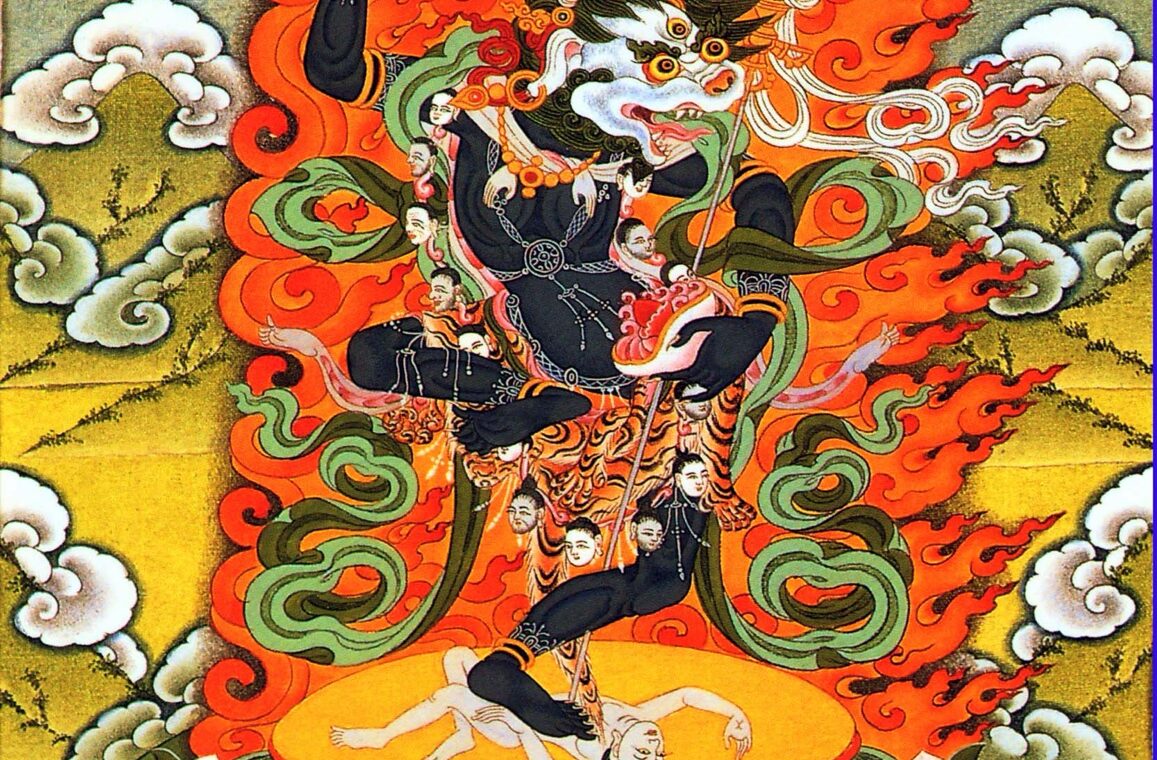
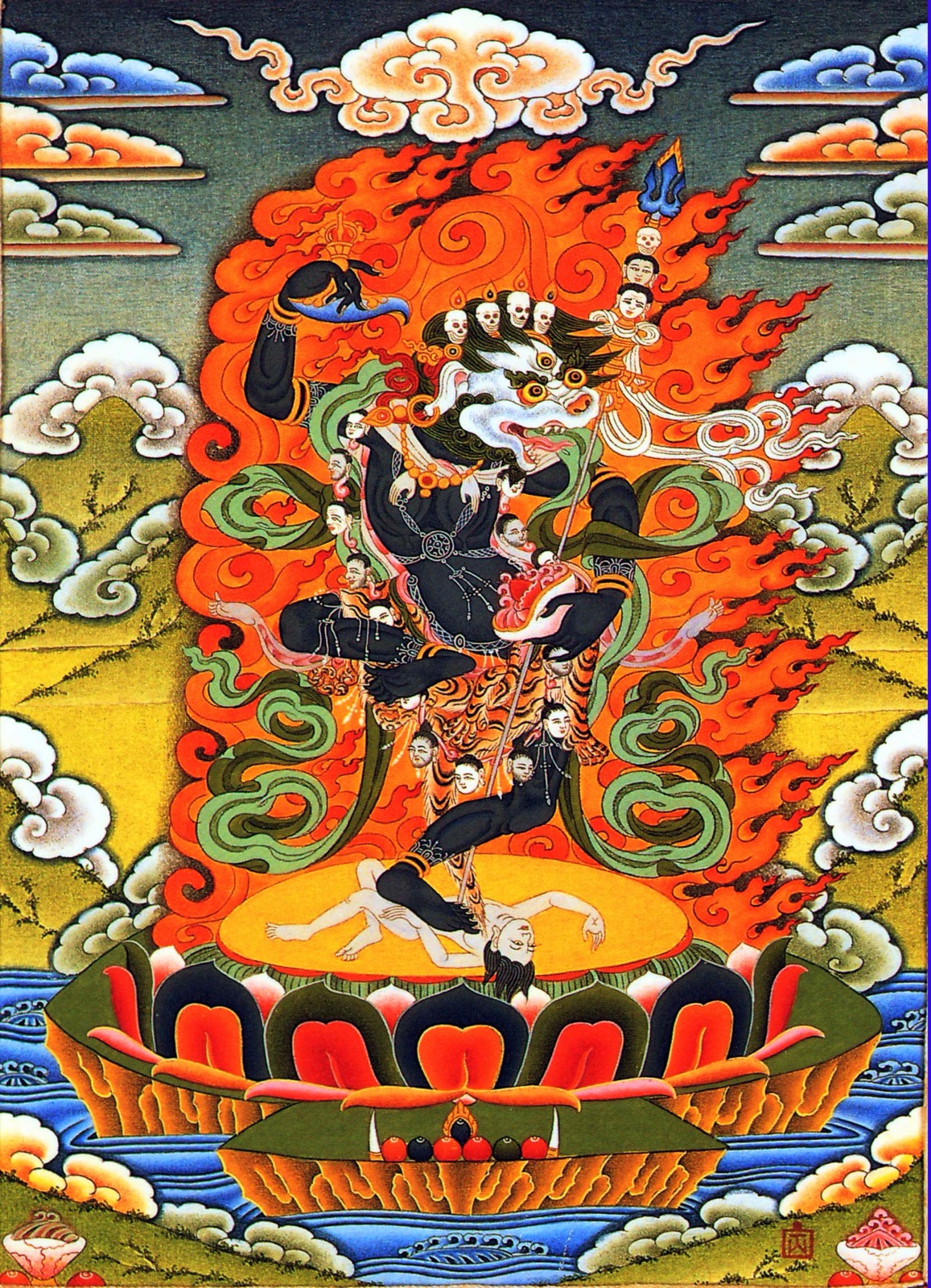
A Simhamukha thangka is immediately striking: a lion-faced female figure dances inside flames, surrounded by skull imagery and ritual implements. The appearance is wrathful, but “wrathful” in Buddhist art does not mean evil. It describes an energetic visual language in which wisdom confronts obstacles without hesitation. Correct identification depends on the lion face, female form, curved knife, skull cup, tantric staff, body color, and dancing posture working together.
Who is Simhamukha?
Simhamukha means “Lion Face.” She is described as a wisdom dakini in several Tibetan Buddhist traditions, with multiple practice lineages and iconographic forms. A dakini may appear peaceful, semi-wrathful, or fully wrathful. Simhamukha’s animal face makes her especially distinctive, yet other lion-faced deities exist, so the name should still be tested against gender, objects, and context.
Her iconography often combines a dark blue or blue-black body, a white or pale lion face, three eyes, upward-flowing hair, a crown of skulls, and a garland of heads. She commonly holds a curved knife and a skull cup while a khatvanga, or tantric staff, rests in the bend of the arm. Variations occur across traditions; not every painting will display every feature with equal clarity.
The lion face is the starting point
In TK0563 the central face is unmistakably leonine. The muzzle projects, the mouth opens to reveal fangs, and the mane expands around the head. The eyes glare beneath the crown. This is different from a deity who merely rides a lion or uses a lion throne. Vaishravana, for example, may sit on a snow lion but keeps a human face. Simhamukha’s own face is the animal feature.
Animal-headed imagery must be read carefully. Hayagriva has one or more small horse heads above a human wrathful face, while Simhamukha has a lion face as the principal face. Vajravarahi may show a sow’s head beside a human face. Naming the location of the animal feature—main face, side face, crest, mount, or throne—prevents many errors.
Curved knife, skull cup, and tantric staff
The raised right hand in TK0563 holds a curved flaying knife. This implement is often called a kartika. It should not be confused with Manjushri’s straight flaming sword. Its hooked blade belongs to a tantric visual vocabulary and is frequently paired with a skull cup. The left hand holds the skull cup near the heart, although small details may be difficult to read in compressed images.
A long staff appears along the body. The khatvanga may carry symbolic heads, a trident-like finial, ribbons, or other elements. In many dakini images it rests against the shoulder or is supported in the crook of the arm. The combination of curved knife, skull cup, and staff also appears with Vajrayogini, so the lion face remains decisive. Compare the human-faced red figure in our Vajrayogini iconography guide.
Flames, dancing stance, and the meaning of wrath
Simhamukha stands dynamically on one leg while the other bends in a dancing posture. Flames rise behind her, and the hair and scarves seem to move with the surrounding energy. The figure tramples a prone body, a conventional image of obstacles or egoic fixation being overcome. It should not be interpreted as a literal celebration of violence.
Wrathful art uses skulls, severed heads, flames, and trampling to express transformation. The same visual language appears with protectors and tantric meditation deities, but their identities remain different. Mahakala is typically male and may have multiple arms and distinct implements. Our Six-Armed Mahakala guide shows why a skull crown and flame aureole alone are insufficient.
Body color and female form
TK0563 presents a dark body with a pale lion face. The figure’s jewelry, bone ornaments, breasts, and dancing posture establish a female dakini form. Body color can vary by lineage, and reproduction settings can shift dark blue toward black. Descriptions should therefore use phrases such as “dark blue or blue-black” when the pigment cannot be confirmed directly.
Color is useful for comparison but not unique. Vajrapani and Mahakala may also be blue-black. Simhamukha’s lion face and dakini implements carry more weight than the background color. This hierarchy of clues—face first, objects second, posture and color third—makes the identification more reliable.
Simhamukha versus common look-alikes
Simhamukha versus Hayagriva
Hayagriva is a wrathful male figure identified by small horse heads rising above one or more human faces. Simhamukha has the lion face as her main face and a female body.
Simhamukha versus Vajrayogini
Both can carry a curved knife, skull cup, and khatvanga while dancing in flames. Vajrayogini normally has a human face and a red body. Simhamukha’s lion face resolves the comparison.
Simhamukha versus Kurukulla
Kurukulla is a red female deity who commonly holds a flower bow and arrow, hook, and noose. Her human face and floral weapons distinguish her from the lion-faced dakini. See our Kurukulla thangka guide.
Practical identification checklist
- Confirm that the main face is a lion, not a human face above a lion mount.
- Check that the body is female and commonly dark blue or blue-black.
- Look for a curved knife in the raised right hand.
- Look for a skull cup held near the heart and a khatvanga staff.
- Note three eyes, skull crown, head garland, bone ornaments, and upward hair.
- Observe the dancing posture, flames, and trampled obstacle figure.
- Record lineage, date, artist, and provenance as uncertain unless documentation confirms them.
How to describe TK0563 responsibly
A useful visual record could read: “Dark blue-black female dakini with a white lion face, curved knife, skull cup, staff, skull ornaments, and dancing posture inside flames.” The archive name supports identification as Simhamukha. It does not, by itself, establish the exact practice lineage, date, artist, or place of production.
This is especially important because Simhamukha has multiple iconographic traditions. A generic name can be secure while a highly specific lineage attribution remains uncertain. Collection research should preserve that distinction rather than forcing every image into the narrowest available category.
Conclusion
Identify Simhamukha through a cluster of mutually reinforcing signs: lion face, female dakini body, curved knife, skull cup, tantric staff, dark color, dancing stance, and flames. Her wrathful appearance visualizes fierce wisdom rather than evil. By comparing the location of the animal feature and the exact implements, readers can separate her from Hayagriva, Vajrayogini, Mahakala, and Kurukulla.
Sources and further reading
- Himalayan Art Resources: comparative records for Simhamukha
- Rubin Museum of Himalayan Art: Simhamukha (object record)
These references support comparative iconographic study. The TANGKAWORLD TK number is an internal catalogue identifier; artist, date, collection history, and provenance remain uncertain unless separately documented.
Download the full Thangka image collection
Continue exploring and download the complete TANGKAWORLD image library through our Thangka image collection.