
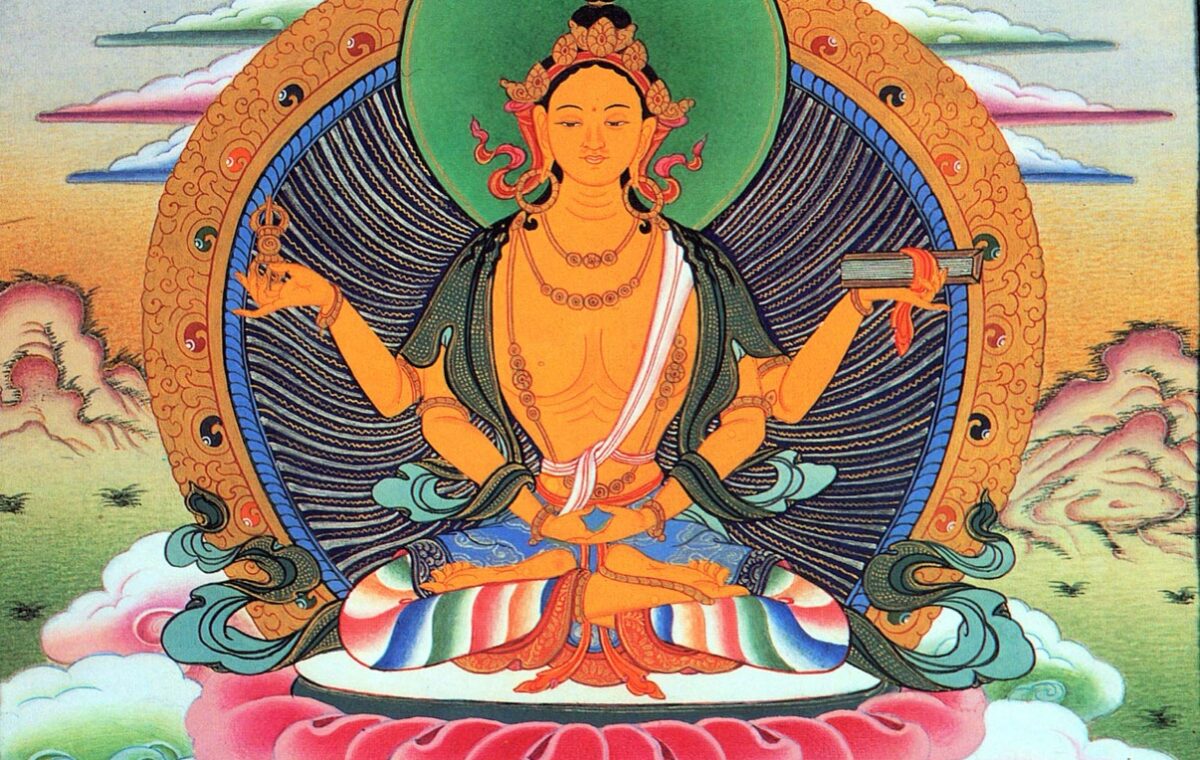
A Prajnaparamita thangka gives visual form to the Perfection of Wisdom teachings. The figure is often called the “Mother of the Buddhas,” because awakened Buddhas arise through wisdom that sees phenomena without fixed, independent essence. In painting, that philosophical idea becomes readable through a sacred book, a golden or yellow body, teaching gestures, lotus supports, and sometimes four arms. The challenge is that several peaceful female deities share the same color, jewelry, and lotus seat. Identification must therefore rest on attributes and configuration, not on beauty or serenity alone.
What Prajnaparamita represents
Prajnaparamita is both a body of Mahayana literature and its personification as a female deity. The Sanskrit name combines “prajna,” wisdom, with “paramita,” perfection or transcendent accomplishment. In visual culture, she does not simply decorate a manuscript tradition; she embodies the insight taught by those texts.
The title “Mother of the Buddhas” should not be read as biological motherhood. It describes wisdom as the indispensable condition for Buddhahood. This meaning helps explain why the book is so important in her iconography. A manuscript is not a generic sign of learning here. It points specifically toward the Perfection of Wisdom tradition.
The sacred book is the primary identification clue
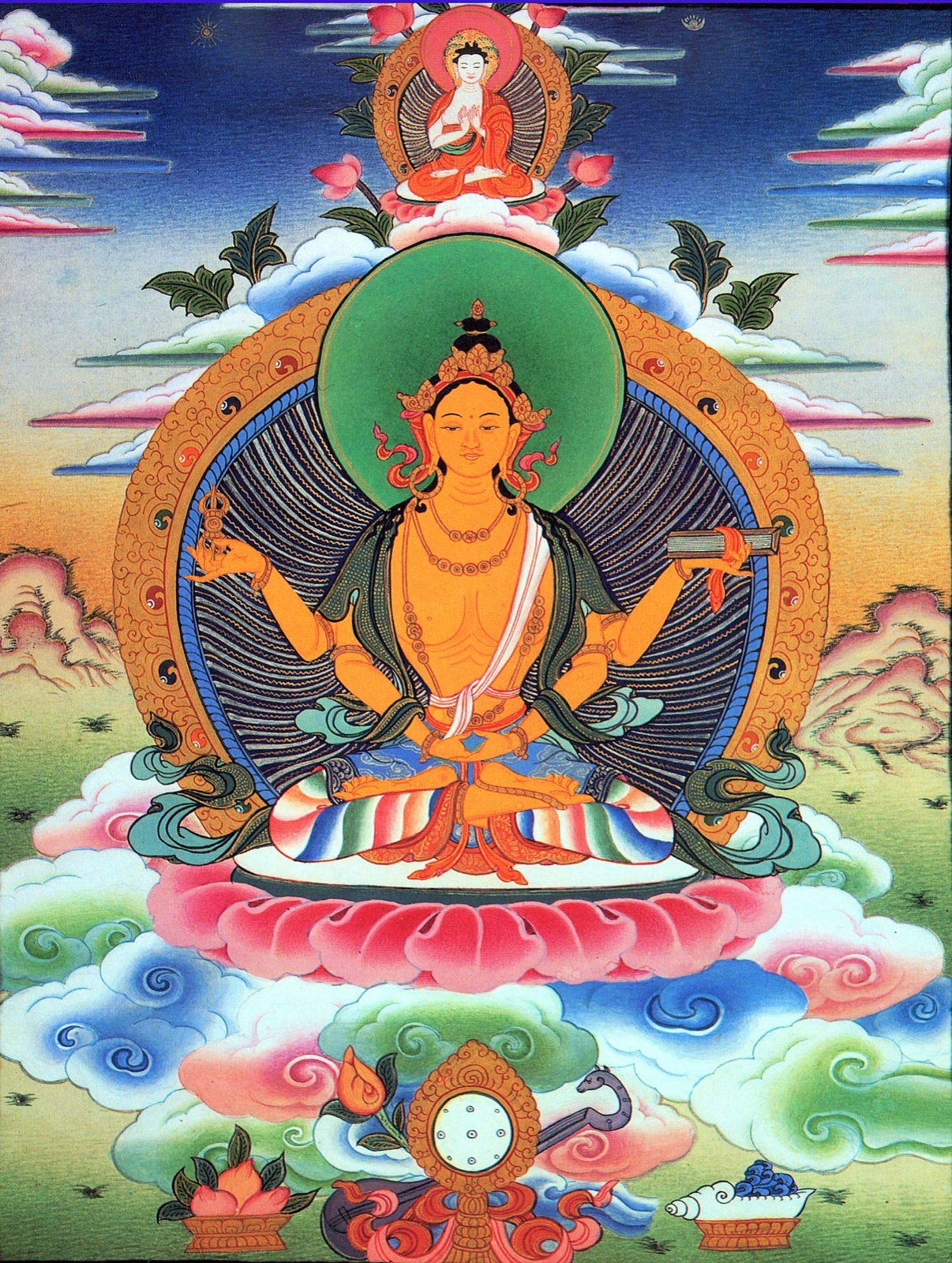
In TK0571 a rectangular book rests on or is supported by the upper left hand. Its long horizontal format recalls traditional palm-leaf or Tibetan loose-leaf manuscripts. When a peaceful female deity holds such a text, Prajnaparamita becomes a strong possibility. The book should be distinguished from a jewel, vase, flower, or flat ritual implement by examining its parallel edges and stacked folio-like form.
Books also appear with Manjushri, often resting on a lotus beside the bodhisattva rather than being directly held in the same configuration. Manjushri is usually paired with a flaming sword, which Prajnaparamita does not carry in standard peaceful forms. Review the contrast in our Manjushri sword, lotus, and book guide.
Reading the four arms in TK0571
The source image shows a golden figure with four arms. The upper left supports the book, while the upper right holds a compact ritual object that appears vajra-like. The lower hands rest together in a meditative gesture at the lap. This arrangement is consistent with a four-armed yellow form of Prajnaparamita, but forms vary across textual and artistic traditions.
Counting arms is an essential first step, yet it is not enough. A four-armed figure could be Avalokiteshvara, a form of Tara, or another goddess. Readers should map each hand separately: upper right, upper left, lower right, lower left. Record whether an object is held, supported on a lotus, or merely appears nearby. Small reproductions can merge an attribute with jewelry or the halo.
Golden body, jewelry, and peaceful posture
Yellow or golden color is common in Prajnaparamita imagery, although white forms also exist. The golden body evokes radiance and value, but color conventions vary with lineage and practice. In TK0571 the figure wears a jeweled crown, earrings, necklaces, armlets, and flowing scarves. She sits in a stable meditation posture on a lotus amid multicolored clouds.
These features establish her as a peaceful enlightened figure. They do not identify her on their own. Green Tara also wears ornaments and sits on a lotus, but her green body, extended right leg, gesture of generosity, and paired lotuses create a different visual grammar. See the Green Tara iconography guide for that comparison.
Offerings and secondary figures
The lower part of TK0571 includes auspicious offerings, including a mirror-like round object and other ritual forms. Offerings create a devotional environment but may not be unique to Prajnaparamita. Above the main figure is a smaller seated Buddha. Without an inscription or verified catalogue entry, the precise identity and doctrinal role of that upper figure should remain uncertain.
This distinction matters in collection research. The central deity may be confidently identified from the book and four-arm configuration even when attendants, lineage figures, or donor elements remain unresolved. A good catalogue record can contain different confidence levels for different parts of the same painting.
Prajnaparamita versus similar figures
Versus Manjushri
Both concern wisdom and may include a book. Manjushri normally carries or is accompanied by a flaming sword that cuts through ignorance. Prajnaparamita instead centers the sacred text and a peaceful female form.
Versus Tara
Tara is recognized through body color, leg posture, gestures, and lotus attributes. A directly held Perfection of Wisdom book and a four-armed golden configuration point elsewhere.
Versus an unidentified female bodhisattva
If the supposed book is blurred or missing, avoid naming the figure solely from a golden body. Describe the visible objects first and use “possibly Prajnaparamita” until better documentation or imagery is available.
Practical identification checklist
- Locate a horizontal sacred book, either held directly or supported on a lotus.
- Count the arms and map every object or gesture.
- Check for a yellow, golden, or white body without treating color as exclusive.
- Look for a peaceful jeweled form seated in meditation.
- Confirm that a Manjushri-style flaming sword is absent.
- Separate the central identification from uncertain attendants or provenance.
- Search inscriptions, reverse text, and current museum records before assigning a date or school.
How to catalogue TK0571 responsibly
A concise evidence-based description might read: “Four-armed golden Prajnaparamita seated on a lotus, holding a manuscript in the upper left hand, with the lower hands in meditation.” The record can then add: “The archive title identifies the figure as Prajnaparamita; artist, date, school, and provenance are uncertain.” This preserves useful iconographic information while making the boundary of knowledge visible.
Readers new to this method can use our beginner’s guide to reading a Thangka to separate the central figure, attributes, gestures, attendants, and setting in a consistent order.
Conclusion
The most reliable way to identify a Prajnaparamita thangka is to begin with the book and then test the number of arms, gestures, color, posture, and comparisons. The sacred text gives the image its clearest connection to the Perfection of Wisdom tradition. Golden color and elegant ornaments support that reading, but they should never replace close observation.
Sources and further reading
- Himalayan Art Resources: comparative records for Prajnaparamita
- Rubin Museum of Himalayan Art: Perfection of Wisdom manuscript page (object record)
These references support comparative iconographic study. The TANGKAWORLD TK number is an internal catalogue identifier; artist, date, collection history, and provenance remain uncertain unless separately documented.
Download the full Thangka image collection
Continue exploring and download the complete TANGKAWORLD image library through our Thangka image collection.