
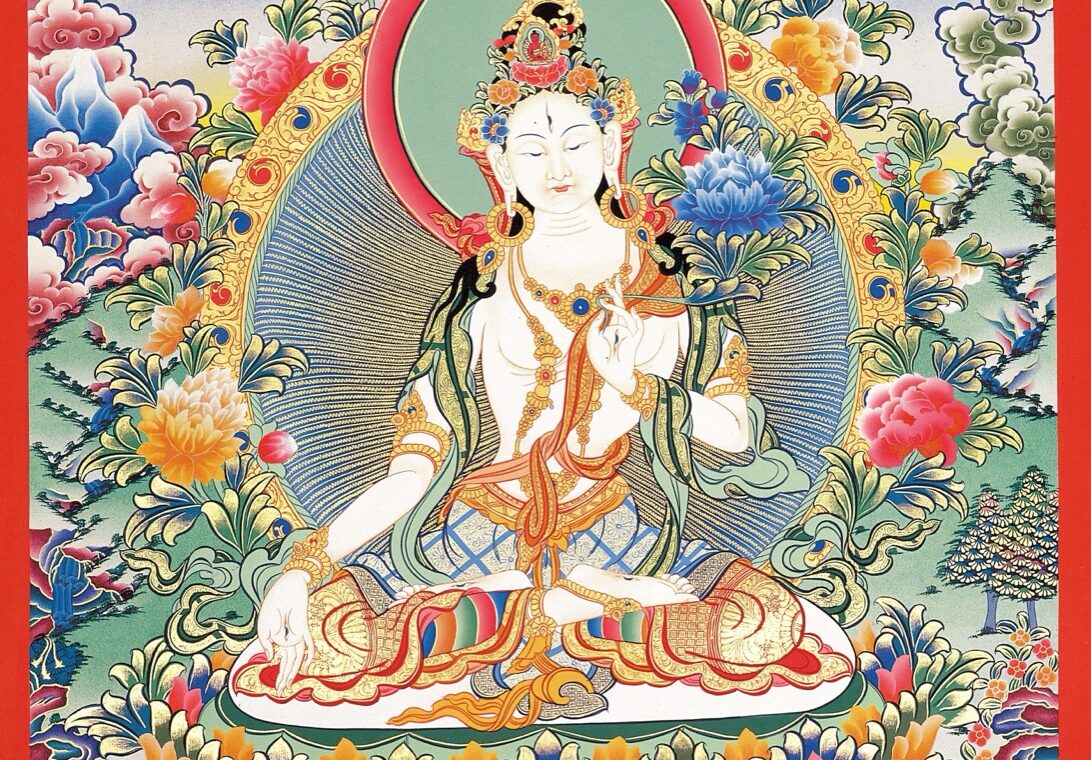
A White Tara thangka is often recognized first by its calm white central figure, but color alone is not enough for a reliable identification. The strongest evidence comes from a group of features read together: Tara’s seated posture, her open right hand, her lotus, and the distinctive system of seven eyes associated with far-reaching compassionate awareness. When those details are clear, White Tara can usually be distinguished from Green Tara, other female bodhisattvas, and pale-colored longevity figures.
What White Tara represents
White Tara is a form of Tara associated with compassion, peaceful activity, healing, and long life. In Tibetan Buddhist traditions she is frequently grouped with Amitayus and Ushnishavijaya as a major longevity deity. This does not mean that every White Tara image was made for the same ritual purpose. A painting may have served meditation, initiation, commemoration, temple display, or a private devotional setting, and that function cannot be recovered from iconography alone.
The white body conveys a peaceful rather than wrathful mode. It can suggest purity, clarity, and the unobstructed quality of awakened awareness. The serene face and balanced posture reinforce that character. White Tara is not passive, however: her compassionate attention is expressed through an expanded capacity to see suffering and respond to it.
How to identify a White Tara thangka
Look for the seven eyes
The best-known feature of White Tara iconography is a total of seven eyes: the ordinary pair, a third eye on the forehead, an eye in each palm, and an eye on each sole. In photographs or web-sized reproductions, the palm and sole eyes may be very small, stylized, damaged, or hidden by the pose. Do not reject an identification only because all seven cannot be counted immediately. Instead, zoom in and examine the forehead, palms, and exposed soles before considering the other attributes.
The seven eyes should be understood symbolically, not anatomically. They visualize compassionate awareness that is not restricted to a single direction or point of view. The Rubin Museum’s White Tara record likewise identifies the third eye and the eyes in the palms as defining features of the deity.
Check the posture and hands
White Tara is normally shown seated with both legs in a meditative, vajra-like posture. This is an immediate contrast with the familiar Green Tara type, in which one leg often extends from the lotus seat to signal readiness to act. White Tara’s right hand commonly opens downward in a gesture of generosity or wish granting. Her left hand is raised near the heart and may hold the stem of a lotus.
Hands are easily misread when jewelry, scarves, and flower stems overlap. Trace the outline of each forearm and finger rather than relying on a quick impression. If the right hand is extended and the left supports a lotus while the figure remains fully seated, the identification becomes much stronger.
Read the lotus and surrounding figures carefully
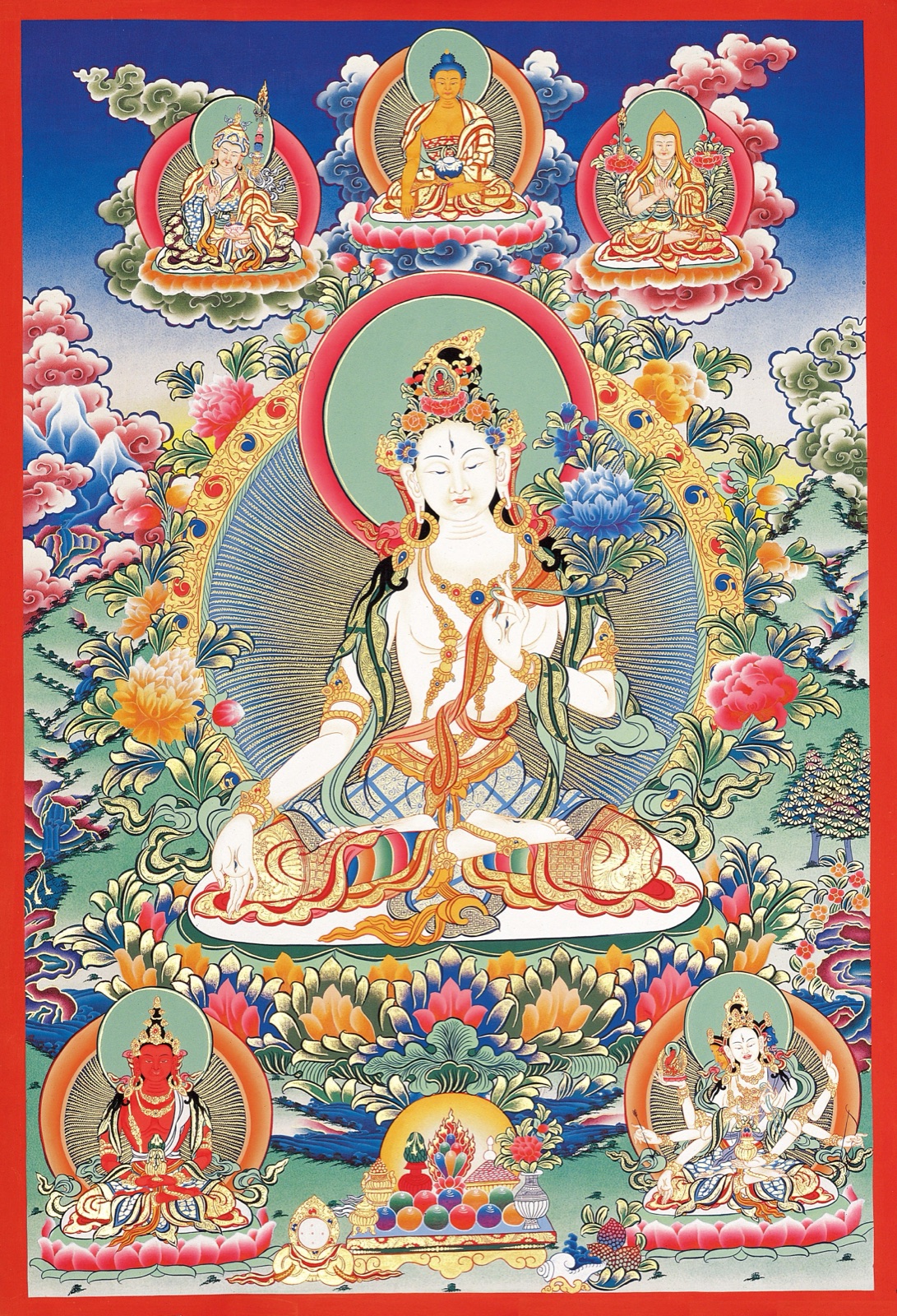
Lotus flowers frame many Buddhist deities, so a lotus by itself does not identify White Tara. Its value comes from its relationship to the hands, posture, color, and eyes. Additional Buddhas, teachers, donors, or longevity figures may appear above and below the central deity. These secondary figures can provide lineage or ritual context, but they should not be named unless their own attributes are legible.
In TK0568, the central white figure dominates an elaborate floral field. Several smaller figures occupy the upper and lower registers. Their presence makes the painting visually rich, yet the current catalogue information does not establish every attendant’s identity. It is safer to describe them as subsidiary figures than to force uncertain names.
White Tara and Green Tara: the visual difference
White Tara and Green Tara belong to the same broad family of Tara imagery, but they answer different visual cues. White Tara is usually white, fully seated, peaceful, and marked by the seven-eye system. Green Tara is usually green, with one leg extended, and is strongly associated with swift compassionate action. Color is helpful, although fading, retouching, photography, and regional palettes can alter it. Posture and attributes remain more dependable.
- White Tara: white body, both legs folded, seven-eye iconography, longevity and peaceful activity.
- Green Tara: green body, one leg commonly extended, active readiness, swift compassionate response.
- Both: lotus imagery, bodhisattva ornaments, graceful female form, and gestures of compassion.
For the companion type, see Green Tara Thangka: Meaning, Symbols, and Iconography.
A practical White Tara identification checklist
- Confirm that the central figure is peaceful and predominantly white.
- Look for three facial eyes, including one centered on the forehead.
- Inspect the palms and soles for four additional eyes.
- Check that both legs are folded in a stable meditation posture.
- Follow the right hand into a generosity or wish-granting gesture.
- Look for a lotus connected to the raised left hand.
- Separate visible evidence from uncertain claims about date, school, artist, and ritual use.
How to catalogue a White Tara image responsibly
A useful catalogue entry records what can be seen before adding historical interpretation. Note the figure’s color, posture, number and location of eyes, gestures, flowers, ornaments, attendant figures, support, condition, dimensions, and any inscriptions. Record the filename or archive number so the visual statement can be traced back to its source.
Then divide attribution into levels of confidence. “White Tara” may be secure when the seven eyes and posture agree. A date such as “18th century,” a regional label, or a named workshop requires stronger evidence: a documented collection record, inscription, provenance, technical analysis, or close stylistic comparison. If these are missing, use uncertain rather than turning a visual resemblance into fact.
Conclusion
The most reliable way to read a White Tara thangka is to combine the seven eyes with posture, hand gestures, lotus imagery, and peaceful visual character. No single cue should carry the entire identification. This layered method also protects a catalogue from overclaiming what an image can reveal about its date or origin. Readers new to the format can continue with What Is a Thangka? and How to Read a Thangka.
Sources and further reading
- Himalayan Art Resources: comparative records for White Tara
- The Metropolitan Museum of Art: White Tara and Green Tara (object record)
These references support comparative iconographic study. The TANGKAWORLD TK number is an internal catalogue identifier; artist, date, collection history, and provenance remain uncertain unless separately documented.
Download the full Thangka image collection
Continue exploring TANGKAWORLD and browse and download the full Thangka image collection, including deity, iconography, Mandala, art-history, and museum-research groups.