
A Sitatapatra thangka may show a serene white goddess holding a parasol, or an overwhelming universal figure with countless heads, arms, eyes, and legs. Both can represent Sitatapatra, the White Parasol Goddess. The contrast is a reminder that Buddhist iconography is not a single portrait system. Textual traditions, ritual functions, and regional workshops can produce dramatically different forms of the same deity. The white parasol remains the most direct clue, but gesture, posture, and configuration complete the identification.
What the name Sitatapatra means
The Sanskrit name combines words for “white” and “parasol” or “umbrella.” In English she is often called the White Parasol Goddess. The parasol is an ancient sign of dignity, sovereignty, and protection. In Buddhist art it also appears among the Eight Auspicious Symbols, above teachers, and with other figures. Sitatapatra is therefore not identified simply because any umbrella appears in a painting; the parasol must belong to her specific bodily and ritual context.
Sitatapatra is associated with protection from obstacles and harmful conditions. Her image can express protection peacefully, through a calm white body and sheltering canopy, or universally, through a multiplied form whose many eyes and limbs suggest awareness and activity in every direction.
The peaceful two-armed form in TK0461
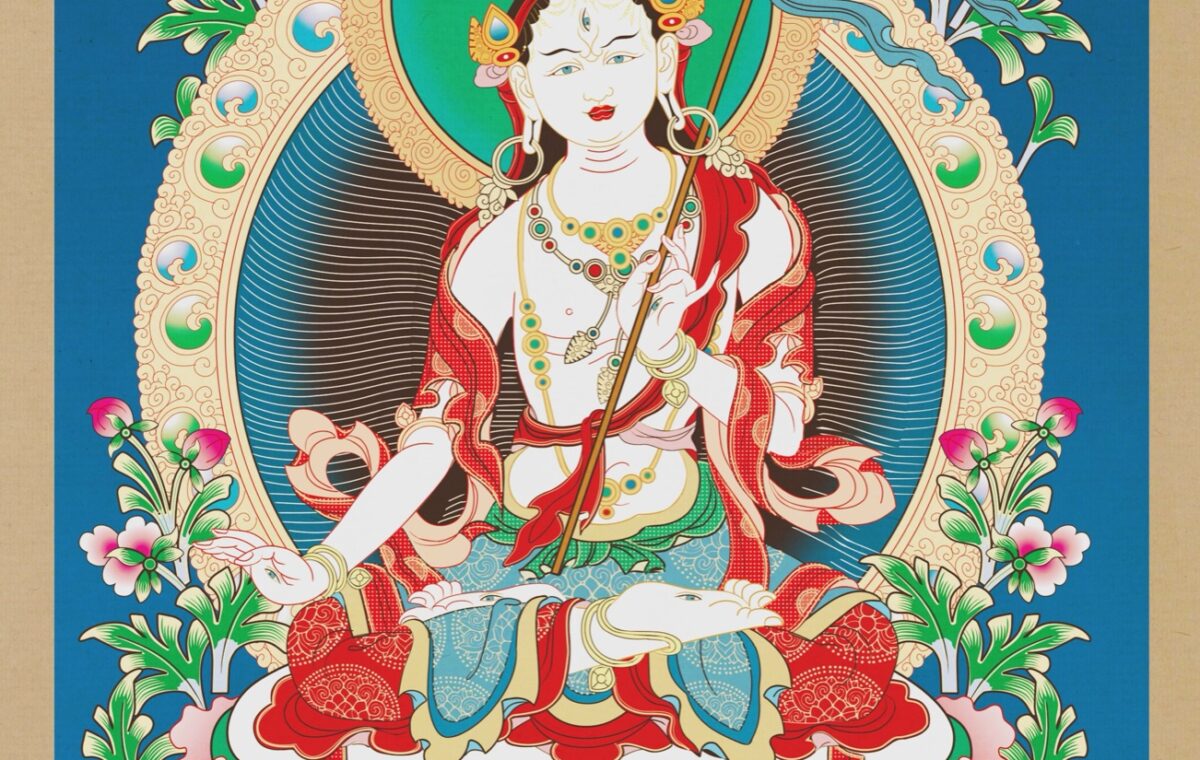
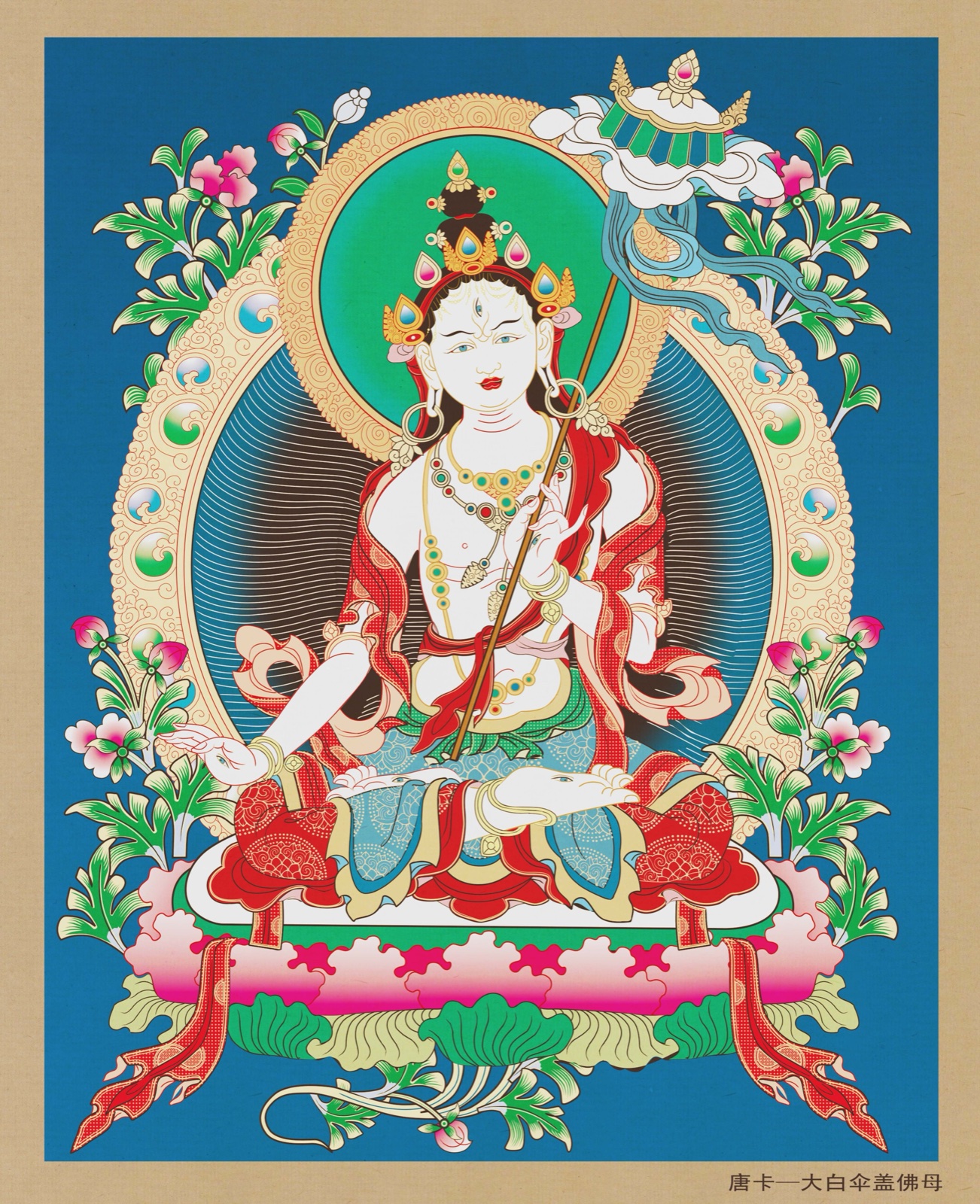
TK0461 shows one face and two arms. The body is white, the expression is peaceful, and the figure sits in a stable meditation posture. The left hand holds the long shaft of a white parasol that opens above and to the side of her head. The other hand extends outward near a wheel-like attribute or gesture. Jewelry, a crown, silk garments, and a lotus throne place her within the visual language of peaceful female deities.
This simple form is important because many readers expect Sitatapatra to have a thousand arms. A two-armed depiction is not automatically a mistake or a simplified modern invention. Iconographic traditions include one-faced, two-handed forms as well as complex universal forms. The specific configuration should be described before a lineage is proposed.
The white parasol as the decisive attribute
The parasol’s canopy is broad and pale, with a jewel-like finial and hanging sections. It rises from a staff held by the deity rather than floating independently over a throne. This direct physical relationship strengthens the identification. A parasol carried by an attendant over an Arhat or teacher would have a different function.
Readers should also distinguish a parasol from a victory banner. Vaishravana commonly holds a tall banner with a decorated top and streaming fabric. Sitatapatra’s object opens into an umbrella canopy. Looking at the silhouette before interpreting small ornament is often the quickest way to tell them apart.
Wheel gesture, seat, and peaceful appearance
Descriptions of two-armed Sitatapatra forms often mention a wheel gesture or wheel in the right hand and the white umbrella in the left. In TK0461 the outward hand and wheel-like element deserve close viewing. Because hand-held objects can overlap with textiles and the throne, a catalogue should avoid claiming a precise object if the reproduction does not resolve it.
The figure sits on a lotus with the legs folded. Her white body, three eyes, crown, and jewelry suggest a deity who is peaceful yet powerful. White Tara is another white female figure, but she normally displays seven eyes and lotus attributes rather than a large parasol. Our White Tara guide explains those differences.
How the universal form changes the image
Complex forms of Sitatapatra multiply faces, arms, legs, and eyes on a vast scale. The many faces can be arranged in colored tiers, while hands hold wheels, arrows, vajras, lotuses, swords, lassos, hooks, and other implements. Numerous feet trample obstacles. A great parasol still marks the identity, but the composition communicates all-direction protection rather than the intimate calm of a two-armed figure.
This multiplication may remind readers of Thousand-Armed Avalokiteshvara. The two are not interchangeable. Avalokiteshvara is identified through compassion imagery, stacked heads, eye-marked palms, and characteristic central hands. Sitatapatra’s white parasol and her own textual configurations direct the reading. Compare the Thousand-Armed Avalokiteshvara guide.
Sitatapatra versus common look-alikes
Versus White Tara
White Tara normally has seven eyes—on the face, palms, and soles—and holds lotuses. Sitatapatra centers the white parasol and can appear in simple or universal forms.
Versus Ushnishavijaya
Ushnishavijaya is another white female longevity deity, commonly shown with three faces and eight arms. Her vases, Buddha image, and multiple hands differ from the two-armed parasol form.
Versus an umbrella-bearing attendant
In Arhat sets an attendant may carry a parasol. The attendant is subordinate within a narrative group, whereas Sitatapatra is the central enthroned deity and holds the parasol as her defining attribute.
Practical identification checklist
- Confirm that the central figure directly holds a white parasol.
- Record whether the image has one face and two arms or a universal multiplied form.
- Check for a white body, peaceful or slightly wrathful expression, crown, and jewelry.
- Look for a wheel gesture or wheel attribute in the other hand.
- Distinguish the umbrella canopy from Vaishravana’s victory banner.
- Compare eye placement and lotus attributes before naming White Tara.
- Leave exact lineage, artist, date, and provenance uncertain without documentation.
How to record the archive image
An evidence-based description of TK0461 could read: “White, one-faced, two-armed female deity seated on a lotus, holding a white parasol and extending the other hand near a wheel-like attribute.” The archive title identifies her as Sitatapatra. The visible form agrees with that name, but the exact ritual lineage and production history are not established by the file alone.
This layered method—observation, identification, then uncertainty—works across the collection. Our guide to reading a Thangka provides a repeatable sequence for central figures, gestures, attributes, attendants, and inscriptions.
Conclusion
The white parasol is the anchor for identifying Sitatapatra, but the form must still be described carefully. TK0461 presents a peaceful two-armed version, not the famous thousand-armed universal form. Recognizing both possibilities prevents false rejection and helps readers see how one protective deity can be visualized as either serene shelter or all-direction activity.
Sources and further reading
- Himalayan Art Resources: comparative records for Sitatapatra
- Rubin Museum of Himalayan Art: Sitatapatra (object record)
These references support comparative iconographic study. The TANGKAWORLD TK number is an internal catalogue identifier; artist, date, collection history, and provenance remain uncertain unless separately documented.
Download the full Thangka image collection
Continue exploring and download the complete TANGKAWORLD image library through our Thangka image collection.