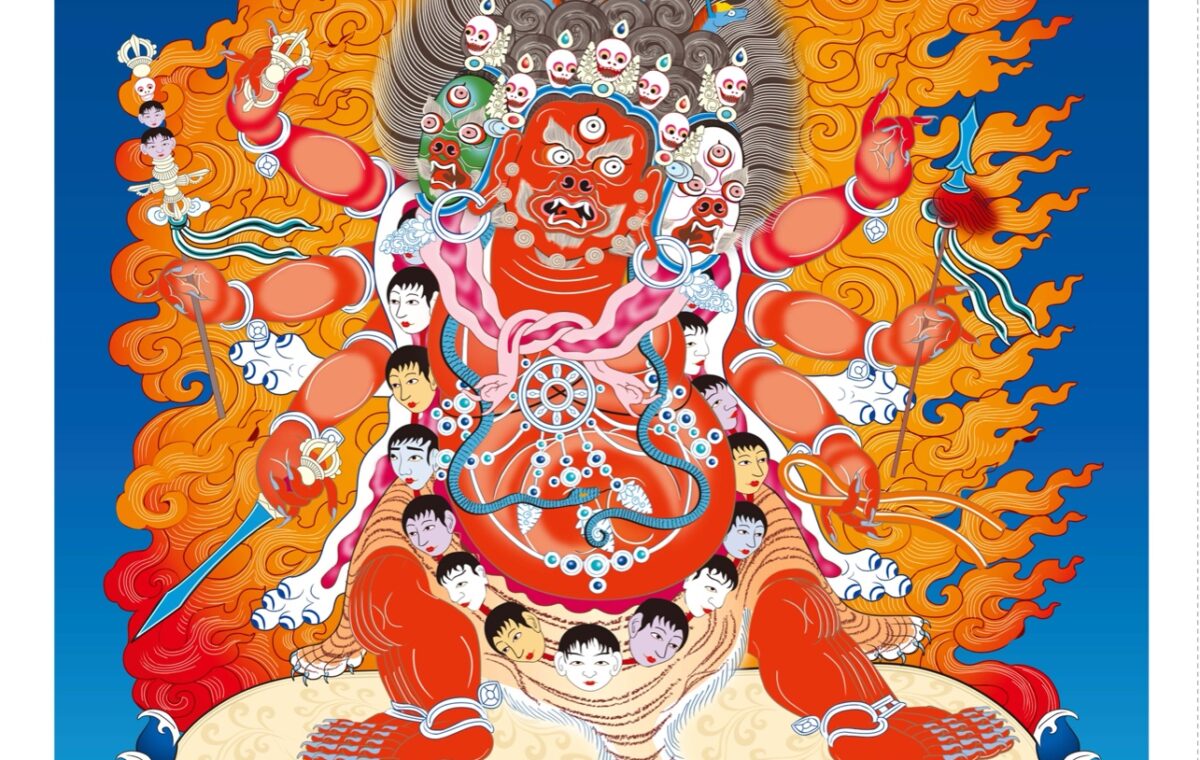
A Hayagriva thangka is best identified from the top down. Above one or more wrathful human faces appear small horse heads, the feature expressed by the Sanskrit name Hayagriva, “Horse Neck.” Below them spread glaring eyes, fangs, skull ornaments, multiple arms, animal skins, flames, and a forceful stance. The horse heads are more diagnostic than the red body or wrathful mood, both of which are shared by many tantric deities.
Who is Hayagriva in Buddhist art?
Hayagriva is a wrathful Buddhist meditation deity associated with the Padma, or Lotus, family and with traditions connected to Amitabha and Avalokiteshvara. He appears in several major forms. A simple form may have one face and two arms, while complex forms can have three faces, six arms, and multiple legs. Some compositions merge Hayagriva with other figures or place him within a larger mandala.
Because the configurations differ, the general name “Hayagriva” may be secure while the exact practice lineage remains uncertain. The correct sequence is to identify the horse-head feature, describe the physical configuration, and only then compare it with documented lineage forms.
The horse heads are the essential clue
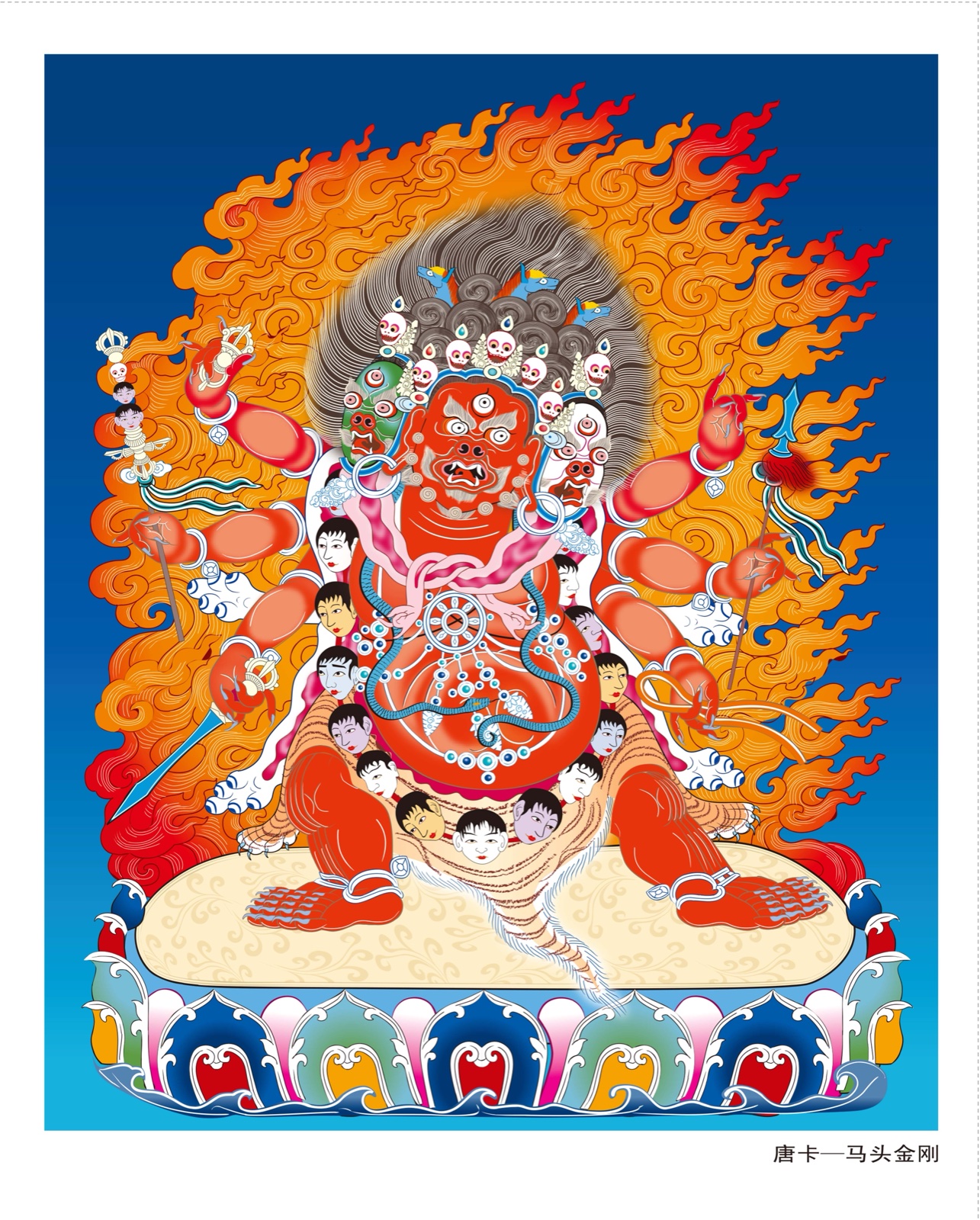
In TK0539 small horse heads rise from the upward-flowing hair above the wrathful faces. Their long muzzles and pointed ears distinguish them from skulls, birds, or flames. Depending on the form, a painting may show one horse head or three. The horse feature is placed above the principal face rather than replacing it.
This placement separates Hayagriva from Simhamukha. Simhamukha’s main face is a lion face on a female dakini body. Hayagriva has human-like wrathful faces with horse heads at the crest. Compare the structure in our Simhamukha thangka guide.
Red body, three faces, and six arms
The central body in TK0539 is red. Additional faces flank the principal face, and each displays three glaring eyes. Multiple arms extend to both sides. This configuration is consistent with a complex Hayagriva form, but the exact number of legs and every implement should be checked against the full-resolution image before assigning a named ritual cycle.
Hands appear to carry a vajra, sword, trident or spear-like objects, and other wrathful implements. Textual descriptions of complex Hayagriva forms can include a khatvanga, lasso, sword, spear, or elephant hide. A painting does not need to match one generalized list, because traditions vary. Catalogue the objects actually visible rather than adding expected ones.
Skulls, skins, snakes, and flames
The figure wears a crown of skulls, a long garland of heads, and a tiger-skin lower garment. Snakes and bone-like ornaments cross the body. The hair rises like fire, and an orange flame aureole encloses the entire form. These elements establish the wrathful tantric environment.
Such imagery symbolizes the transformation of poisons, obstacles, and fear. The trampled figures and fierce implements should not be read as a simple scene of violence. In Buddhist iconography, terrifying appearance can serve compassionate activity by dramatizing the force required to overcome destructive states.
Hayagriva and the Padma family
Hayagriva’s association with the Lotus Buddha family connects him iconographically and doctrinally with Amitabha and Avalokiteshvara. That does not make every red wrathful deity Hayagriva. The horse head remains necessary. The family context is most useful when peaceful figures or lineage deities appear above the central form.
Avalokiteshvara is typically peaceful and carries lotuses, a vase, prayer beads, or other compassion-related attributes depending on the form. Hayagriva embodies wrathful activity. Our Four-Armed Avalokiteshvara guide provides a clear peaceful contrast.
Hayagriva versus common look-alikes
Versus Vajrapani
Wrathful Vajrapani is often blue, holds a vajra, and stands inside flames. He does not normally carry horse heads above the face. See the Vajrapani identification guide.
Versus Vajrakilaya
Vajrakilaya may have three faces and six arms, but the ritual dagger or phurba defines the composition, often shaping the lower body. Horse heads instead direct the reading toward Hayagriva.
Versus Simhamukha
Simhamukha has a lion face as the central face and a female body. Hayagriva is male, with human wrathful faces topped by one or more small horse heads.
Practical Hayagriva identification checklist
- Inspect the crest for one or more clearly shaped horse heads.
- Determine whether the main body is male and wrathful.
- Record body color, number of faces, arms, and legs.
- Map each visible implement without filling gaps from expectation.
- Look for skull crown, head garland, tiger skin, snakes, and flames.
- Compare Vajrapani, Vajrakilaya, and Simhamukha before finalizing the name.
- Leave the exact practice lineage uncertain unless inscriptions or records confirm it.
Reading TK0539 without overclaiming
The archive label calls TK0539 Hayagriva, and the visible horse heads strongly support that identification. The painting appears to show a complex red, multi-faced, multi-armed form. However, the file does not provide verified information about the artist, date, workshop, geographic origin, or ritual lineage. Those fields should remain uncertain.
A precise visual description can still be valuable: “Red wrathful Hayagriva with multiple faces and arms, three horse heads above the crest, skull ornaments, head garland, tiger skin, ritual implements, and flame aureole.” This is more useful than an unsupported historical attribution because it tells future researchers exactly what was observed.
Why close comparison matters
Wrathful deities share a vocabulary deliberately. Flames, skulls, trampling, animal skins, and weapons establish enlightened activity, but do not function like unique name tags. Identification becomes reliable only when a deity-specific feature—here, the horse heads—is combined with body configuration and context. For another example of a distinctive central attribute, study the phurba in the Vajrakilaya guide.
Conclusion
Begin a Hayagriva identification at the crest: find the horse head or heads, then describe faces, arms, implements, color, ornaments, and stance. The red body and flames support the reading but do not decide it. TK0539 is convincingly Hayagriva at the general level, while its exact lineage and production history remain uncertain.
Sources and further reading
- Himalayan Art Resources: comparative records for Hayagriva
- Rubin Museum of Himalayan Art: Hayagriva (object record)
These references support comparative iconographic study. The TANGKAWORLD TK number is an internal catalogue identifier; artist, date, collection history, and provenance remain uncertain unless separately documented.
Download the full Thangka image collection
Continue exploring and download the complete TANGKAWORLD image library through our Thangka image collection.