
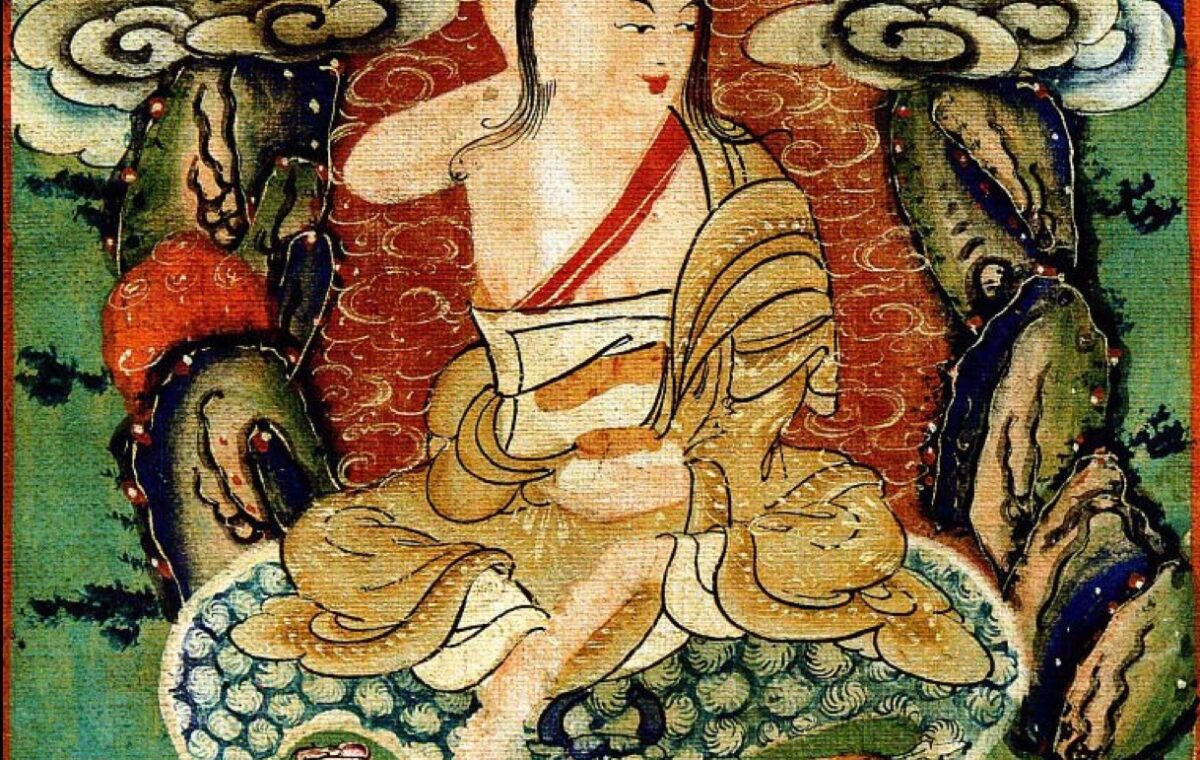
A Milarepa thangka can often be recognized without a crown, halo of flames, or ritual weapon. The key is a human gesture: the Tibetan yogi raises one hand and cups it beside his ear as if listening to or projecting a song. A white cotton robe, bare or thin body, mountain cave, deer, hunter, and disciples may reinforce the identification. Because later yogis sometimes imitate the same ascetic appearance, the complete composition still needs to be read carefully.
Who was Milarepa?
Milarepa is remembered as a Tibetan yogi, poet, and teacher associated with the Kagyu transmission. Accounts of his life emphasize intense practice in mountain retreats and songs that communicate realization in direct, memorable language. In art he appears as an individual religious teacher rather than as a Buddha or bodhisattva with a standardized set of supernatural limbs.
His human biography gives painters a different vocabulary: robe, posture, body, cave, students, animals, and narrative episodes. These elements make Milarepa paintings valuable for studying how sacred biography and iconographic recognition overlap.
The hand cupped to the ear
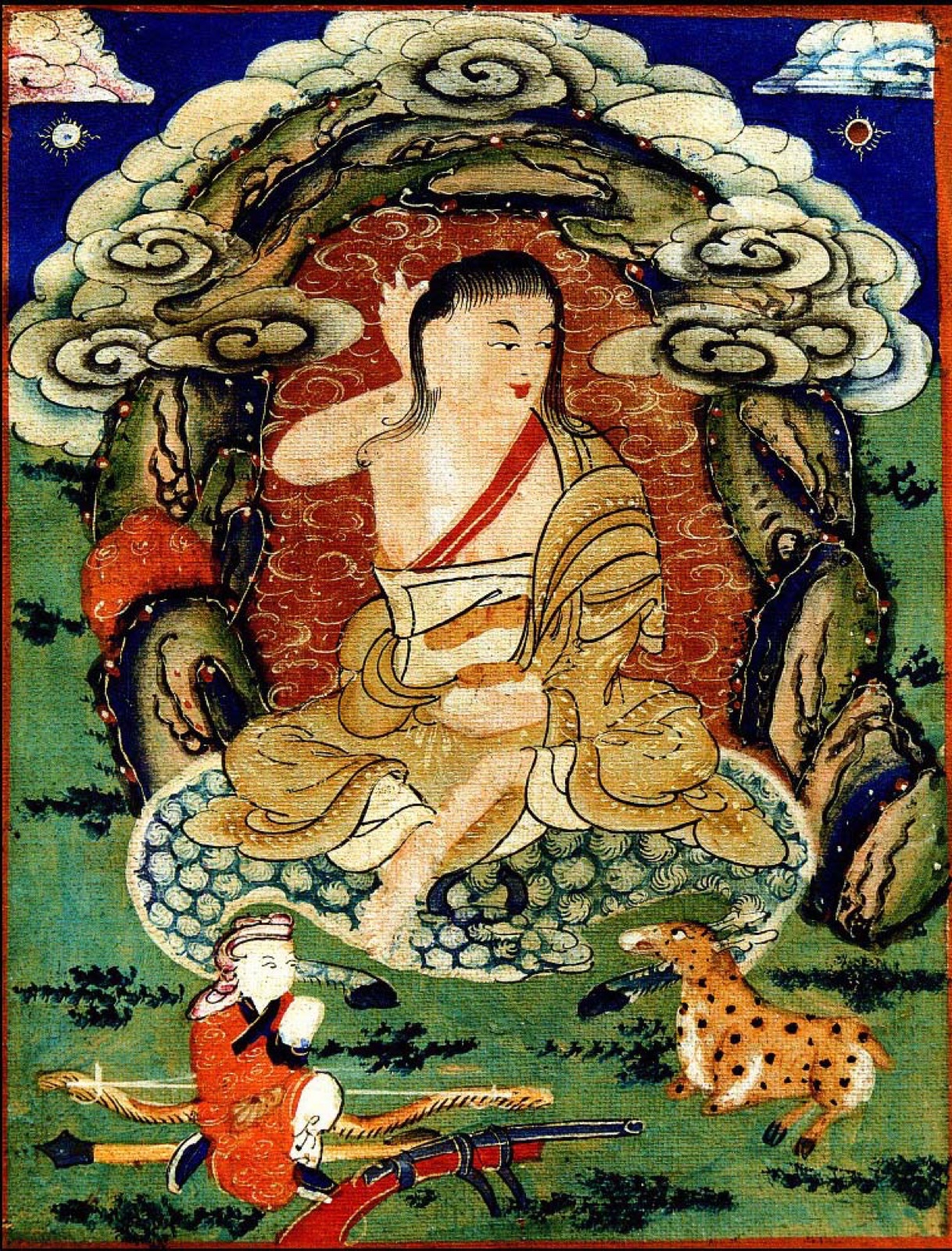
Milarepa’s best-known visual attribute is a hand raised beside the ear, palm cupped outward. The gesture is commonly interpreted as the pose of singing or listening to the resonance of his songs. In TK0593 the raised hand sits clearly beside the head, while the other hand rests nearer the lap.
The side can vary in paintings and sculpture, so readers should not reject an image merely because the left rather than right hand is raised. Direction may be reversed by artistic convention, copying, or composition. The cupped shape and singer’s context matter more than rigid handedness.
White cotton robe and ascetic body
Milarepa is often called the cotton-clad yogi. A light white robe wraps around the body, sometimes leaving a shoulder or much of the torso bare. The figure may look thin, with long hair rather than a shaved monastic head. He is frequently barefoot and sits in a relaxed posture rather than the perfectly symmetrical lotus pose of a Buddha.
TK0593 shows a pale, lightly clothed ascetic seated on a patterned cushion before a rocky cave. The simplicity of dress distinguishes him from crowned bodhisattvas and richly robed lamas. Yet other Kagyu yogis may also wear white cotton, so the hand-to-ear gesture and narrative setting remain essential.
Cave, mountains, and the retreat landscape
A rocky opening frames the teacher from behind. Clouds gather around the mountain, and a sun and moon appear in the sky. Landscape is not neutral decoration. It locates the figure within a world of retreat, solitude, and direct encounter with the natural environment.
When cataloguing a teacher portrait, readers should ask whether the landscape contains biographical clues. A cave may point to Milarepa’s retreat life; a monastery throne might instead emphasize institutional authority. Trees, peaks, rivers, animals, and weather can carry narrative meaning even when no inscription survives.
The deer and hunter narrative
Below Milarepa in TK0593 a spotted deer stands near a kneeling or seated hunter with bow and arrows. This is not a generic pastoral scene. Milarepa life-story paintings often include an encounter involving a hunted deer and a hunter, using the narrative to show the transformative force of the yogi’s teaching or song.
The deer helps connect the central portrait to biography, while the bow and arrows explain the human figure’s role. Without that relationship, the lower figure might be misread as a donor or attendant. Narrative identification depends on reading actions and objects across the composition, not isolating each figure.
Milarepa versus similar teachers
Versus Padmasambhava
Padmasambhava wears a lotus hat and holds a vajra and skull cup, with a khatvanga staff at the shoulder. Milarepa has the cotton robe and singer’s gesture. See our Padmasambhava guide.
Versus a generic Kagyu yogi
Other yogis may wear white cotton and sit in caves. Milarepa is strengthened by the cupped hand, thin body, biographical deer-hunter scene, and possible presence of known students.
Versus an Arhat
Arhats are commonly shown as monastic elders in landscapes, often with attendants and individual attributes. Their robes, facial type, and set structure differ from Milarepa’s ascetic singer identity. Compare our Arhat paintings guide.
Practical Milarepa identification checklist
- Look for a hand cupped beside the ear in a singer’s gesture.
- Check for a single white cotton robe and a lean, barefoot yogi body.
- Observe a relaxed seated posture rather than a formal Buddha pose.
- Search the landscape for a mountain cave or retreat setting.
- Identify deer, hunter, bow, or other life-story scenes.
- Compare nearby disciples, lamas, or lineage figures if present.
- Keep artist, date, and collection history uncertain without verified documentation.
How to handle the Yonghe Temple archive label
The bilingual filename associates TK0593 with Yonghe Temple in Beijing. That label is a research lead, not sufficient proof of present ownership, display location, or catalogue status. A current institutional record, accession number, or direct collection confirmation would be needed before presenting the association as verified provenance.
A responsible caption can say: “Milarepa with singer’s gesture, cave, deer, and hunter; local archive label mentions Yonghe Temple; current collection status, artist, and date uncertain.” This preserves the useful clue while preventing a local filename from becoming an unsupported public claim.
Why teacher portraits require a different reading method
Deity identification often begins with color, arms, and ritual implements. Teacher portraits rely more on physiognomy, dress, gesture, lineage, and biography. The same disciplined sequence still applies: observe first, compare second, and document uncertainty last. Our beginner’s Thangka reading guide can be adapted by treating narrative scenes as attributes distributed across the landscape.
Milarepa also connects naturally to Vajradhara within Kagyu lineage imagery, but a lineage relationship should not be invented when surrounding figures are absent. For the peaceful blue source figure commonly shown at the head of such lineages, see the Vajradhara thangka guide.
Conclusion
The hand cupped to the ear is the fastest route to Milarepa, but the best identification combines gesture, white cotton robe, ascetic body, cave setting, and biographical narrative. TK0593 includes a deer and hunter that deepen the reading beyond portraiture. Its subject is visually persuasive, while its artist, date, and Yonghe Temple association remain uncertain pending documentation.
Sources and further reading
- Himalayan Art Resources: comparative records for Milarepa
- Rubin Museum of Himalayan Art: Milarepa and scenes from his life (object record)
These references support comparative iconographic study. The TANGKAWORLD TK number is an internal catalogue identifier; artist, date, collection history, and provenance remain uncertain unless separately documented.
Download the full Thangka image collection
Continue exploring and download the complete TANGKAWORLD image library through our Thangka image collection.