
The Four Heavenly Kings in Buddhist art are a coordinated group of armored guardians rather than four interchangeable warrior figures. Each protects a cardinal direction, and together they mark the boundary between an ordered sacred realm and the dangers outside it. They appear at temple entrances, beside Shakyamuni Buddha and the Arhats, and at the gates or outer zones of some Mandala compositions. Their stern faces and weapons can look wrathful, but their role is protective: they defend the Buddhist teachings and the community that preserves them.
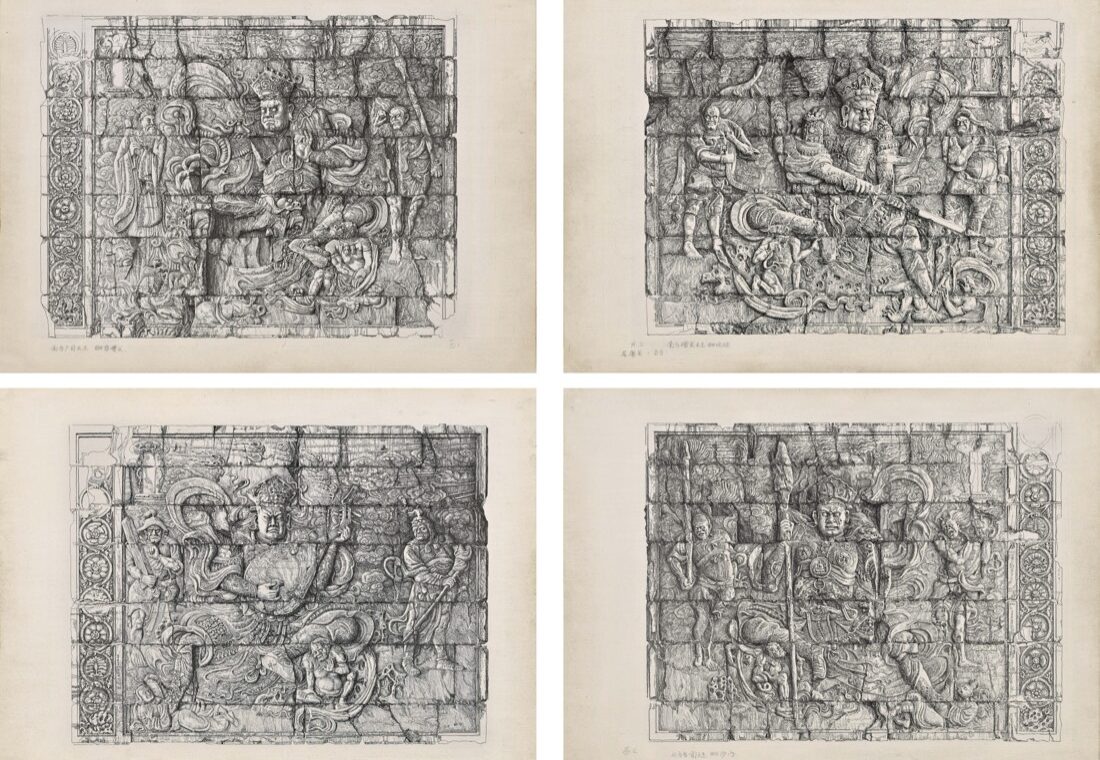
This guide explains how to recognize the group, how the four names and directions fit together, and why attributes must be read cautiously across regions. It also uses TANGKAWORLD image TK1210 as a visual case study. The file records four guardian relief compositions in a monochrome drawing or rubbing-like format. Its precise site, date, artist, and original publication source are uncertain, so the image is useful for visual comparison rather than firm provenance claims.
Who are the Four Heavenly Kings?
The group is also called the Four Guardian Kings, Four Direction Kings, or Lokapalas. In Himalayan Buddhist art, the standard directional sequence is Dhritarashtra in the east, Virudhaka in the south, Virupaksha in the west, and Vaishravana in the north. Himalayan Art Resources notes that the same four figures can appear under several English names and that they are frequently shown with Shakyamuni Buddha and the Sixteen Arhats.
Their placement helps explain their meaning. A guardian at a doorway does more than frighten hostile beings: he announces that the viewer is crossing into protected ritual space. A set placed around a central image makes the cardinal directions visible. In a Mandala, guardians may occupy doors or peripheral positions, reinforcing the ordered geometry described in our guide to Mandala structure.
The four directions, names, and common clues
Names are more dependable than modern color charts, but even names may be transliterated differently. The chart below gives a practical starting point for Tibetan and Himalayan contexts. It is not a universal key for every Chinese, Korean, Japanese, or Central Asian image.
| Direction | Guardian | Common visual clues |
|---|---|---|
| East | Dhritarashtra | Armored king; a stringed instrument is frequent in East Asian and Himalayan-derived sets. |
| South | Virudhaka | Armored king; a sword is a common identifying attribute. |
| West | Virupaksha | Armored king; a serpent and small stupa can identify him in Tibetan iconography. |
| North | Vaishravana | Armored king; banner, stupa, umbrella, spear, or mongoose may appear according to context and tradition. |
Dhritarashtra, guardian of the east
Dhritarashtra is associated with the eastern direction. A lute or another stringed instrument is a familiar clue in many later sets, yet it should not be treated as an absolute rule. Museum catalogues sometimes preserve inscriptions that disagree with later identifications. When an image lacks a readable label, compare the complete quartet before naming one figure.
Virudhaka, guardian of the south
Virudhaka commonly carries a sword. Look for a military stance, layered armor, and the weapon’s placement across or beside the body. A sword by itself does not prove the identification, because numerous protectors carry blades. The directional set, companion figures, and architectural location supply the stronger evidence.
Virupaksha, guardian of the west
Virupaksha is the western guardian and is linked with naga beings in Tibetan visual traditions. Himalayan Art Resources lists the stupa and snake among his characteristic attributes. A curling serpent is especially useful when the other kings are present, but damaged reliefs and cropped paintings may conceal it.
Vaishravana, guardian of the north
Vaishravana is both the northern king and an important protector with a wider independent iconography. In a quartet, he may differ from the wealth-and-protection forms seen in a dedicated Vaishravana Thangka. The British Museum records variations that include a spear and miniature pagoda, while Tibetan forms may emphasize a victory banner, mongoose, umbrella, stupa, or other royal attribute. Context determines which clue matters.
How to read armor, posture, and setting
Begin with the group before examining hand-held objects. Four related warriors arranged around a doorway, altar, central Buddha, or sacred diagram are more likely to be the Four Heavenly Kings than four unrelated protectors. The Metropolitan Museum of Art describes Japanese examples as armored generals with fierce expressions, often standing over subdued demons. Himalayan examples likewise use heavy layered garments and royal or military dress, although some Tibetan sets adopt a more peaceful deity appearance.
Armor communicates vigilance and worldly authority. Bulging eyes, raised brows, mustaches, windblown scarves, and dynamic legs create alertness rather than uncontrolled rage. Figures beneath their feet can symbolize the defeat of obstacles or enemies of the teachings. Do not confuse every trampling guardian with Mahakala, Palden Lhamo, or Vajrapani. Those figures have their own body colors, implements, vehicles, attendants, and ritual contexts; compare our Six-Armed Mahakala guide and Vajrapani identification guide when the composition is uncertain.
What TK1210 shows—and what remains uncertain
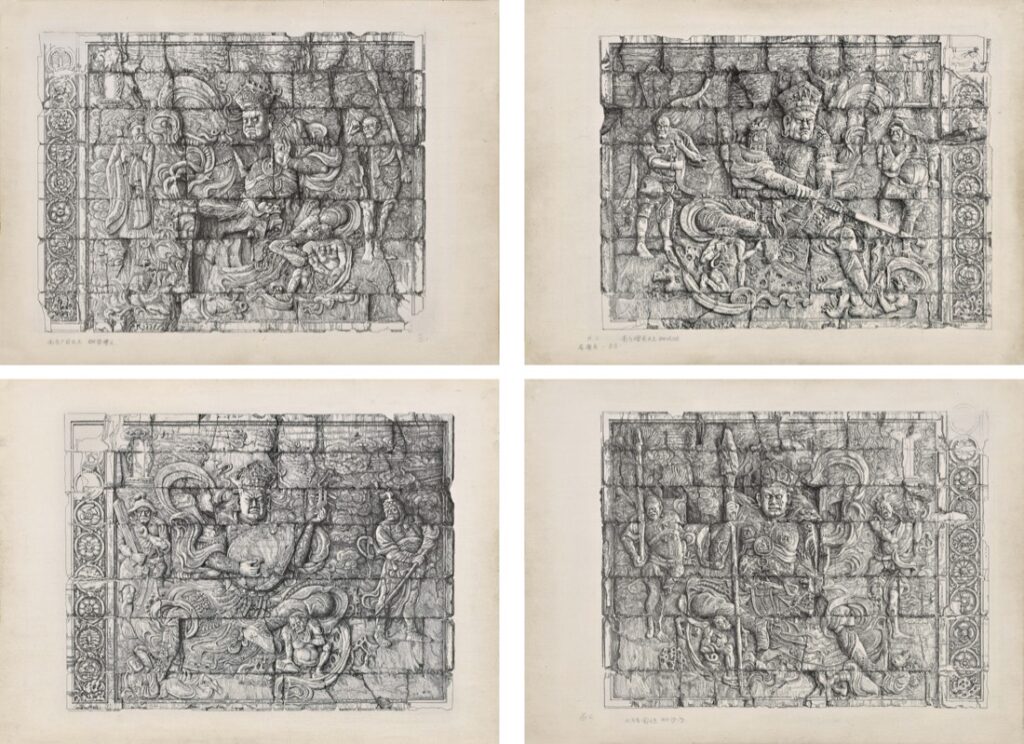
TK1210 presents four rectangular relief scenes as a single two-by-two image. Each panel centers on a large armored guardian surrounded by smaller attendants, clouds, decorative borders, and figures underfoot. A prominent sword is visible in the upper-right panel. Other objects are less secure at web scale, and the surviving linework is dense. The four-part organization strongly supports the catalog title “Four Heavenly Kings,” but the image alone does not justify assigning every panel to a named direction.
The medium also deserves careful language. The visible sheet looks like a drawing, rubbing, or printed record made from sculptural reliefs; it is not a conventional painted Thangka. TANGKAWORLD retains it because comparative material helps readers recognize guardian types across media. Without documentary metadata, its exact temple, archaeological site, period, and maker remain uncertain. Those limits should stay attached to the image whenever it is reused.
Regional variation changes the attributes
The Four Heavenly Kings traveled through multiple Buddhist cultures, and local conventions changed their colors, weapons, names, and temple placement. Tibetan and Himalayan works often follow Chinese or Central Asian “king appearance,” with boots, armor, layered textiles, and courtly authority. Chinese, Korean, and Japanese works may emphasize different instruments, jewels, pagodas, dragons, or weapons. Japanese names such as Jikokuten, Zochoten, Komokuten, and Tamonten refer to the same directional framework but belong to a different linguistic and artistic setting.
This is why a checklist is safer than a single-symbol lookup. The British Museum’s catalogue for a Korean guardian painting discusses conflicting directional inscriptions and identifications, a useful reminder that historic labels, later cataloguing, and actual attributes do not always align. Treat color as supporting evidence, not the first test. Read the set, direction, medium, inscription, and provenance together.
Four Heavenly Kings identification checklist
- Count the figures: Is there a coherent set of four related armored guardians?
- Check placement: Are they at cardinal points, temple entrances, around Shakyamuni, near Arhats, or at Mandala gates?
- Read the attributes: Look for a stringed instrument, sword, serpent with stupa, and Vaishravana’s variable royal or wealth symbols.
- Compare costumes: Heavy armor, boots, crowns or helmets, scarves, and stern expressions support “king appearance.”
- Separate group and individual forms: Vaishravana in a quartet may not match a standalone wealth deity composition.
- Use inscriptions carefully: Record original labels, transliterations, and later museum identifications separately.
- Verify the medium: A painting, sculpture, mural, rubbing, or relief record may preserve the same iconographic group.
- Mark gaps honestly: If date, school, artist, site, or a guardian’s exact identity cannot be demonstrated, write “uncertain.”
How the group fits a wider Thangka study
For a beginner, the Four Heavenly Kings are an excellent lesson in reading composition before detail. Our beginner’s guide to reading a Thangka explains the same sequence: identify the central hierarchy, locate directional figures, then test attributes. Guardian sets also connect iconography with architecture. They show that a Buddhist image can map space, define thresholds, and guide movement—not merely portray a named deity.
When cataloguing, create separate fields for group title, individual names, directions, visible objects, inscription, medium, date, place, and source. Avoid turning a probable identification into a fact. This method protects future research from circular copying and makes it easier to compare paintings with murals, reliefs, and museum records.
Conclusion
The most reliable way to recognize the Four Heavenly Kings in Buddhist art is to combine four kinds of evidence: a coordinated quartet, cardinal placement, armored guardian appearance, and a complementary set of attributes. Dhritarashtra, Virudhaka, Virupaksha, and Vaishravana form one protective system, but their visual details vary across regions and periods. TK1210 clearly preserves a four-guardian composition; its exact panel order and provenance remain uncertain. Reading those certainties and uncertainties separately produces a stronger identification than matching one weapon or color.
Research references
- Himalayan Art Resources: Four Guardian Kings — names, directions, contexts, and Himalayan visual forms.
- The Metropolitan Museum of Art: One of the Four Heavenly Kings — temple guardianship, armor, and directional protection.
- British Museum: Korean Guardian-King painting — a museum example of attribute and inscription complexity.
- Himalayan Art Resources: Virupaksha — western direction, naga association, stupa, and snake.
Download the full Thangka image collection
Continue exploring guardian figures, deities, Mandalas, and comparative Buddhist art in the complete TANGKAWORLD gallery. Browse and download the full Thangka image collection for further visual study.