
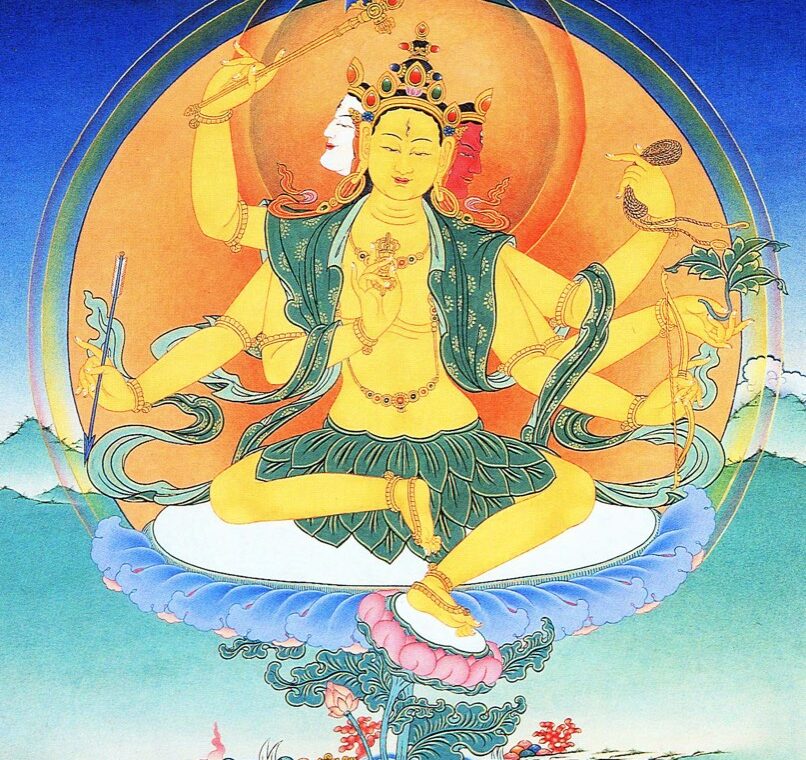
A Parnashavari Thangka can be recognized through an unusual combination of forest imagery and precise tantric iconography. The goddess is typically yellow, has three faces and six arms, and wears a skirt made from fresh leaves. Her hands carry a group of attributes that may include a vajra, axe, arrow, lasso, leafy branch, and bow. Together, these signs distinguish the leaf-clad goddess from Tara, Prajnaparamita, Sitatapatra, and other female figures in Himalayan Buddhist art.
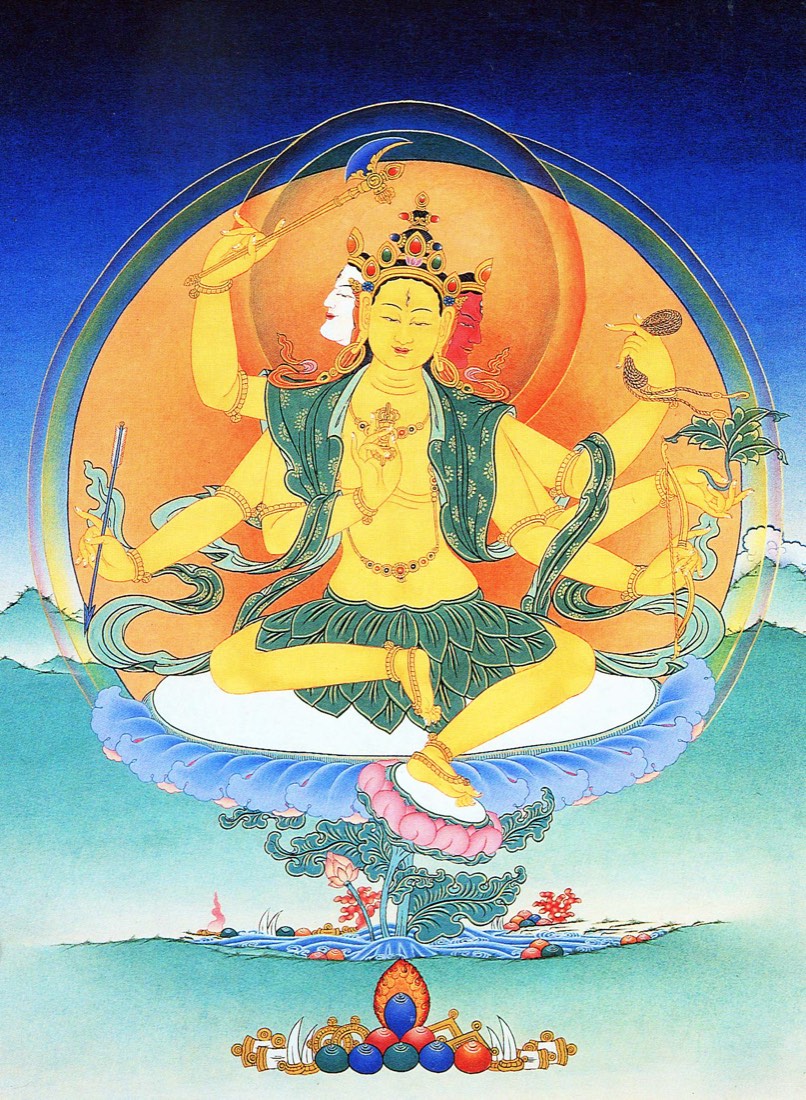
TANGKAWORLD image TK0405 provides a particularly clear view of these features. This guide explains how to read the faces, hands, leaf garment, posture, and ritual tools without treating every small detail as certain. It also places Parnashavari’s healing associations in their religious and art-historical context rather than presenting the image as a substitute for modern medical care.
Who is Parnashavari?
Parnashavari is a female tantric deity associated with forests, healing practice, protection from contagious illness, and the suppression of epidemics. Her name is often translated in relation to leaves, and museum descriptions also call her the Forest Goddess or Leaf-Clad Goddess. The Rubin Museum connects her to the Shavari people of ancient India and describes her as an example of a folk deity incorporated into Tantric Buddhism.
Start with the three faces
The central yellow face
In TK0405, the principal face is yellow and looks directly outward. A vertical third eye appears above the brows. The expression is composed rather than openly fierce. This matters because Parnashavari is not normally identified by an exaggerated wrathful face alone; textual descriptions can present the main face as smiling yet slightly wrathful.
The white and red side faces
A white face turns toward the viewer’s left, while a red face turns toward the viewer’s right. Their presence immediately narrows the identification. Himalayan Art Resources records a widely represented yellow form with three faces and six hands, but it also documents variations in how side-face colors and expressions are described. A cataloger should record what is visible in the individual work before forcing it to match a single template.
The three faces should be read together with the six arms and leaf garment. Multiple faces occur in many tantric deities, so the count by itself is not sufficient evidence.
Read the six hands as an iconographic set
Vajra at the heart
One of Parnashavari’s hands holds a small vajra close to the chest. In TK0405, this central attribute is compact and can be missed at thumbnail size. Its position near the heart is more useful than color alone because it helps connect the figure to tantric ritual iconography.
Axe and arrow on the viewer’s left
The raised hand at the upper left of TK0405 holds an axe. Another left-side hand displays an arrow. These tools introduce active protective imagery. The arrow should be paired visually with the bow held on the opposite side; treating either object in isolation can lead to a mistaken identification.
Lasso, leafy branch, and bow on the viewer’s right
The upper right hand carries a looped cord or lasso. A lower hand presents a branch or fan of fresh leaves, and the lowest right hand holds a bow. The leafy attribute is especially important because it reinforces the garment and the deity’s forest identity. Published descriptions may refer to leaves bearing flowers or fruit, but the precise botanical species in TK0405 is uncertain and should not be guessed.
Small implements can be simplified by the painter, obscured by wear, or blurred in a reproduction. The safest method is to compare the complete six-object pattern, the three faces, and the foliage before assigning a name.
The leaf skirt is the decisive visual clue
Parnashavari’s most memorable attribute is the lower garment constructed from overlapping green leaves. In TK0405, the leaf skirt forms a dark green band around the hips, with pointed blades arranged in layers. A longer green scarf falls around the arms, but it is the skirt—not green textile alone—that makes the forest association specific.
This feature separates her from Green Tara, whose green body, lotus flowers, and two-armed form answer a different iconographic program. It also separates her from Prajnaparamita, usually identified through the wisdom text and lotus supports rather than a leaf garment.
Posture, halo, and surrounding space
TK0405 shows Parnashavari seated on a pale cushion above a lotus, with her legs arranged asymmetrically. One foot rests lower on a small lotus support. This active, off-center posture prevents the figure from appearing as a static meditation Buddha. Textual and visual traditions also include kneeling and standing variants, so posture should support an identification rather than function as an inflexible rule.
Parnashavari and Buddhist healing imagery
The Rubin Museum associates Parnashavari with healing practice, particularly the curing of contagious diseases and the suppression of epidemics. This gives the image historical significance when studying how Buddhist communities visualized protection during collective illness. Her leafy dress, active tools, and semi-wrathful aspect together communicate a form of healing protection rooted in ritual practice.
Her iconography should not be collapsed into that of Medicine Buddha. Medicine Buddha is commonly a blue monastic Buddha holding a bowl and medicinal plant. Parnashavari is a yellow, jeweled, three-faced, six-armed goddess in a leaf skirt. The search intentions are related but distinct: one concerns Bhaishajyaguru’s Buddha form, while the other concerns a forest goddess with a separate ritual history.
These religious traditions can be studied as art, history, and living practice. They do not replace diagnosis, vaccination, public-health measures, or treatment from qualified medical professionals.
How to distinguish common look-alikes
Parnashavari versus Green Tara
Green Tara normally has one face and two arms, holds lotus stems, and extends one leg in readiness. Parnashavari typically has three faces, six arms, yellow skin, multiple tools, and a skirt of leaves.
Parnashavari versus Sitatapatra
Sitatapatra is centered on the white parasol and may appear with many heads, eyes, and arms. Parnashavari’s identifying cluster is the leaf garment, three faces, six hands, and the vajra–axe–arrow–lasso–leaves–bow set.
Parnashavari versus Mahamayuri
Mahamayuri is another protective female deity, but peacock imagery is central to her identification. Parnashavari instead emphasizes foliage and forest dress. Protective function alone never proves that two deities are the same.
Parnashavari Thangka identification checklist
- Confirm the body color. A golden or yellow body supports the common yellow Parnashavari form, but color must be combined with other evidence.
- Count three faces and six arms. Record the visible colors and third eyes rather than assuming all variants are identical.
- Find the leaf skirt. Look for a garment made from distinct overlapping leaves, not merely green cloth.
- Match the attributes as a set. Check for a vajra, axe, arrow, lasso, leafy branch or fan, and bow.
- Study the posture. Note whether the figure is seated, kneeling, or standing and how the feet meet the seat.
- Separate observation from attribution. Iconography can support the subject name without proving an artist, date, region, school, or ritual lineage.
- Check a reliable record. Compare museum catalogues and specialist iconographic resources before publishing a detailed label.
What can be said safely about TK0405
The filename identifies Parnashavari, and the painting visibly shows a yellow female deity with three faces, six arms, a layered leaf skirt, vajra, axe, arrow, looped cord, leafy branch, and bow. These combined features strongly support the subject. The image is also sufficiently clear to document the posture, halo, lotus seat, and lower offerings.
The exact artist, date, workshop, school, geographic origin, patron, ritual lineage, materials, collection history, and provenance are uncertain. No readable inscription or verified institutional record accompanies the local file. Those gaps should remain explicit rather than being filled through resemblance to a museum object.
Sources and further reading
- Himalayan Art Resources: Parnashavari, yellow three-faced form, including attribute descriptions and documented variants.
- Rubin Museum: Forest Goddess Parnashavari, a catalogued comparison object with healing and leaf-garment context.
- How to Read a Thangka, for a broader method of combining posture, color, attributes, and written evidence.
Conclusion
A Parnashavari Thangka is best identified through a cluster of evidence: the yellow body, three differently colored faces, six arms, leaf skirt, vajra, axe, arrow, lasso, fresh foliage, and bow. TK0405 presents that cluster with unusual clarity. The image also shows why accurate cataloging requires restraint: the subject is well supported, while its maker, date, place, materials, and provenance remain uncertain.
Download the full Thangka image collection
Continue browsing and download the complete TANGKAWORLD image library on our Complete Collection page. The collection preserves English titles and TK numbers so you can compare Parnashavari, healing imagery, female deities, and related Buddhist art across the archive.