
A Buddha preaching assembly presents teaching as a communal event rather than an isolated portrait. The central Buddha may raise one or both hands, while monks, bodhisattva-like attendants, guardians, donors, and ritual objects form a visual audience. Reading this arrangement requires more than naming a mudra: scale, dress, gaze, halos, position, and documentary evidence all matter.
This guide offers a careful method for interpreting preaching scenes without assuming that every teaching gesture identifies the same Buddha or episode. It uses TANGKAWORLD image TK0225 as a case study while keeping its date, artist, school, individual figures, collection history, and provenance uncertain.
What is a Buddha preaching assembly?
A preaching assembly centers the act of transmitting Buddhist teaching. The Buddha occupies the dominant position, often seated on a lotus or elaborate throne and surrounded by figures who listen, protect, witness, or honor the event. The scene may refer to the first sermon at Sarnath, a discourse described in a sutra, a Pure Land assembly, or a more general vision of the Buddha teaching.
Those possibilities should not be collapsed into one story. The Metropolitan Museum of Art identifies a specific first-sermon sculpture from Sarnath through its gesture, setting, and inscription. An image lacking deer, a wheel, an inscription, or a reliable catalogue may still depict preaching, but the exact sermon remains uncertain.
Start with the central Buddha
Begin with observable features. Record whether the figure wears monastic robes or jewelry, sits cross-legged or on a chair, holds an object, and displays an urna, ushnisha, halo, or aureole. Note the position of each hand before assigning a Sanskrit name to the gesture. This neutral description prevents a familiar title from controlling the entire reading.
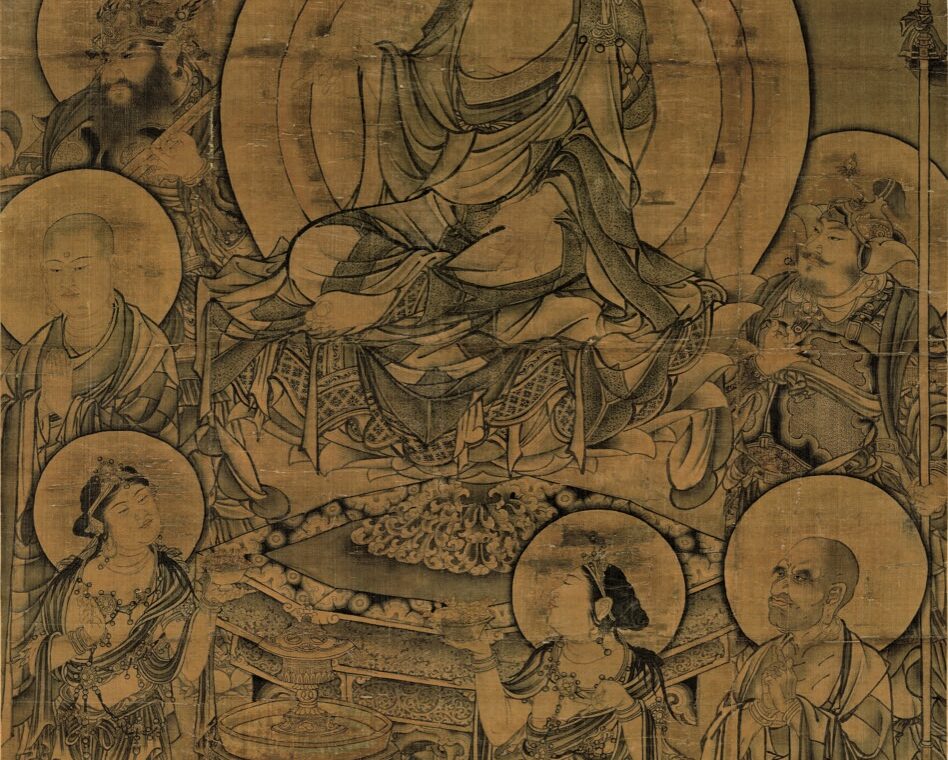
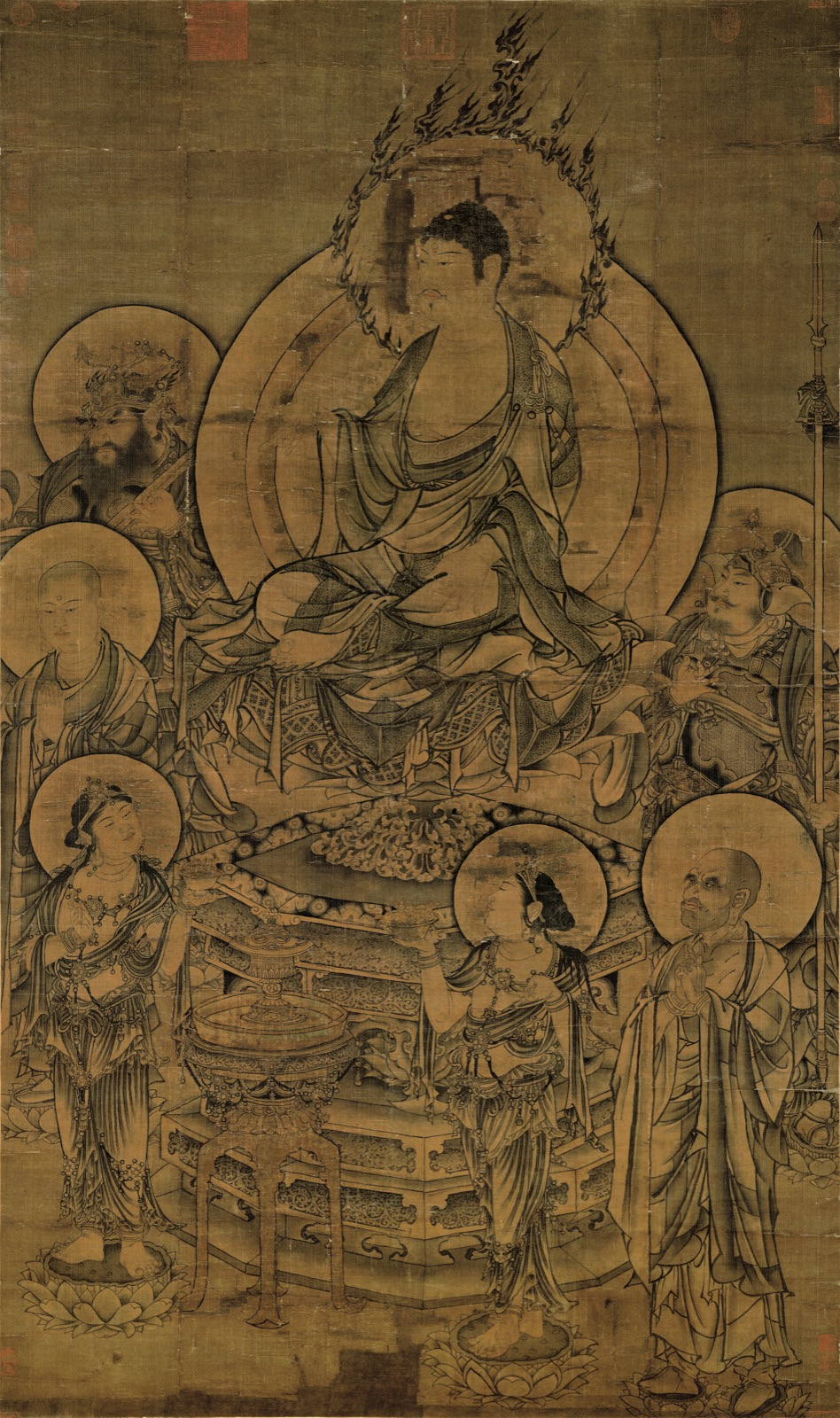
In TK0225 the central figure is monastically robed, seated, and much larger than the surrounding figures. A round halo and an outer flame-like aureole amplify the sacred center. The raised right hand supports a teaching interpretation, but the exact finger configuration is not clear enough in every reproduction to justify an absolute mudra label.
Teaching gestures: vitarka and dharmachakra
Vitarka mudra
Vitarka mudra is commonly associated with explanation, discussion, or exposition. One hand is usually raised, with the thumb and a finger joining or approaching each other while the other fingers extend. The Met describes an eighteenth-century Sri Lankan Buddha Preaching the Dharma as raising the right hand in vitarka mudra.
The circle made by the fingers may be tiny, damaged, hidden by paint loss, or softened by photography. If the contact point cannot be seen, write “raised teaching hand” instead of forcing the more specific term. A descriptive label remains useful and can be revised when a better image appears.
Dharmachakra mudra
Dharmachakra mudra evokes turning the wheel of the Dharma and is strongly associated with teaching. Both hands generally participate near the chest, although details vary. It often appears in representations of the first sermon. The Met’s Pala-period manuscript leaf shows a Buddha with both hands raised in this gesture and two attendant disciples.
Vitarka and dharmachakra should not be treated as interchangeable labels for any raised hand. Count the active hands, inspect the fingers, and compare securely identified objects. Gesture indicates activity, but surrounding figures, setting, inscriptions, and attributes are needed to identify the speaker or event.
How halos and scale establish hierarchy
The central Buddha in a preaching assembly is often much larger than attendants. This is hierarchical scale, not an attempt to describe literal body size. The large figure establishes doctrinal and visual importance, while smaller listeners define the teaching community around him.
Halos also organize status. A head halo isolates the face; a body aureole can frame the entire figure. Flames or radiating forms may indicate sacred energy, but they do not by themselves identify a particular Buddha. In TK0225, overlapping circular halos help separate monks, jeweled attendants, and the central figure within a dense composition.
Read the audience by dress and position
Monastic figures
Shaved heads and layered robes commonly mark monks or Arhats. Their location near the Buddha may suggest discipleship, but a name such as Ananda or Kashyapa requires additional evidence. Facial age, gesture, and placement can support a hypothesis without proving it. Our guide to Arhats in Buddhist art explains how individualized monastic figures differ from Buddhas and bodhisattvas.
Jeweled attendants
Crowns, necklaces, scarves, and richly patterned garments often indicate bodhisattvas or other celestial attendants. Their hand gestures and attributes may eventually establish identity, but ornament alone does not. Avalokiteshvara, Manjushri, Maitreya, and other bodhisattvas share a princely visual vocabulary across many regions.
In TK0225, two standing figures near the lower center appear richly adorned and haloed. One presents an object or offering, while the other holds the hands in a respectful position. Calling them “bodhisattva-like attendants” is more defensible than assigning names that the image cannot confirm.
Guardian-like figures
Armor, vigorous bodies, facial hair, weapons, and forceful poses can mark guardians. They protect the teaching space and visually separate sacred order from threat. They are not automatically the Four Heavenly Kings. Directional position, attributes, inscriptions, and a documented ensemble are needed for that conclusion. Compare our Four Heavenly Kings visual guide.
The throne, platform, and ritual objects
The area beneath the Buddha often carries as much information as the face. Lotus petals, textile covers, carved supports, offering tables, censers, vessels, and hanging ornaments establish a ceremonial environment. They can also preserve regional design details that later help specialists compare workshops.
TK0225 includes a layered platform with patterned textiles and an elaborate vessel or basin in front. These elements support the assembly reading, but their exact ritual functions are uncertain. Describe shape, material appearance, and location before deciding whether an object is an incense burner, offering bowl, reliquary, or another implement.
Why a preaching gesture does not identify the Buddha
Several Buddhas can teach. Shakyamuni may preach the Dharma, Amitabha can preside over a Pure Land assembly, Medicine Buddha appears with healing retinues, and Vairocana may occupy a central teaching role in esoteric compositions. A shared gesture identifies an action more reliably than an individual.
For comparison, the Shakyamuni Buddha guide focuses on the earth-touching gesture and awakening context, while the Vairocana guide examines a different central-Buddha pattern. If an assembly lacks distinctive attributes or documentation, keep the exact identity uncertain.
How to read TK0225 responsibly
The archive title, Buddha Preaching the Dharma, agrees with the visible central Buddha, raised teaching hand, attentive monks, jeweled figures, and guardian-like attendants. The image therefore supports the broad subject “Buddha preaching assembly.” It does not independently establish the first sermon, a named sutra, a particular Pure Land, or the identities of every participant.
Red seals and marks appear around the painting, while creases, tonal changes, abrasion, and surface irregularities are also visible. These features may be important for collection and conservation research, but they cannot be interpreted securely from the photograph alone. The exact support, pigments, restoration history, inscription content, and ownership record remain uncertain.
A practical Buddha preaching assembly checklist
- Is the central figure clearly a Buddha in monastic robes?
- Which hand or hands are active, and are the finger contacts visible?
- Is vitarka mudra, dharmachakra mudra, or only a general teaching hand supported?
- Do deer, a Dharma wheel, or an inscription identify the first sermon?
- Which listeners are monastic, jeweled, armored, or donor-like?
- Do attributes support individual names, or should identities remain uncertain?
- How do scale, halos, gaze, and position organize the hierarchy?
- What throne, platform, offering, or ritual objects are directly visible?
- Are seals or inscriptions legible enough for expert transcription?
- Are date, artist, school, medium, collection, and provenance documented?
A repeatable research workflow
First, record the archive title and source without treating either as infallible. Second, describe the whole composition and central figure. Third, inspect hands, dress, attributes, listeners, and ritual furniture at full resolution. Fourth, compare exact museum object records rather than visually similar thumbnails. Finally, separate confirmed, probable, possible, and uncertain statements in your notes. This evidence-first method also keeps future catalogue corrections traceable, precise, and separate from direct visual observation.
The British Museum’s discussion of a Dunhuang preaching painting shows why this discipline matters: a shared vitarka gesture can support more than one proposed Buddha identity. For a broader image-reading sequence, use the TANGKAWORLD guide to studying Thangka iconography with high-resolution images.
Conclusion
A Buddha preaching assembly is recognized through the relationship between teacher and audience. Gesture establishes the act of teaching; scale and halos organize sacred hierarchy; monks, jeweled attendants, guardians, and ritual objects define the gathering. TK0225 supports this broad reading, while its exact Buddha, sermon, attendant identities, date, artist, school, medium, collection history, and provenance remain uncertain.
Download the full Thangka image collection
Continue browsing and download the complete TANGKAWORLD image library at Free Downloads. The full collection supports side-by-side study of Buddha teaching gestures, preaching assemblies, Buddhist iconography, and preservation details.