
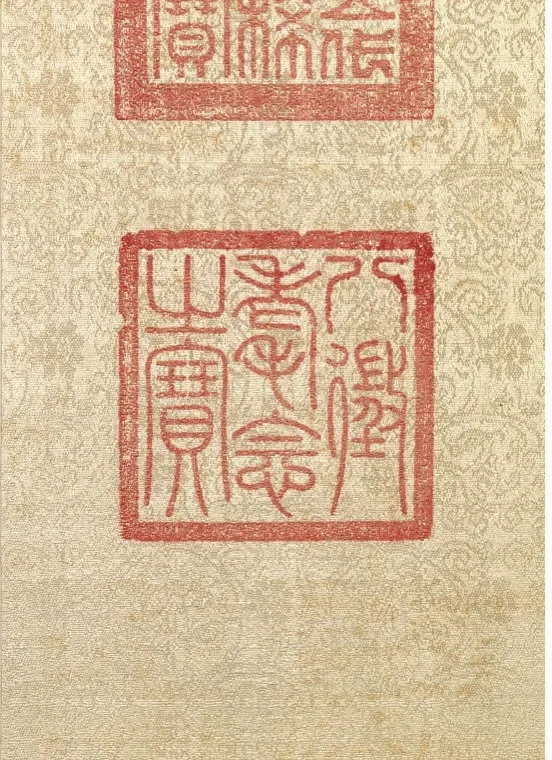
Buddhist painting seals can preserve evidence of authorship, ownership, viewing, cataloguing, and institutional history. They can also mislead. A red impression may be original, later, copied, misread, or placed on a replacement mount rather than on the painted support. The right first question is therefore not “Whose seal is this?” but “What exactly is visible, where is it located, and what evidence connects it to the object?”
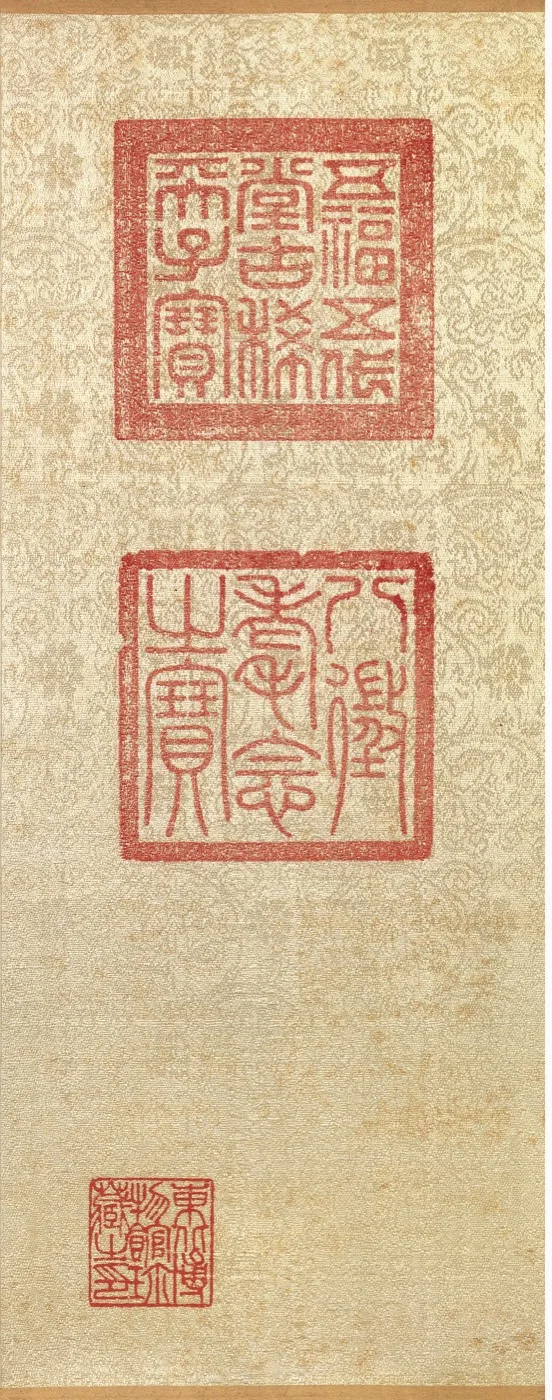
TK0779 provides a useful documentation exercise. Three rectangular or square impressions appear on a light patterned textile or textile-like mounting surface. Their sizes, border structures, carving styles, and impression quality differ. Those facts can be recorded from the image. Reading the archaic characters, identifying a collector, or dating the mounting requires specialist evidence that the image alone does not supply.
Why seals matter in Buddhist painting research
In Chinese painting and calligraphy, seals may identify an artist, a studio, an owner, a collector, an official collection, or an appreciative viewer. Some carry a name; others use a sobriquet, hall name, title, or short phrase. The Metropolitan Museum of Art explains that artists often used seals near signatures or as compositional red accents, while later collectors added ownership marks to older paintings and their margins.
On handscrolls, inscriptions and seals can accumulate over generations. The Met’s introduction to Chinese handscrolls describes these additions as evidence of how an object passed from viewer to viewer. That makes a seal potentially important provenance evidence, but only when its reading, location, physical layer, and documentary context are established.
Not every Thangka belongs to this East Asian seal tradition. Tibetan paintings more often foreground inscriptions, consecration writing, lineage information, textile mounting, and other forms of documentation. A red seal on a Buddhist image should therefore be studied within the work’s regional format rather than treated as a universal Thangka feature. Start with our guide to reading a Thangka to separate subject identification from later collection marks.
Step 1: record location before trying to read a seal
Location can change interpretation. State whether the impression appears on the painted field, a border, frontispiece, endpaper, colophon, backing paper, textile mount, label, wrapper, storage box, or detached document. Use viewer’s left and right, measure from stable edges, and mark the position on an overall photograph.
A seal on a painting may have been applied during or after its creation. A seal on a later lining or outer wrapper cannot automatically date the picture beneath it. A cluster divided by seams or repairs may reveal changes in mounting, but that relationship must be examined physically. TK0779 appears to show seals on a patterned mounting element; whether that element is original, later, or associated with the complete painting remains uncertain.
Document the object as a layered structure
Record support, paint layer, borders, linings, dowels, cords, wrappers, and labels separately. Do not remove a backing or unfold a fragile section simply to expose a mark. If access is limited, write “not examined” rather than assuming no seals are present. Our Thangka condition report checklist offers a practical system for distinguishing observations from interpretations.
Step 2: describe shape, border, and positive or negative script
Before transcription, describe what the eye can verify. Is the impression square, rectangular, round, oval, gourd-shaped, or irregular? Does it have a single border, double border, compartmented field, pictorial device, or damaged edge? Record dimensions and orientation. If the seal is rotated relative to the painting, note that rather than digitally turning the evidence without a record.
Chinese seals commonly produce either red characters on a pale ground or pale characters within a red field. These are often described as relief and intaglio impressions, sometimes called positive and negative script. The distinction helps researchers compare published seal catalogues, but worn paste, uneven pressure, fading, and photographic exposure can obscure it.
TK0779 shows three impressions with different proportions. The upper and middle examples have substantial red borders and large pale character areas, while the smaller lower impression is denser. This visual difference is worth recording. It does not prove that the seals belonged to different people, were applied at different dates, or are authentic.
Step 3: examine impression quality as physical evidence
A seal impression is not a clean digital logo. Look for doubled lines, missing corners, broken strokes, pooled paste, feathering, offset, abrasion, and interruptions caused by the surface weave. Describe whether the red sits continuously across fibers or disappears in recessed areas. Raking light and magnification may help during direct examination, but online sharpening can create false edges.
Compare color cautiously. Traditional red seal paste is often associated with cinnabar, but color in a JPG or WebP cannot establish composition. The National Museum of Asian Art notes that red paste was commonly used for seals on Chinese paintings and calligraphy, yet identifying a specific pigment or binder requires material analysis. Never sample, clean, wet, or enhance a seal impression merely to make the text easier to read.
Preserve a neutral digital record
Make one overall photograph showing placement, followed by square-on details with a scale and color target when possible. Retain an unedited archival master. Any contrast increase, rotation, infrared image, tracing, or character overlay should be saved as a separate derivative with the edit documented. For preservation and access choices, see JPG versus TIF for Thangka art.
Step 4: separate transcription, reading, and identification
These are different research stages. A transcription proposes the visible character forms. A reading converts them into standardized characters and language. An identification connects the legend to a person, studio, reign, collection, or phrase. Each stage needs its own confidence level and source citation.
Seal script can be highly stylized, archaizing, damaged, or deliberately compact. Similar names and studio titles recur, and the same collector may use many seals. Conversely, later copies can reproduce famous marks. Record alternative readings and consult a specialist, seal dictionary, institutional worksheet, or verified comparison impression. Do not identify a seal merely because a search result looks similar.
The Freer Gallery’s historical Song and Yuan painting documentation project demonstrates the value of cataloguing signatures, individual seals, and seal clusters as separate evidence. Its approach also shows why difficult characters require transcription and expert checking rather than confident visual guessing.
Step 5: test provenance claims against independent evidence
A genuine collector’s seal can establish that an object was in a collection no earlier than that collector’s lifetime. It does not automatically prove the painting’s artist, original date, or uninterrupted chain of ownership. A copied or forged seal proves even less. Strong provenance research combines seal evidence with inscriptions, catalogues, inventories, labels, mounting history, photographs, acquisition files, and technical examination.
Check whether the seal appears in a published catalogue and whether its exact form, dimensions, character arrangement, border, damage, and placement agree. Ask if the claimed owner is documented as having the work. Compare old photographs to determine when the impression first becomes visible. If a seal is present only on a replacement mount, state that limitation.
Buddhist subject matter adds another layer. A seal may belong to a secular collector, temple, imperial collection, artist, donor, dealer, or later institution. It should not be interpreted as a consecration mark without evidence. Iconography must be evaluated separately through figures, attributes, composition, and inscriptions; our guide to studying Thangka iconography with high-resolution images explains that workflow.
Buddhist painting seals documentation checklist
- Assign a stable object ID and a separate number to every seal impression.
- Record whether each mark is on the painting, border, mount, lining, wrapper, label, or box.
- Measure height and width; note orientation, shape, border, and compartments.
- Describe red-text or pale-text structure without forcing an uncertain reading.
- Photograph overall placement and square-on details with scale and color reference.
- Log fading, abrasion, doubling, gaps, surface weave, repairs, and overlaps.
- Keep transcription, reading, owner identification, and date in separate fields.
- Cite comparison catalogues and retain alternative readings with confidence levels.
- Test provenance against inventories, labels, photographs, inscriptions, and acquisition records.
- Never use a seal alone to prove artist, date, authenticity, or ritual function.
Conclusion: treat every seal as evidence, not a verdict
Buddhist painting seals are valuable because they can connect a physical object to histories of making, viewing, collecting, and remounting. Their value increases when researchers document exact placement, form, impression quality, text, and uncertainty. Their value collapses when a red mark is treated as automatic proof of a famous owner or early date.
For TK0779, a responsible record can describe three differently proportioned red impressions on a patterned scroll mounting. The characters, owners, dates, application sequence, authenticity, and relationship to the associated artwork remain uncertain. That careful boundary leaves room for future comparison without turning an attractive image into an unsupported provenance claim.
Download the full Thangka image collection
Continue browsing and download the full TANGKAWORLD image collection for comparative study, visual identification, and collection research. Keep each TK number with its source file, preserve the original, and make separate working copies for seal diagrams, transcriptions, and annotations.