
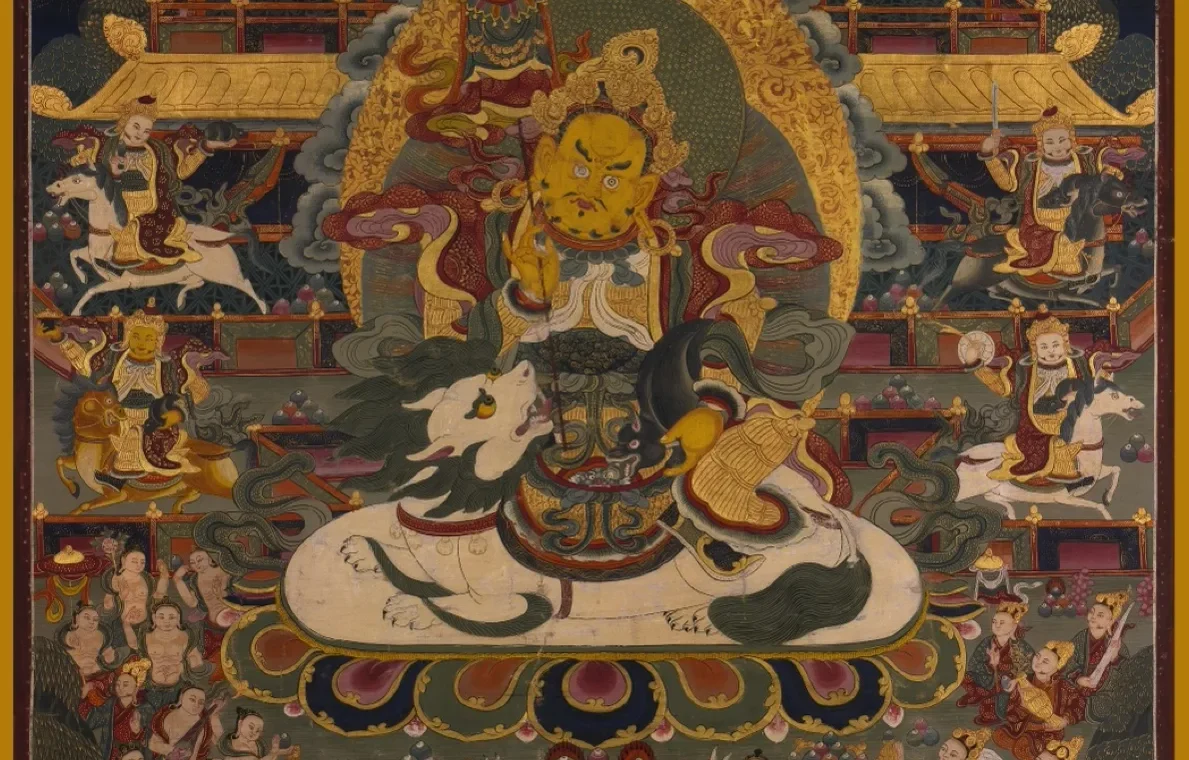
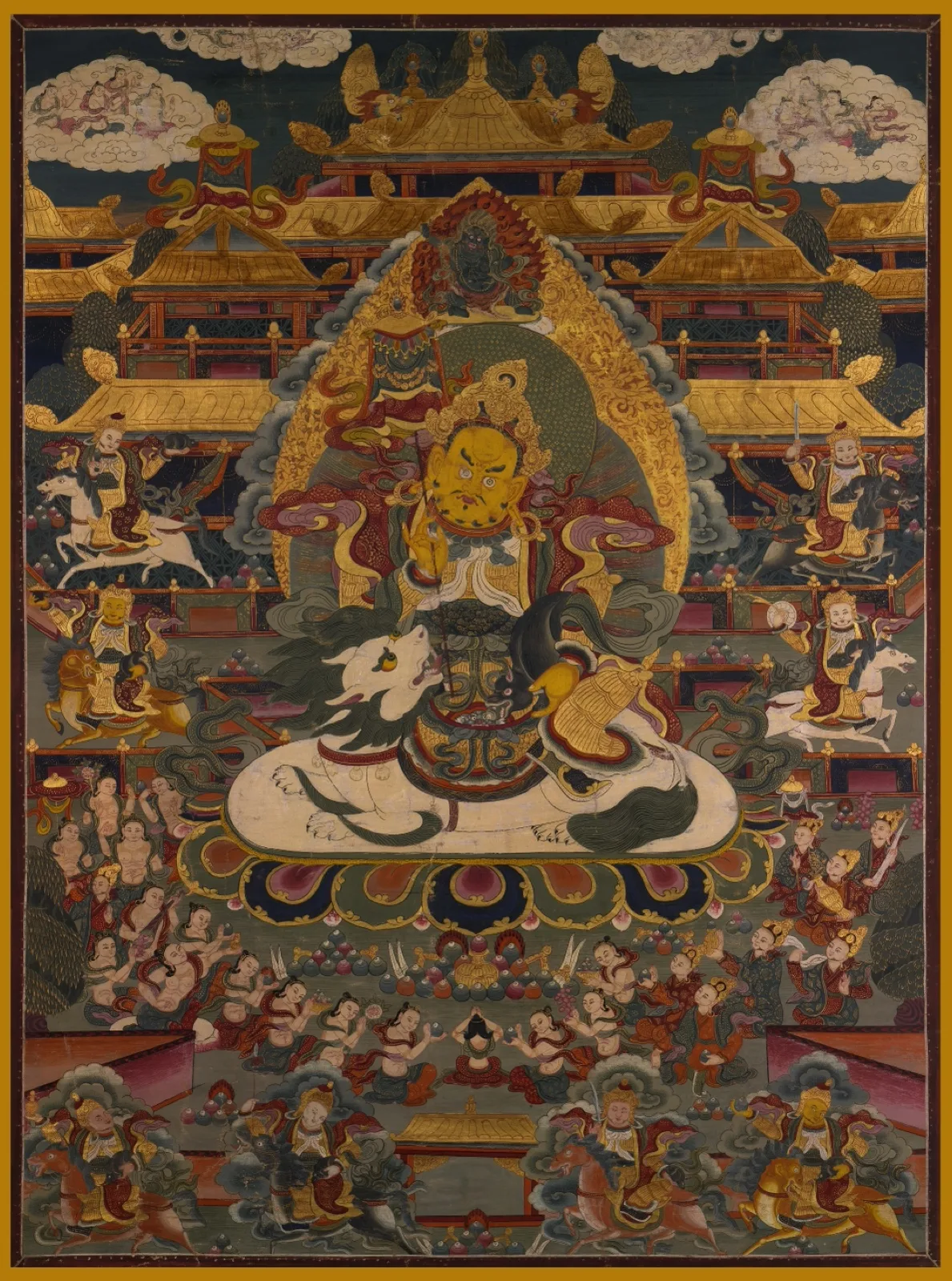
An Eight-Direction Wealth Deities painting is not simply a picture of one “god of money.” It is a structured sacred assembly in which a dominant central figure, mounted guardians, attendants, architecture, clouds, and offerings work together. The TANGKAWORLD image TK1288 carries the archive title “Eight-Direction Wealth Deities.” That title is useful as a starting point, but the exact names of every figure, the ritual system, date, artist, workshop, school, collection history, and provenance remain uncertain. A careful reading should therefore begin with what the painting visibly shows and only then compare those features with securely cataloged examples.
Quick answer: Read this group from the center outward. Establish the principal figure, count and compare the surrounding guardians, record their mounts and objects, then study the offering registers and palace setting. Do not identify a deity from color alone.
What “Eight-Direction Wealth Deities” means
Directional groups organize sacred space. A central presence may be surrounded by figures assigned to cardinal and intermediate directions, creating a complete protected field rather than a casual gathering. In paintings associated with prosperity, the group can also connect abundance with guardianship, ethical order, the support of Buddhist practice, and the protection of communities. “Wealth” in this setting is broader than modern financial success: it can refer to resources, fertility, nourishment, auspicious conditions, and the removal of obstacles to religious life.
However, the English archive title should not be treated as a full catalog record. Tibetan Buddhist traditions contain several wealth-deity systems, while Chinese, Mongolian, and regional workshops may arrange related figures differently. The number eight can describe a directional structure without proving that each figure belongs to one universally standardized list. An inscription, lineage text, museum record, or reliable provenance would be needed to name every figure with confidence.
Start with composition before iconographic names
1. Find the visual center
TK1288 is dominated by a large yellow-faced figure seated on a white animal mount. The central figure is enclosed by a luminous aureole and placed before elaborate palace architecture. Scale, central alignment, the mount, and the surrounding halo establish hierarchy: this is the figure around which the rest of the assembly is organized. A smaller dark figure appears above within the same vertical axis, suggesting another level of authority or transmission, but its exact identity is uncertain.
2. Trace the directional ensemble
Smaller armored or royal figures appear around the central zone and along the lower register. Several ride different animals and carry distinct implements. Instead of jumping immediately to names, make a simple diagram of their positions: upper left, upper right, middle left, middle right, and the figures distributed below. Direction in a ritual diagram does not always match ordinary left and right as seen by the viewer, so a label such as “north” should be withheld unless the underlying system is documented.
3. Read the supporting world
The painting includes palace roofs, railings, clouds, attendants, musicians, groups of worshippers, and abundant offerings. These details are not empty decoration. They build the environment in which protection and prosperity are enacted. The lower offerings include vessels, textiles, fruit-like forms, and grouped valuables. Together with the mounted retinue, they suggest abundance under organized guardianship rather than an isolated portrait.
Common wealth-deity clues—and their limits
Comparative iconography helps narrow possibilities, but no single attribute is sufficient. Mongoose imagery, jewels, fruit, grain, treasure vases, victory banners, armor, royal clothing, and animal mounts can all appear in wealth-related paintings. The same object may also belong to a protector, guardian king, or supporting figure in another context. Use several clues at once: body type, posture, facial expression, number of arms, mount, hand objects, position, and companions.
Vaishravana: royal protection and guarded riches
Vaishravana is often recognized as an armored guardian king associated with the north. Securely cataloged paintings may show a victory banner, a jewel-producing mongoose, royal armor, and a lion or other mount. Yet not every armored figure holding wealth symbols is Vaishravana. In a complex directional group, another guardian may share military dress while serving a different role.
Jambhala: several colors and ritual forms
Jambhala is not restricted to one appearance. Museum and scholarly catalogs document yellow, white, black, red, and green forms with different lineages and attributes. A yellow form may hold a citrus-like fruit and a mongoose; black forms can be naked and wrathful; white forms may ride a dragon; green forms may appear with a consort. This variety is precisely why color alone cannot identify an unclear figure. Attributes and textual context must agree.
Vasudhara: abundance in peaceful form
Vasudhara is commonly represented as a peaceful female wealth deity. Cataloged examples may include grain, a jewel, a lotus, a gesture of generosity, or a wealth vase. Her imagery emphasizes nourishment and abundance rather than the armored authority associated with a guardian king. When examining a group painting, first confirm whether the figure is peaceful or wrathful, female or male, solitary or paired, before comparing individual objects.
How to study TK1288 without over-identifying it
The safest description of TK1288 follows observable evidence. The image presents a monumental central mounted figure, a dark secondary figure above, multiple smaller mounted guardians, extensive palace architecture, clouds, attendants, worshippers, musicians, and offerings. The archive places the work in an Eight-Direction Wealth Deities group. Those facts support a study of hierarchy, directionality, guardianship, and abundance.
They do not independently prove the names of the central figure or every guardian. Small attributes are difficult to read even in a high-resolution image, and the object has no verified inscription or museum catalog attached to the local record. The central white mount should be described as an animal mount unless anatomy and comparative evidence support a more specific identification. Likewise, the dark upper figure should not automatically be called Mahakala, even though Mahakala imagery provides a useful comparison for wrathful faces, flames, and protective symbolism.
This evidence-first approach is the same method used to distinguish closely related wrathful subjects in the Yama versus Yamantaka guide. It is better to preserve uncertainty than to force a confident label from a familiar color, mount, or weapon.
Practical identification checklist
- Record the archive data. Keep the exact title, TK number, folder, dimensions, and file state before interpreting the image.
- Correct display orientation. TK1288 lacks reliable orientation metadata; rotate only a temporary study copy and never overwrite the source.
- Map the hierarchy. Note the largest figure, the vertical axis, halos, palace placement, and the relative scale of the retinue.
- Count figures and positions. Sketch the surrounding guardians before assigning directional names.
- Describe mounts carefully. Record color, horns, hooves, paws, mane, or saddle without guessing the species when details are unclear.
- List visible attributes. Separate objects you can see from objects expected from a textbook description.
- Compare multiple sources. Require agreement between posture, dress, mount, hand objects, retinue, and a trustworthy catalog.
- Mark every unsupported claim uncertain. Date, artist, school, region, medium, ritual lineage, and provenance all need independent evidence.
Related TANGKAWORLD guides
For a general method, begin with How to Read a Thangka, then use the high-resolution iconography workflow to inspect mounts and attributes. Compare the guardian structure with the Four Heavenly Kings visual guide. These pages help separate compositional evidence from assumptions based on a single familiar symbol.
Sources and further reading
- Himalayan Art Resources: Padmasambhava as a Wealth Deity, with cataloged examples of several Jambhala and Vaishravana forms.
- Himalayan Art Resources: Vasudhara, describing a peaceful abundance deity and her attributes.
- Rubin Museum: Vaishravana and Virupaksha, a museum record for directional guardian imagery.
- Rubin Museum: Buddha Ratnasambhava with Wealth Deities, discussing hierarchical scale and Jambhala figures.
What wealth imagery does not promise
Wealth-deity paintings should not be reduced to guarantees of personal profit. Their ritual meanings depend on lineage, initiation, liturgy, ethical conduct, generosity, and the community in which the image is used. A jewel-spitting mongoose or a field of offerings is an iconographic sign, not evidence that a painting functions as a commercial charm. Museum viewers can respect this distinction by describing the visual language without making devotional claims on behalf of practitioners.
The same caution applies to monetary value. Those questions require examination of the support, pigments, mounting, inscriptions, repairs, provenance, legal ownership, and comparable documented works. A digital image can support visual study, but it cannot replace technical analysis or a qualified appraisal. This boundary is especially important for TK1288 because the archive record preserves a subject label but does not provide a verified historical catalog.
Conclusion
An Eight-Direction Wealth Deities Thangka is best approached as an organized sacred field. Begin with hierarchy, then examine the mounted retinue, palace, attendants, and offerings. Comparative figures such as Jambhala, Vasudhara, and Vaishravana can clarify the visual vocabulary, but they should not be used as automatic labels. For TK1288, the group title and visible composition support a study of wealth, protection, and directionality; the precise identities and historical attribution remain uncertain.
Download the full Thangka image collection
Continue exploring and download the complete TANGKAWORLD image library through the full Thangka image collection, including high-resolution material for close comparison and iconographic study.