
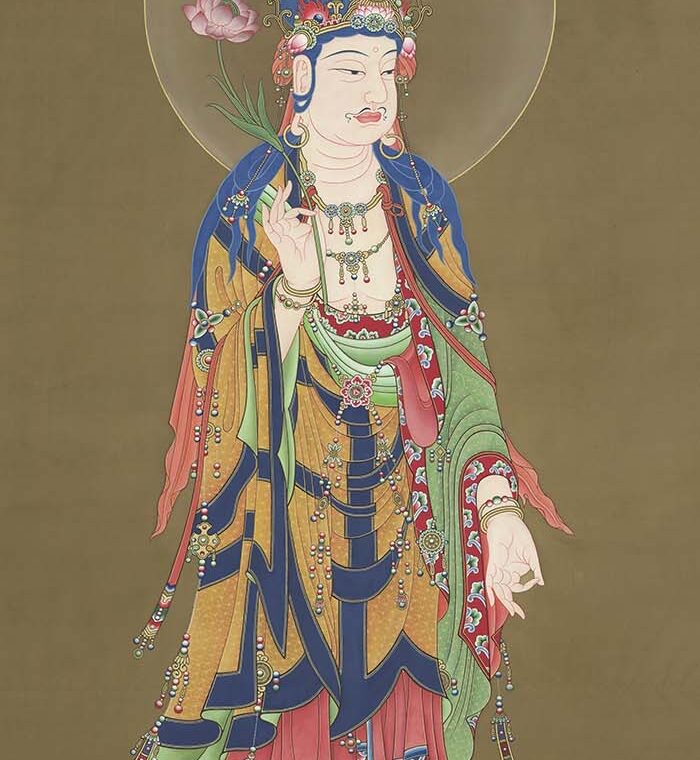
A lotus stem in Buddhist painting can do more than identify a flower: its direction, height, and relation to a figure’s hand shape how the image is read. In TANGKAWORLD archive image TK1105, a long green stem rises diagonally beside a standing, haloed figure and ends in a pink blossom near the head. That visible arrangement is a useful case study in lotus stem iconography—but it does not, by itself, establish the figure’s identity, date, ritual use, or provenance.
Begin with what the image actually shows
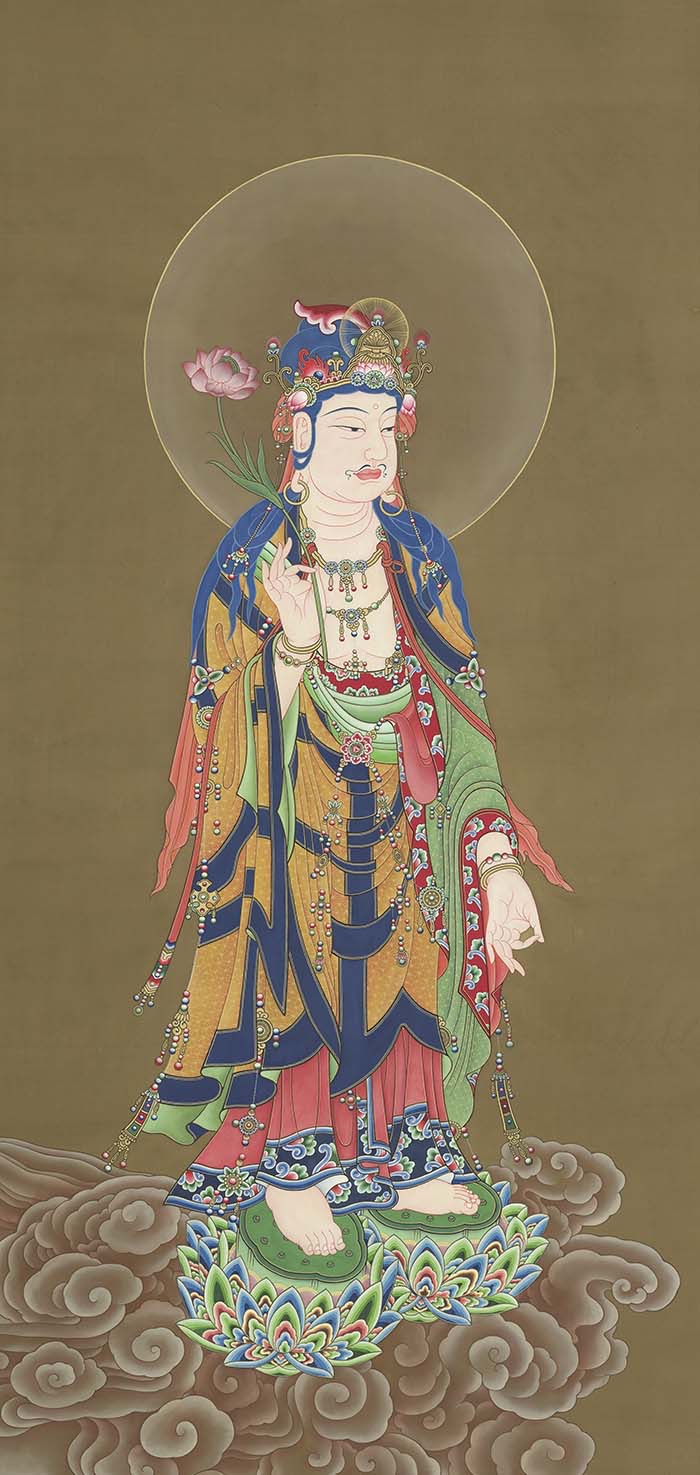
TK1105 is a tall-format painting. A single standing figure occupies most of the composition, set against a plain brown field and surrounded by a circular halo. The figure wears a layered, richly ornamented robe and stands on a lotus base above cloudlike forms. One raised hand holds a slender green stem that angles upward toward a pink flower beside the head; the other hand extends lower with an open palm. These are observations, not a complete iconographic identification.
The archive files the image within a group labeled “Three Saints of the West,” and the individual filename includes a Great-Power (Mahasthamaprapta) label. Those catalog labels are useful leads, but they are not proof that this isolated image can be identified from the flower alone. The current view does not show its companion figures or an inscription that settles the question. For this guide, the safest description is therefore a standing Buddhist figure holding a lotus stem, with the specific identity uncertain.
What the lotus stem contributes
When a lotus stem is held in the hand, it connects the body to a blossom placed elsewhere in the composition. That connection can guide the viewer’s eye: in TK1105, the diagonal rises from the figure’s hand toward the space beside the face. The line crosses the vertical rhythm of the body and robe, making the flower a prominent attribute rather than a small background detail.
The distinction matters. A stem held by a figure is not the same visual feature as a flower presented by an attendant, a lotus growing from water, or the layered lotus supporting a throne. A lotus may carry associations such as purity or awakening in Buddhist contexts, but meanings vary with the tradition, the represented figure, and the surrounding program. Do not assign a fixed meaning to every pink flower. First record how it is shown, then interpret it in context.
For comparison, the site’s guide to the lotus throne in Buddhist art focuses on the seat beneath a figure. The separate guide to flower offerings in Buddhist art examines flowers presented within a scene. Those pages address related motifs, but neither should be substituted for a close reading of a hand-held stem.
Read direction, hand, and flower together
A useful method is to follow the attribute in sequence. Start at the point where the stem meets the hand. Note whether the fingers grasp it, support it lightly, or frame it. Then follow the stem’s direction and record where the blossom sits relative to the face, shoulder, halo, and frame. In TK1105 the line rises beside the head, while the blossom sits outside the face’s outline. That placement makes it legible against the open ground.
Next compare the object with the figure’s other gesture. Here the raised hand holding the stem and the lowered open hand create two distinct points of attention. Describe them separately before naming either gesture. An open palm may be meaningful, but a photograph alone may not show enough detail to distinguish a formal mudra from a more general pose. Avoid converting a visual resemblance into a confident ritual interpretation.
Finally, look at the flower itself: its color, number of visible petals, orientation, and relationship to the stem. If the image is small or softened, say so rather than filling in detail. High-resolution study can reveal paint boundaries and hand positions, but it cannot supply missing historical documentation. The site’s high-resolution iconography study method offers a repeatable approach for moving from broad composition to small attributes.
Do not let one attribute identify the whole figure
Lotus flowers and stems occur across Buddhist art, so a lotus is rarely a self-sufficient name tag. Identification is stronger when several independent clues agree: the figure’s companions, crown or head emblem, hand-held objects, posture, inscriptions, and the work’s documented context. A file title or collection grouping can guide further research, but it should be recorded as catalog information rather than silently turned into visual proof.
TK1105 is a good reminder of this distinction. Its archive folder places it among images associated with the Western triad, and the filename proposes a specific figure. Yet the visible crop presents one figure rather than the full group. A careful caption can preserve both facts: “TK1105, a standing haloed figure holding a lotus stem; archived in a Western-triad group, individual identity uncertain from this image alone.” The site’s Mahasthamaprapta visual guide discusses another attribute-based identification problem; compare the evidence, but do not infer a match simply because both images involve a bodhisattva and symbolic objects.
A practical checklist for documenting a lotus stem
- Record the format: note whether the image is a full painting, detail, crop, or reproduction.
- Locate the hand: describe which side of the image holds the stem and how the fingers meet it.
- Trace the line: record whether the stem rises, falls, curves, or crosses the body.
- Describe the blossom: note visible color, orientation, and detail without guessing at obscured petals.
- Separate nearby motifs: distinguish the hand-held flower from the lotus seat, background plants, and offerings.
- Document context: look for companion figures, inscriptions, labels, and reliable catalog records.
- Mark uncertainty: keep visible description separate from proposed identity, date, school, ritual use, and provenance.
- Save the view: retain the full-frame image and a detail crop so later readers can check the observation.
This method is useful for collection notes, image captions, and comparative research. A condition report can also record whether paint loss, abrasion, or a fold obscures the stem or hand; the Thangka condition report checklist helps keep those observations separate from interpretation. If you are new to reading a complete composition, begin with How to Read a Thangka and then return to the attribute at full scale.
Conclusion: describe first, interpret second
A lotus stem in Buddhist painting is best read through its connection to the hand, the direction of its line, the placement of its flower, and the surrounding composition. TK1105 shows how one attribute can organize attention without resolving every question about the figure. Record the visible evidence precisely, compare it with the full image and reliable context, and leave identity uncertain where the evidence remains incomplete.
Download the full Thangka image collection
Continue browsing and download the complete TANGKAWORLD image collection from the free Thangka downloads page.