
Mahasthamaprapta iconography is easiest to recognize when several clues agree. The most useful is often a vase-shaped emblem in the bodhisattva’s crown. A position beside Amitabha and Avalokiteshvara in a Pure Land triad can strengthen the identification, while a lotus, jeweled dress, halo, and graceful posture establish the broader bodhisattva type. No single decorative detail should be treated as proof in every region or period.
This guide uses TANGKAWORLD image TK0212 to build an evidence-first method. The archive identifies the standing figure as Mahasthamaprapta, and the visible crown vase supports that label. However, the date, artist, school, exact medium, original setting, collection history, and provenance are uncertain. Those limits matter because iconographic forms change across China, Korea, Japan, Tibet, and other Buddhist cultures.
Who is Mahasthamaprapta?
Mahasthamaprapta is a bodhisattva associated with wisdom and the Pure Land tradition. The British Museum describes Mahasthamaprapta as one of the two attendants of Amitabha, generally placed at Amitabha’s left. The other attendant is Avalokiteshvara. Together, these three figures form a triad that appears in sculpture, painting, embroidery, and ritual imagery across East Asia.
Names vary with language and place. English catalogues may use Mahasthamaprapta; Chinese sources often use Dashizhi; Japanese records use Seishi. A searcher should keep these variants in mind, but matching names does not mean that every visual tradition uses identical attributes or positions. Begin with the object itself, then consult a secure catalogue record.
The crown vase: the strongest visual clue
The Metropolitan Museum of Art identifies Mahasthamaprapta on a seventh-century Chinese stele through a vase symbol in the headdress. On the same stele, Avalokiteshvara is distinguished by a small Buddha in the crown. This paired comparison is especially valuable because it shows two similar, richly adorned bodhisattvas separated by their crown emblems.
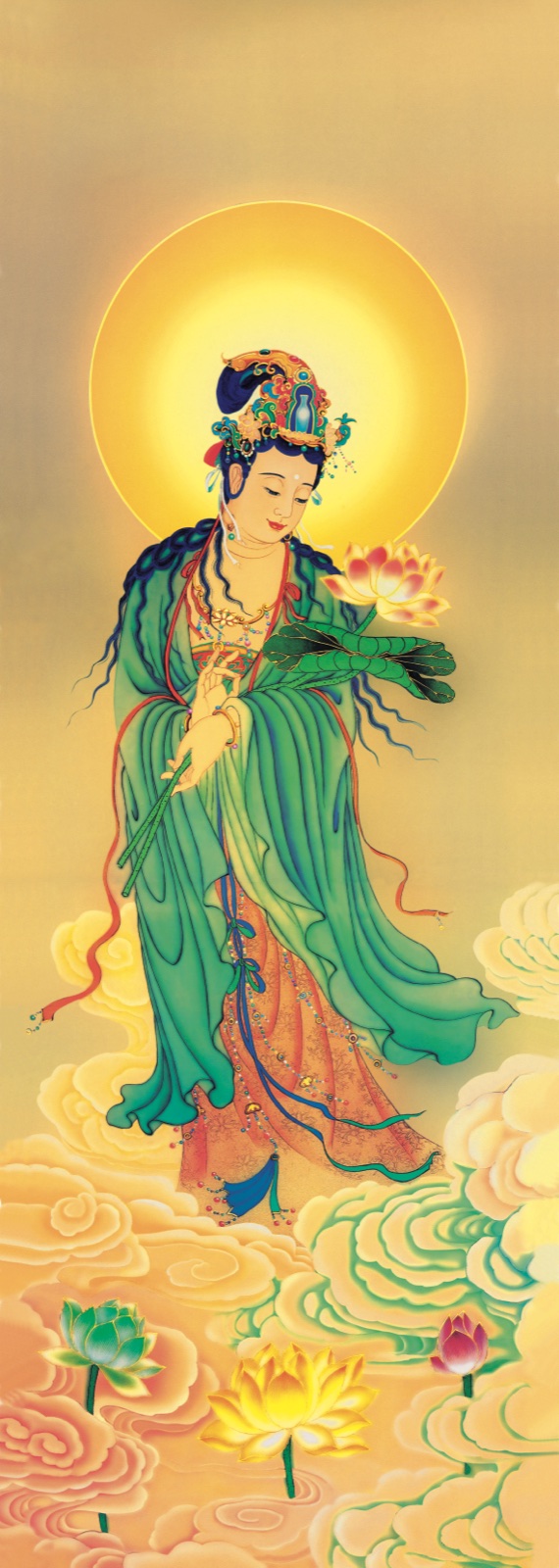
In TK0212, the crown contains a clear pale vessel with a narrow neck and rounded body. Its placement is deliberate: the vessel sits near the visual center of the crown rather than appearing as a background vase or handheld offering. That observation aligns with the Met’s documented vase-emblem comparison and gives the archive title meaningful support.
Still, describe before naming. Record the object as “a vase-shaped crown emblem” before deciding that it confirms Mahasthamaprapta. Check whether the form could be a jewel, stupa, floral ornament, or damaged image. High-resolution viewing is essential because compression, overexposure, repainting, and decorative overlap can blur the silhouette.
Why the lotus is supporting evidence, not proof
TK0212 shows the figure holding the long stem of a large lotus. Lotus imagery communicates purity and sacred presence across Buddhist art, and many bodhisattvas hold or sit upon lotuses. Avalokiteshvara, Green Tara, White Tara, Manjushri, and other figures may all appear with lotus blossoms, so a lotus alone cannot identify Mahasthamaprapta.
The flower is more useful when read as part of a cluster. In TK0212, the crown vase supplies the specific clue, while the lotus, jewelry, flowing scarves, halo, and cloud setting confirm the broader bodhisattva vocabulary. This hierarchy of evidence prevents a common catalogue error: treating a widespread symbol as if it belonged to only one figure.
Mahasthamaprapta in the Amitabha triad
Triad context can be as important as an attribute. Mahasthamaprapta commonly appears with Amitabha and Avalokiteshvara. The central Buddha is usually larger, while the two bodhisattvas flank or precede him as attendants. In some paintings of descent to the Pure Land, Avalokiteshvara presents a lotus seat and Mahasthamaprapta clasps the hands in reverence. Other works use different gestures or objects.
The British Museum records examples in which the triad is explicit, including a painting where Amitabha stands between Avalokiteshvara and Mahasthamaprapta. TANGKAWORLD’s Amitabha Pure Land painting guide explains how central scale, attendants, architecture, and repeated lotus imagery organize such assemblies.
TK0212 is a single standing figure, not a complete triad. Triad relationships therefore provide comparative context rather than direct proof for this image. Do not invent absent companions. If a work survives as a fragment or detached panel, the missing original ensemble may be uncertain unless documentation establishes it.
How to distinguish Mahasthamaprapta from Avalokiteshvara
Inspect the crown before the handheld objects
Avalokiteshvara frequently carries a lotus and may also appear with a water vessel, so handheld objects can overlap. In many East Asian images, the crown offers a cleaner distinction: a small Buddha image supports Avalokiteshvara, while a vase emblem supports Mahasthamaprapta. The two symbols must be visible enough to describe; a bright oval or dark patch is not sufficient.
Use the pair, not color alone
Robe color changes with workshop, pigment, restoration, and modern reproduction. Green clothing in TK0212 should not be turned into a fixed identity rule. Instead, compare crown emblem, position in a triad, gesture, and inscription. Our guide to Buddhist attendant figures shows how scale and placement help distinguish central deities from flanking figures.
Check inscriptions and catalogue history
An inscription can be decisive when it is original, legible, and correctly read. A later label or filename is weaker evidence. The Met’s late seventeenth- to early eighteenth-century Mahasthamaprapta painting, for example, is identified by a cartouche and depicts a form with a lion mount, lotus stems, a pearl, and a vajra-like implement. Its attributes differ from TK0212, demonstrating that variation is normal.
Reading TK0212 step by step
Start with neutral description. A youthful standing bodhisattva occupies the vertical center. The figure wears a jeweled crown and layered green and red garments, holds the stem of a pink lotus, and stands amid clouds and multiple lotus blossoms. A large circular halo frames the head. The face tilts downward, and the body follows a gentle curve rather than a rigid frontal axis.
Next, rank the evidence. The vase-shaped crown emblem is the most specific visible feature. The lotus and princely ornaments support a bodhisattva reading but are not exclusive. The archive title adds documentary evidence, although the history of that title is not supplied. Taken together, the evidence makes “Mahasthamaprapta” a reasonable working identification.
Finally, state what cannot be recovered from the pixels. TK0212 does not provide a readable inscription, a dated colophon, a documented collection record, or a known original location. The exact technique is also uncertain from the digital file. The image should not be assigned to a dynasty, monastery, painter, or Himalayan lineage on appearance alone.
Mahasthamaprapta iconography checklist
- Crown: Is there a clearly shaped vase emblem, or only an ambiguous ornament?
- Triad: Does the figure accompany Amitabha and Avalokiteshvara in a documented ensemble?
- Position: Is the placement consistent with the object’s regional tradition and viewing orientation?
- Companion emblem: If Avalokiteshvara is present, can a small Buddha be seen in that figure’s crown?
- Lotus: Treat the flower as supporting bodhisattva evidence, not an exclusive identifier.
- Gesture: Describe hand position precisely before assigning ritual meaning.
- Inscription: Check whether a name cartouche, colophon, seal, or inventory label is original and legible.
- Condition: Look for abrasion, overpaint, cropping, glare, or digital processing that may hide attributes.
- Comparison: Use securely catalogued museum objects from the same region or visual tradition.
- Uncertainty: Keep date, artist, school, medium, provenance, and missing ensemble context uncertain when evidence is absent.
A repeatable research workflow
First, save the image’s archive title and TK number without treating the label as infallible. Second, inspect the crown at full resolution and sketch the emblem’s outline. Third, record lotus, gesture, dress, halo, posture, companions, and spatial hierarchy. Fourth, compare the combination—not just one attractive detail—with securely identified objects. Fifth, separate your notes into observed, documented, probable, and uncertain claims.
This workflow makes later corrections easier. It also links a long-tail deity study to broader resources: consult How to Read a Thangka for a general sequence, then use the high-resolution iconography guide to evaluate small crown symbols and condition details.
Conclusion
Mahasthamaprapta iconography depends on combined evidence. A vase emblem in the crown is the strongest clue in many East Asian works; Pure Land triad context can reinforce it; lotus flowers and jeweled dress establish the broader bodhisattva type. TK0212 supports the archive identification through its visible crown vase, while its date, artist, school, exact medium, provenance, and original setting remain uncertain.
Download the full Thangka image collection
Continue browsing and download the complete TANGKAWORLD image library at Free Downloads. The full collection lets you compare Mahasthamaprapta, Avalokiteshvara, Amitabha triads, crown emblems, lotus imagery, and other Buddhist iconographic details side by side.