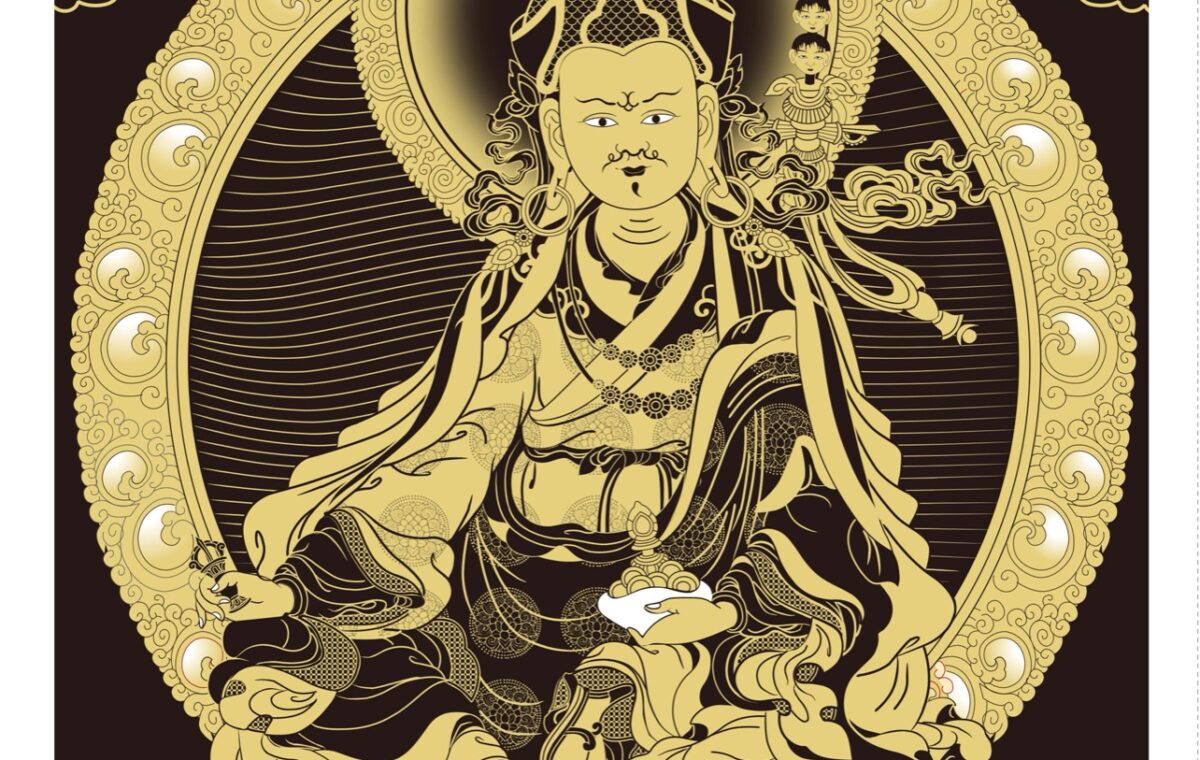
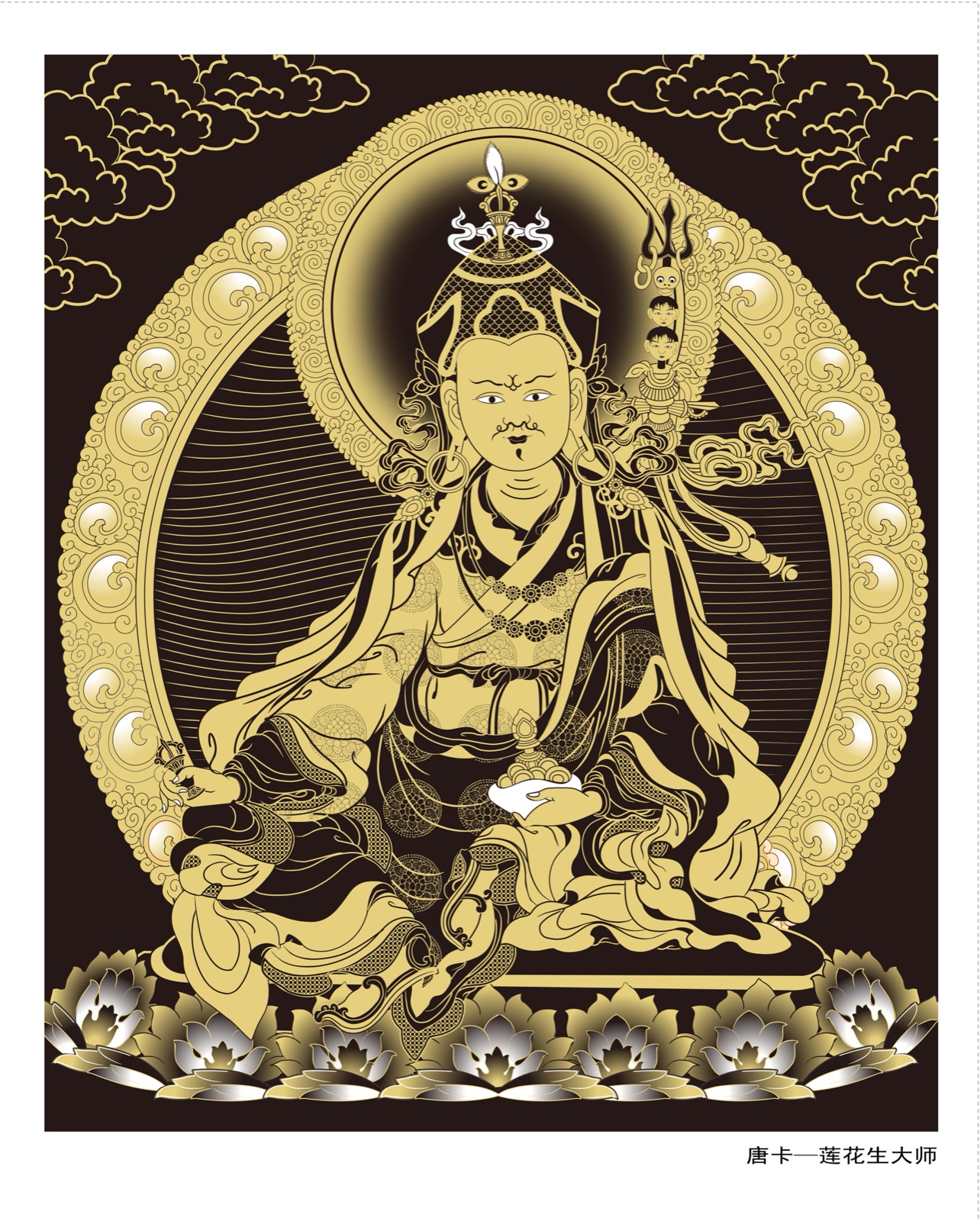
A Padmasambhava thangka can often be recognized from four elements before any inscription is read: the distinctive lotus hat, a vajra in the right hand, a skull cup in the left, and a khatvanga staff resting against the shoulder. Together they identify Padmasambhava, widely known in Tibetan as Guru Rinpoche, the “Precious Guru.” The exact arrangement varies, so reliable identification depends on the cluster rather than one object.
Who is Padmasambhava?
Padmasambhava is a foundational master in Tibetan Buddhist tradition and is especially central to the Nyingma school. Traditional accounts connect him with the establishment of tantric Buddhism in Tibet during the eighth century and with the reign of Trisong Detsen. Biography, revelation literature, ritual history, and later artistic traditions overlap in complex ways, so a short visual guide should not pretend that every narrative detail is equally historical or equally accepted.
For identification, the important point is that he is represented as an accomplished tantric teacher rather than as a monastic Buddha. His posture, clothing, gaze, ritual implements, and hat combine authority, meditation, and active mastery. The Metropolitan Museum of Art’s Padmasambhava record highlights the vajra, skull cup, and distinctive cap in an early sculptural portrait.
The key symbols in a Padmasambhava thangka
The lotus hat
The lotus hat is usually the fastest clue. It rises in a pointed or petal-like form and may include a small sun-and-moon emblem, a vajra finial, or a feather at the top. Ear flaps or decorated side panels frame the face. Artists simplify these details differently, especially in small paintings, printed reproductions, and modern line-based images.
A similar hat can appear on lineage teachers who consciously echo Padmasambhava. Therefore, continue to the hands and staff. A hat without the expected implements is suggestive but not conclusive.
The vajra in the right hand
Padmasambhava commonly raises or presents a vajra in his right hand. In many images it is held near the heart, expressing the indestructible and awakened quality of tantric insight. At small scale, the vajra may resemble a short scepter or simply a symmetrical gold object. Count its prongs only when the resolution allows it; do not invent a five-pronged or nine-pronged classification from blurred pixels.
The skull cup in the left hand
The left hand usually rests in the lap holding a skull cup, or kapala. A longevity vase may stand within the cup. The combination joins tantric symbolism with the sustaining quality of life and realization. In TK0537, the pale bowl is visible in the lap with a small vessel above it. The form is stylized, but its placement agrees with standard Guru Rinpoche iconography.
The khatvanga staff
A khatvanga leans against Padmasambhava’s left shoulder. It is a tantric staff often topped by a trident-like form and stacked heads or skulls. Ribbons may stream from it. Because the shaft can disappear behind the body and halo, viewers sometimes notice only the decorated upper end. Trace the staff downward rather than assuming that a floating trident belongs to an attendant.
Posture, clothing, and expression
Padmasambhava is frequently seated in a royal-ease posture, with one leg relaxed or slightly raised rather than both legs locked into a perfectly symmetrical meditation pose. His robes combine monastic, lay, and royal-looking layers. Boots may be visible. The face often carries a direct, focused gaze and a small moustache, giving him a human yet intensified presence.
These cues distinguish him from a Buddha, who normally wears monastic robes and displays canonical Buddha marks, and from a crowned bodhisattva, whose jewelry and silk garments follow a different visual system. Padmasambhava is a master shown with specific tantric insignia.
Padmasambhava’s eight manifestations
Some paintings depict one of the Eight Manifestations of Padmasambhava rather than the familiar central Guru Rinpoche type. Appearance, color, dress, pose, and implements may change substantially. A figure that lacks the standard lotus hat or staff might still belong to this larger cycle, but naming the specific manifestation requires dependable attributes or an inscription.
This is an important uncertainty boundary. Do not label every wrathful or royal-looking teacher as one of the eight forms merely because Padmasambhava is associated with them. State “possibly a form of Padmasambhava” only when the visual evidence warrants that level of confidence.
Identification checklist
- Find the distinctive lotus hat with a high central point or feather.
- Look for a vajra held in the right hand near the heart.
- Check the left hand for a skull cup, often with a vase inside it.
- Trace the khatvanga staff leaning against the left shoulder.
- Note the layered robes, possible boots, moustache, and focused gaze.
- Check whether the posture is relaxed or royal rather than fully symmetrical.
- Keep the specific manifestation, date, artist, and lineage uncertain unless documented.
How to catalogue a Padmasambhava image
Begin with the archive title and TK identifier. Record the hat shape, hand-held objects, staff, posture, clothing, halo, lotus seat, attendants, teachers, and inscriptions. Use the high-resolution Thangka iconography method to inspect those details in a fixed order. If a modern reproduction preserves iconography but not a historical painted surface, say so, and use the Thangka condition report checklist before attributing missing details to the original work. A clean digital outline should not be assigned an early date simply because it copies an old compositional model.
Secondary figures may include lineage holders, consorts, protective deities, or manifestations of the master. Name them only when their attributes or inscriptions support the reading. If a surrounding figure is too small, “unidentified teacher” or “unidentified attendant” is better than a confident but untestable label.
Why the attributes should be read together
Each object has a broader life in Vajrayana art. Vajras appear with many deities and masters; the Vajrapani iconography guide shows why a vajra alone is not enough for identification. Skull cups and khatvangas occur in yogini and protector imagery. Elaborate hats distinguish multiple teaching lineages. Padmasambhava emerges from the intersection of all these signs, positioned in a familiar teacher portrait.
This combined-reading method is the same one used for other Thangka subjects: establish the body type and posture, identify the hands and objects, study the surrounding register, and then test the result against inscriptions or trustworthy collection records. See How to Read a Thangka for the full sequence.
Conclusion
The lotus hat, vajra, skull cup, and khatvanga form the most reliable visual signature of a Padmasambhava thangka. Posture, robes, and expression reinforce the identification, while the surrounding figures may reveal a broader lineage context. Where the exact manifestation or historical origin is not documented, preserve that uncertainty. For related wrathful imagery, continue with the Six-Armed Mahakala guide.
Sources and further reading
- Himalayan Art Resources: comparative records for Padmasambhava
- The Metropolitan Museum of Art: The Spiritual Master Padmasambhava (object record)
These references support comparative iconographic study. The TANGKAWORLD TK number is an internal catalogue identifier; artist, date, collection history, and provenance remain uncertain unless separately documented.
Download the full Thangka image collection
Continue exploring TANGKAWORLD and browse and download the full Thangka image collection, including Buddhist masters, deities, protector figures, Mandalas, and museum works.