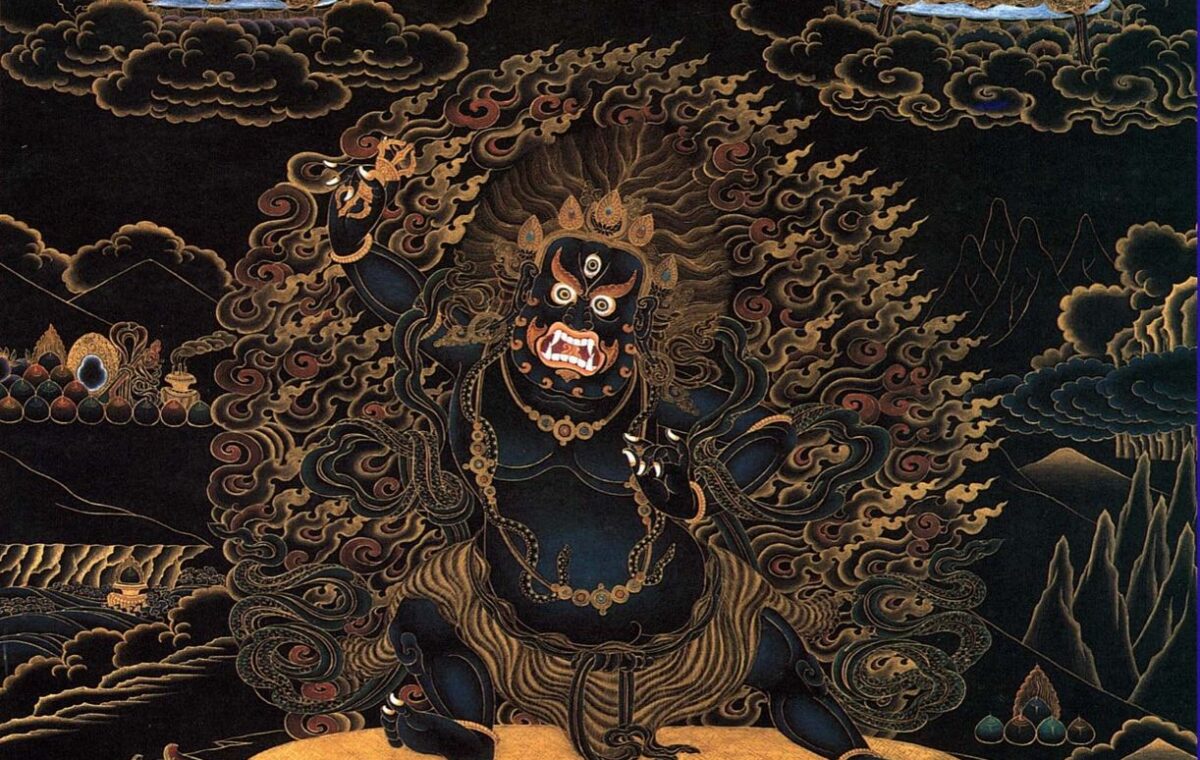
A Vajrapani thangka can look unmistakable: a powerful blue figure, eyes wide, teeth bared, hair rising, and flames surrounding the body. Yet wrathful Buddhist images are among the easiest to misidentify. Mahakala, Vajrabhairava, Yama-related figures, and other tantric deities may share dark color, skull ornaments, dynamic movement, and fire. The safest approach is to identify the attribute that gives Vajrapani his name: the vajra held in the hand.
Vajrapani means “vajra in hand” or “holder of the vajra.” In Buddhist art he appears in peaceful, semi-wrathful, and fully wrathful forms. Therefore, a single fixed checklist cannot cover every lineage or ritual cycle. This guide focuses on the common wrathful form and explains how to separate visible evidence from uncertain attribution.
Vajrapani thangka identification: the core evidence
Look first for the vajra
The vajra is the most important identifying attribute. In many wrathful forms, Vajrapani raises it in his proper right hand as if ready to strike through obstruction. The object may be small, partly hidden by flames, or visually merged with the hand in a low-resolution image. A label should not be accepted automatically if the vajra cannot be found; instead, note that the identification follows the catalog title and remains open to verification.
The vajra is not merely a weapon. It represents indestructibility and the concentrated power of awakened mind. In painting it usually has a central grip with symmetrical prongs. Do not confuse it with a short sword, curved knife, ritual chopper, club, or flame.
Read the blue or blue-black body cautiously
Wrathful Vajrapani is frequently dark blue. This color creates strong contrast against orange or red flames, white eyes, and pale bone ornaments. Pigment loss, varnish, scanning, and modern color correction can push the blue toward black or green. Color supports the identification but cannot establish it by itself.
Recognize wrathful appearance as a visual language
Glaring eyes, bared fangs, an open mouth, upward-streaming hair, a broad chest, and a forceful stance communicate intense awakened activity. They are not a depiction of moral evil. Wrath in Buddhist iconography expresses the uncompromising destruction of ignorance and obstacles. The expression should be interpreted with the hand attributes and ritual context, not isolated as a frightening face.
Flames, posture, and ornaments
A flame aureole often encloses the figure. The fire is commonly understood as the fire of pristine awareness, marking a transformed rather than ordinary anger. Vajrapani may stand in a lunging posture on a lotus, sun disc, prone figure, serpent, or another support specified by a particular practice. Because these details vary, they help identify the form only after the vajra and body type have been checked.
Wrathful ornaments may include a skull crown, bone jewelry, garlands, snake ornaments, an elephant skin, or a tiger-skin garment. Not every painting contains all of them. Their exact combination can point toward a named textual form, but making that final step usually requires an inscription or specialist comparison.
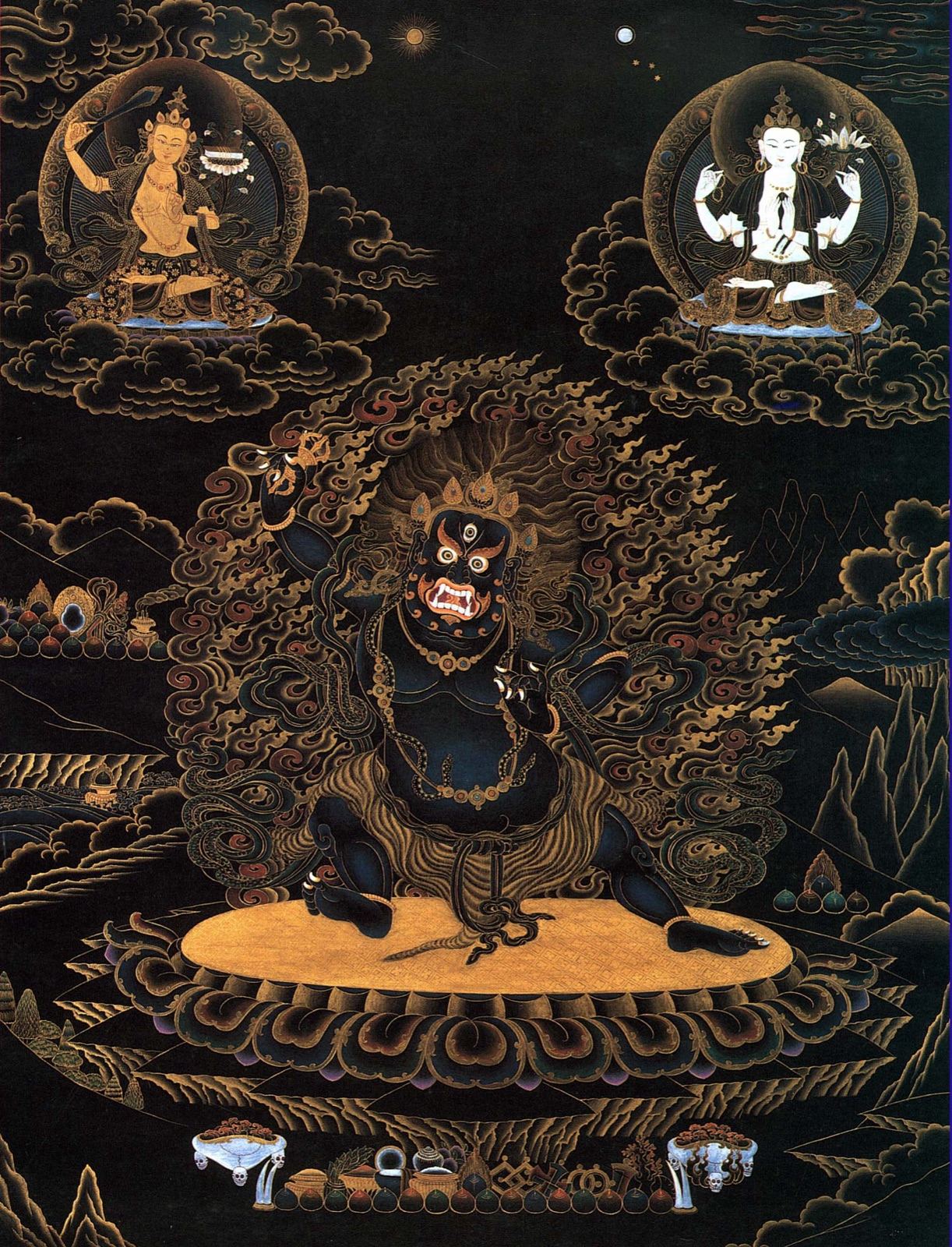
TK0585 presents a large dark central figure in a flame mandorla, seated or braced on a bright lotus platform. Two peaceful figures occupy the sky, and offerings appear below. The central posture and open arms differ from some familiar two-armed standing types. For that reason, the local title “Vajrapani” is useful, while the precise ritual form should remain uncertain unless documentary evidence is found.
How Vajrapani differs from Mahakala
Vajrapani and Mahakala can both be blue-black and wrathful. Mahakala is a protector category with many forms and may hold a curved knife, skull cup, trident, drum, lasso, or other implements. Vajrapani’s defining clue is the vajra. Number of arms also matters, but it is not sufficient because both names encompass multiple forms.
Compare the present method with the Six-Armed Mahakala thangka guide. That painting uses six arms and a specific group of ritual implements. A dark two-armed figure should not be called Mahakala or Vajrapani merely because the face and flames appear similar.
Peaceful Vajrapani and other variations
In Mahayana triads, Vajrapani may appear as a peaceful bodhisattva representing power, alongside Avalokiteshvara as compassion and Manjushri as wisdom. Peaceful forms may wear a crown, jewels, and silks. This is why “blue wrathful deity” is not a complete definition of Vajrapani. The name links diverse visual forms through texts and ritual traditions.
Context is often decisive. A peaceful bodhisattva holding a vajra in a known triad can be identified more securely than an isolated sculpture with no inscription. Similarly, a wrathful painted figure surrounded by a documented lineage or mandala cycle may be clearer than a cropped reproduction.
A practical wrathful Vajrapani checklist
- Can you locate a vajra, especially in the raised proper right hand?
- Is the body blue or blue-black, with a forceful wrathful appearance?
- Are the eyes, mouth, hair, and stance consistent with wrathful Buddhist iconography?
- Does a flame aureole surround the figure?
- Which ornaments, skins, garlands, snakes, or subsidiary figures are visible?
- Does the composition or inscription identify a lineage or ritual form?
- Could the figure instead be Mahakala or another similar wrathful deity?
How to write a responsible catalog description
Begin with observation: “dark blue wrathful male figure within flames.” Add attributes you can actually see. Then state the interpretation: “cataloged as Vajrapani; the exact form is uncertain.” If the vajra is clearly visible, say where it is held. If it is not visible, do not invent it from expectations.
This evidence-first habit is central to reading a Thangka. It is also useful when comparing Vajrapani with Manjushri and Avalokiteshvara: each identification rests on a network of attributes, not a single color.
Conclusion
A wrathful Vajrapani thangka is best identified through the vajra, supported by a blue body, fierce expression, dynamic posture, flames, and context. Wrath is a symbolic mode of awakened power, not a sign of evil. When an image lacks a clear attribute or inscription, preserving uncertainty is more accurate than forcing a highly specific name.
Sources and further reading
- Himalayan Art Resources: comparative records for Vajrapani
- The Metropolitan Museum of Art: The Bodhisattva Vajrapani (object record)
These references support comparative iconographic study. The TANGKAWORLD TK number is an internal catalogue identifier; artist, date, collection history, and provenance remain uncertain unless separately documented.
Download the full Thangka image collection
Continue browsing and download the complete TANGKAWORLD image library from our Thangka downloads. Comparing multiple paintings is one of the best ways to recognize recurring attributes and meaningful variations.