
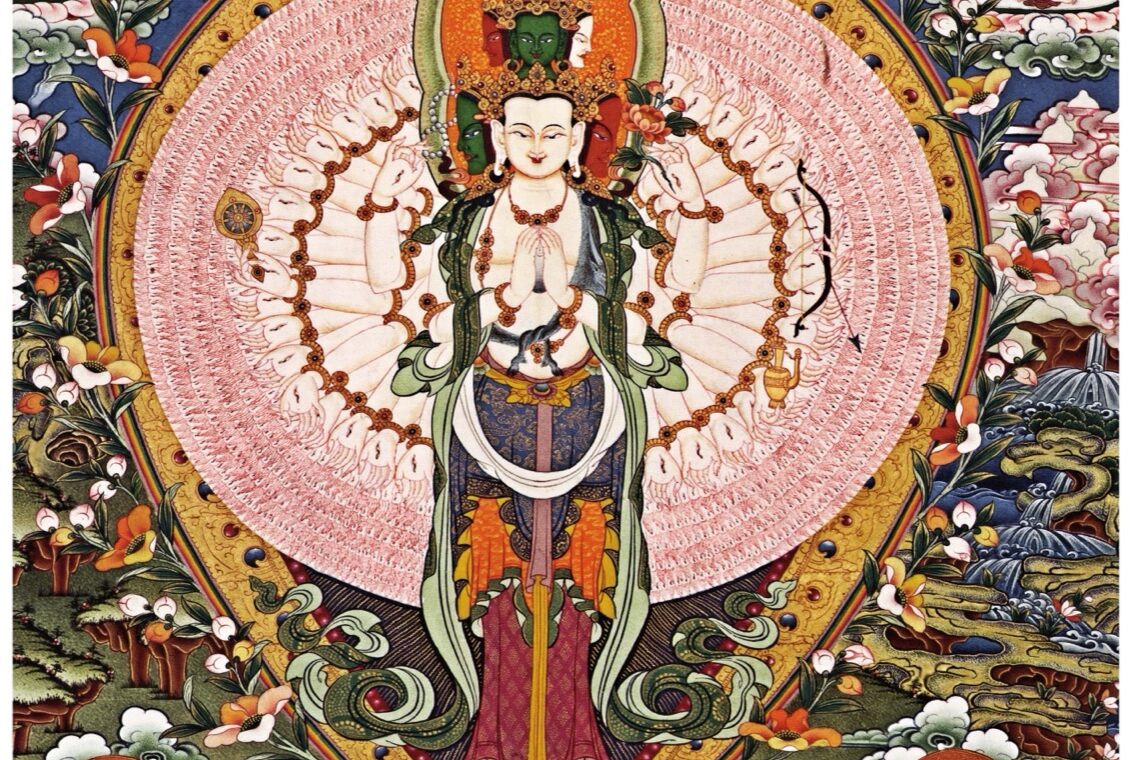
Thousand-Armed Avalokiteshvara is one of the most visually complex forms of the bodhisattva of compassion. A radiating field of hands can fill nearly the entire painting, while a vertical stack of heads rises above the central face. The abundance is purposeful: the composition turns compassion into a visible capacity to perceive suffering and respond in every direction.
This guide explains how to read that structure without relying on a single dramatic feature. It focuses on the central hands, the eyes placed in many palms, the arrangement of heads, and the surrounding figures that help establish context. It also distinguishes this form from Four-Armed Avalokiteshvara, whose smaller number of arms creates a very different visual rhythm.
Why Avalokiteshvara appears with so many arms
Avalokiteshvara is associated with compassionate attention to sentient beings. In the thousand-armed form, multiplicity becomes the central visual language. The many arms suggest activity extended across countless situations, while the eyes in the palms join seeing with doing. The image does not simply say that compassion observes suffering; it presents observation and response as inseparable.
The word “thousand” should not always be treated as a literal instruction to count every painted hand. Artists may render a dense symbolic field rather than exactly one thousand individually differentiated arms. Condition, cropping, scale, and regional convention can also affect what remains visible. Identification should therefore depend on the complete iconographic system, not on arithmetic alone.
Key features of Thousand-Armed Avalokiteshvara iconography
A calm central body
The central figure is typically peaceful even when the surrounding design is extraordinarily elaborate. A light-colored body, refined ornaments, long scarves, and a lotus support establish bodhisattva status. This contrast matters: visual complexity surrounds a composed center. A crowded painting with no peaceful Avalokiteshvara core may represent a different multi-armed deity.
Principal hands at the heart
The foremost pair of hands is often joined before the chest in a gesture of reverence. Other larger hands may hold recognizable attributes such as a lotus, rosary, wheel, bow, vessel, or other ritual objects. The exact selection can vary. These prominent hands form an intermediate layer between the central body and the great halo of smaller hands.
Eyes in the palms
Many palms display an eye. This is one of the strongest visual clues for the Thousand-Eyed form. The eye and hand operate as a symbolic pair: awareness is joined to compassionate action. In a high-resolution image, look for repeated eye shapes centered inside open palms rather than decorative marks placed randomly around the figure.
A vertical arrangement of heads
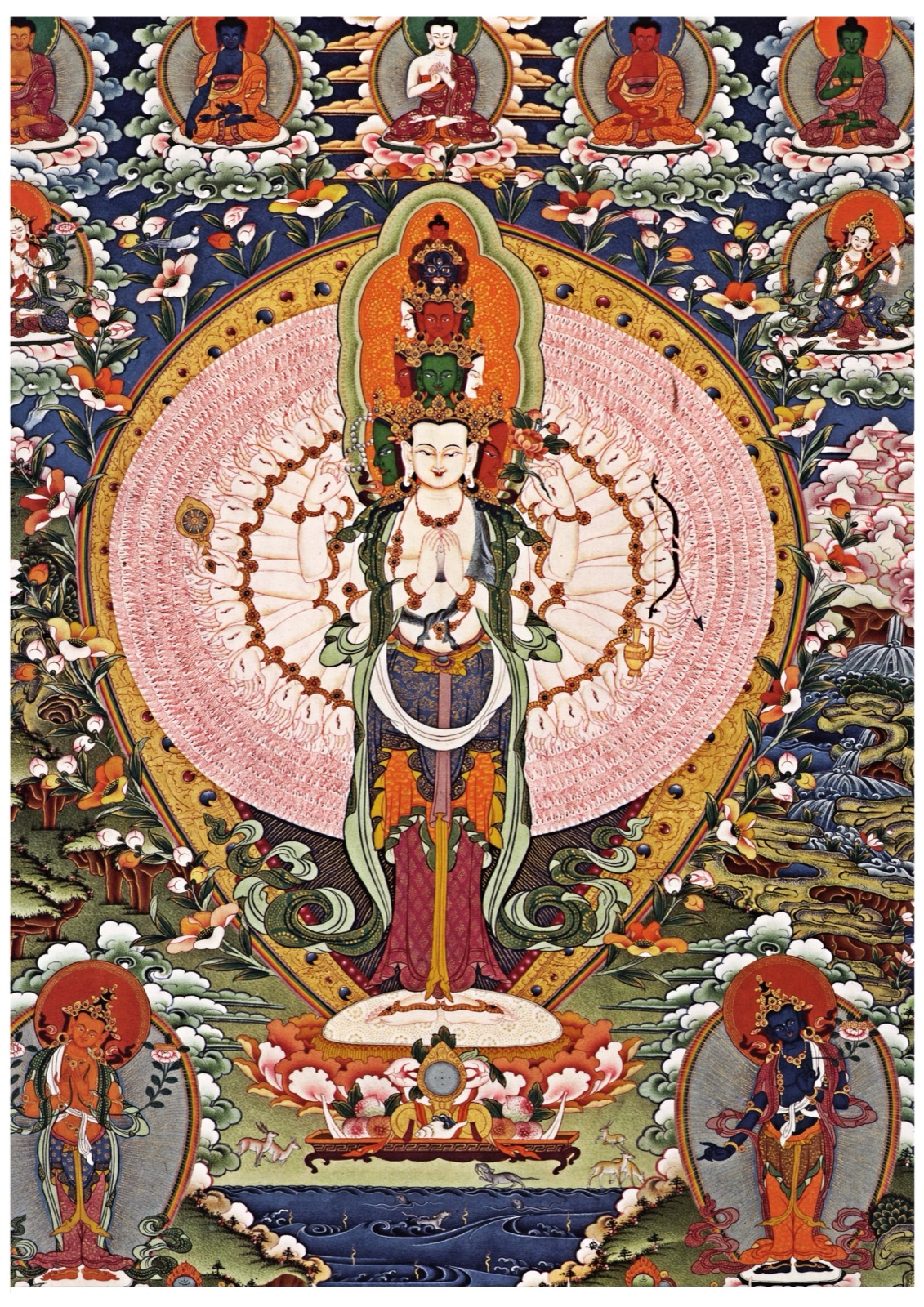
Multiple heads commonly rise in tiers. A typical composition may present peaceful faces in several colors, a wrathful face higher in the stack, and a Buddha image at the summit. The exact count can be difficult to read when faces overlap or details are small. In TK0402, the stacked heads are clearly central to the design, but the image alone does not establish which textual lineage or ritual cycle determined every detail.
The circular field of arms
The smaller arms often spread in concentric bands, producing an aureole-like field around the figure. This differs from a deity with six, eight, or twelve clearly separated arms, where every hand and attribute may be individually emphasized. Here, repetition itself carries meaning. The many pale arms create a visual atmosphere of unlimited reach.
How to distinguish this form from similar images
First compare it with Four-Armed Avalokiteshvara. The four-armed form often has two hands joined at the heart and two outer hands holding a rosary and lotus. It does not have the immense radiating hand field. Next, separate Thousand-Armed Avalokiteshvara from other multi-armed tantric figures by checking the peaceful expression, bodhisattva ornaments, central prayer gesture, and repeated palm eyes.
Do not identify the subject only because a filename contains “Guanyin,” “Chenrezig,” or “Avalokiteshvara.” Those names cover many forms across Tibetan, Chinese, Japanese, and other Buddhist traditions. A reliable reading connects the label to visible evidence. If the head arrangement, palm eyes, and principal attributes cannot be seen, the specific form should remain uncertain.
Reading the surrounding composition
TK0402 places additional deities and teachers around the main figure. Small seated Buddhas appear across the upper register, and subsidiary figures occupy the lower corners. Such figures can indicate lineage, retinue, donors, protectors, or a broader ritual program, but their identities should not be guessed from color alone. A tiny blue or red figure is not automatically identifiable without attributes, inscriptions, or a documented comparison.
Landscape, clouds, lotus ponds, offerings, and jewel-like borders also help organize the hierarchy. The central Avalokiteshvara is substantially larger than the surrounding figures, confirming the primary devotional focus. For a general method of moving from the largest figure to secondary registers, see How to Read a Thangka.
Practical identification checklist
- Is the central figure peaceful and bodhisattva-like rather than wrathful?
- Do two principal hands meet at the heart?
- Are larger attribute-bearing hands visible near the body?
- Does a broad circular field of smaller hands surround the figure?
- Can you see repeated eyes centered in many palms?
- Are multiple heads stacked vertically above the main face?
- Is a Buddha figure visible at or near the top of the head arrangement?
- Do the surrounding figures support, rather than replace, the main identity?
What the image cannot prove
Iconography can support identification, but it cannot by itself prove authorship, date, geographic origin, monastery, ritual ownership, or collecting history. Pigment color may also shift through scanning and digital editing. The archive title for TK0402 supports the subject identification, while the artist, exact date, school, and provenance remain uncertain. Those questions require inscriptions, object records, technical examination, or a documented chain of custody.
Conclusion
A strong identification of Thousand-Armed Avalokiteshvara rests on a coordinated group of features: the peaceful central figure, joined principal hands, attribute-bearing arms, eyes in the palms, a great radiating hand field, and tiers of heads. Together they transform compassion from an abstract virtue into an image of limitless perception and activity. When only one of these clues is visible, keep the attribution cautious; when the full system appears, the identification becomes much more secure.
Continue with the Four-Armed Avalokiteshvara guide to compare two major forms, or review White Tara’s seven-eye iconography for another Buddhist image that links compassionate awareness with additional eyes.
Sources and further reading
- Himalayan Art Resources: comparative records for Thousand-Armed Avalokiteshvara
- The Metropolitan Museum of Art: Thousand-Armed Chenresi (object record)
These references support comparative iconographic study. The TANGKAWORLD TK number is an internal catalogue identifier; artist, date, collection history, and provenance remain uncertain unless separately documented.
Download the full Thangka image collection
Continue browsing and download the complete TANGKAWORLD image library on the Downloads page.