
Amitabha vs Amitayus in Buddhist art is not a question with one universal visual rule. The names are closely related, and museum records do not always describe the relationship in the same way. In Tibetan and Himalayan images, however, the two are often catalogued as distinct iconographic forms: Amitayus is commonly shown richly adorned and holding a long-life vase, while Amitabha may appear in monastic robes in a Pure Land assembly or as a standing Buddha. These are useful clues, not automatic proofs. Read costume, attributes, posture, surrounding figures, inscriptions, and regional context together.
This guide offers a practical comparison for viewers and collection researchers. It also shows why an archive title should be recorded as a source label rather than silently converted into a certain identification.
| Visual clue | May support | Important limit |
|---|---|---|
| Vase of longevity held in meditation | Amitayus in many Himalayan images | Confirm that the object is a vase and read its setting |
| Monastic robes in a Pure Land assembly | Amitabha in some image types | Clothing and scene are not universal identifiers |
| Standing pose or hand gesture | Useful comparison evidence | Posture alone does not establish the name |
| Archive title or inscription | Documented naming evidence | Record who supplied it; verify inscription and image context |
Why Amitabha and Amitayus can be difficult to separate
Amitabha is associated with Infinite Light and the western Pure Land of Sukhavati; Amitayus is associated with Infinite Life and longevity. The names and devotional roles are related, and some museum descriptions explicitly call Amitayus a form or emanation of Amitabha. Other collection records give each name as a distinct object identity and describe different visual attributes. That variation means a comparison should begin with the specific tradition and catalogue language, not with a claim that one feature always settles the question.
For example, the Los Angeles County Museum of Art describes Amitayus as a form of Amitabha, while its object record identifies a particular Amitayus image through the long-life vase and meditation gesture. The Metropolitan Museum of Art separately catalogs a Tibetan Amitayus painting and a dated standing Amitabha sculpture. These records are useful comparanda, but their object-specific labels do not make every similar image certain.
Compare the visual clues as a group
1. Look for the attribute before relying on color
A vase held in the hands or resting in the lap is a strong clue for Amitayus in many Himalayan depictions, especially when it is presented as a longevity vase. The Met’s Tibetan painting record describes Amitayus with a jar of amrita in his lap; its separate Enthroned Amitayus object record likewise emphasizes the longevity vase. But a small vessel can be hard to distinguish from a bowl, flower, or painted ornament in a low-resolution image. Record what is visible first, then state whether the object is identified or only probable.
Color alone is weaker. Red, gold, and other saturated colors appear across many Buddhist figures and painting traditions. Do not label a figure Amitayus merely because the body or robe appears red, and do not label Amitabha merely because a figure wears red or ochre monastic clothing.
2. Read clothing and adornment together
Amitayus is often represented in a richly ornamented, bodhisattva-like appearance: crown, jewelry, patterned garments, and a vase may appear as a coordinated set. Amitabha may instead wear the simpler robes of a Buddha, particularly in Pure Land imagery. Yet these are conventions, not a universal costume code. Regional style, ritual setting, and the particular image type can change how a figure is dressed.
Describe the visible clothing precisely—crown, bare or covered shoulders, necklaces, robe edges, and textile patterns. Then compare those details with a named reference object from a museum collection. Avoid turning “looks like a robe” into proof of a school, date, or identity.
3. Treat posture and hand gestures as supporting evidence
Seated meditation, a standing pose, a lowered hand, or a gesture near the chest can help narrow an interpretation, but gestures vary across regions and image types. A standing Amitabha is a documented form: the Met’s 1506 example is identified through a sleeve inscription as well as its visual features. That is a useful lesson for research: when a strong inscription or reliable catalogue exists, it can make the attribution more secure than posture alone.
When no inscription is legible, name the hand positions descriptively: “right hand raised near the chest,” “left hand lowered,” or “hands joined around a vessel.” Use the Sanskrit or tradition-specific name for a mudra only when the hand shape and context support it. A partial or stylized gesture should remain uncertain.
4. Read the surrounding composition
Amitabha often appears in a western Pure Land setting or with attendants associated with that assembly. Amitayus images may foreground longevity, a vase, offerings, or a long-life ritual context. Assemblies, inscriptions, donor figures, and neighboring deities can all help. Still, a single central figure cropped from a larger painting cannot preserve every contextual clue.
Separate three levels in your notes: what is visible in the surviving image; what the archive title or collection record says; and what remains an interpretation. This distinction is especially important when an image has been cropped, digitally recolored, or detached from its original mount. For a practical way to record condition and uncertain areas separately, see our Thangka condition report visual checklist.
Case study: what TK1109 supports—and what it does not
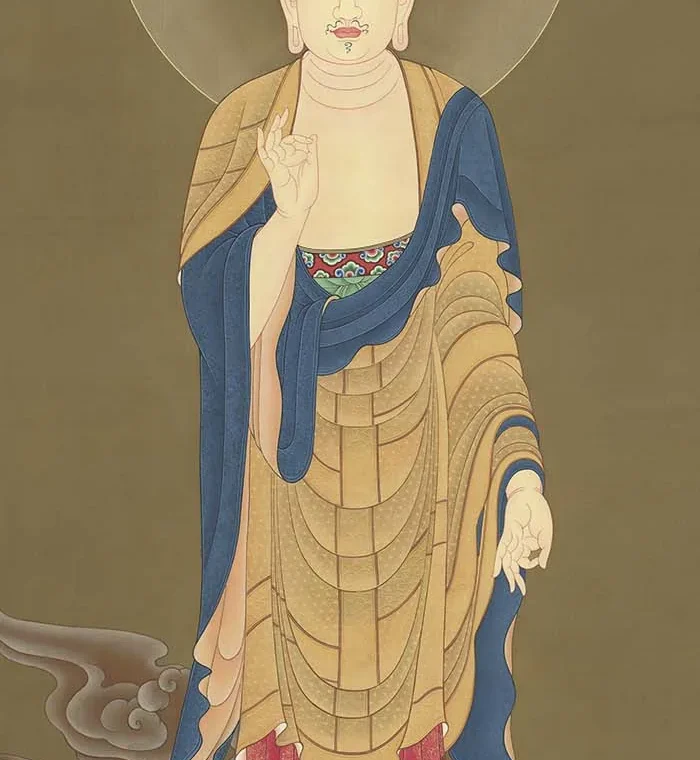
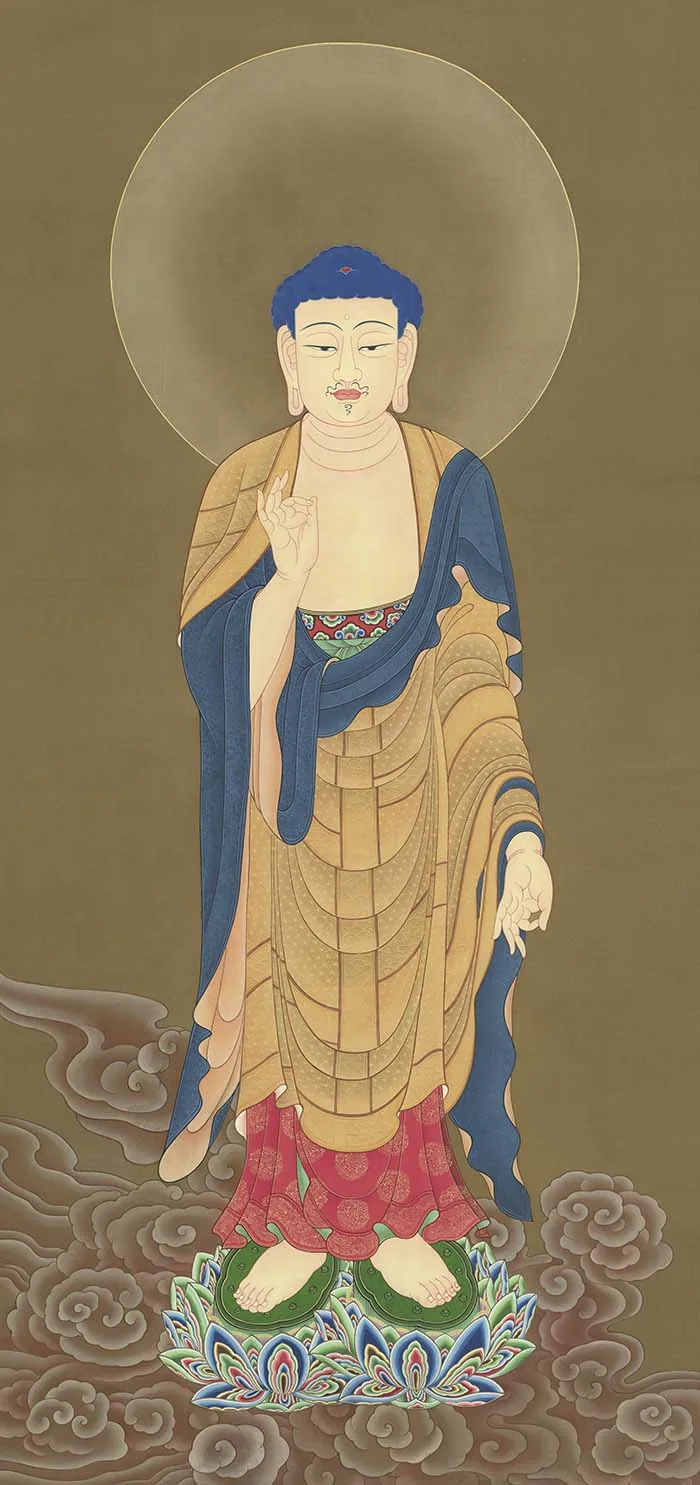
The archive filename for TK1109 reads “Three Saints of the West and Amitabha Buddha.” The available image, however, shows one standing Buddha-like figure with a circular halo, raised and lowered hands, gold-and-blue robes, a multicolored lotus base, and clouds. The filename is valuable evidence of how the image was labeled in the archive, but it does not independently establish that the source object showed a triad, nor does it prove the figure’s identity, date, maker, school, provenance, or original context.
A careful record might therefore say: “Archive filename identifies Amitabha; visible image presents one standing haloed figure; exact identification and original grouping uncertain.” If a higher-resolution original, a mount, an inscription, or a reliable catalogue becomes available, the attribution can be reviewed. Until then, the image is best used to demonstrate a method of comparison rather than as a definitive Amitabha or Amitayus template.
A short identification checklist
- Record the label: copy the archive or collection title exactly and mark its source.
- Describe the figure: note standing or seated posture, robe or jewelry, halo, and visible colors.
- Check for attributes: determine whether a vase, bowl, lotus, or other object is actually legible.
- Inspect the hands: describe the gesture before assigning a mudra name.
- Read the setting: look for attendants, Pure Land architecture, offerings, inscriptions, and donor figures.
- Compare responsibly: use documented Amitabha and Amitayus examples from the same broad tradition where possible.
- State uncertainty: keep visual observation, archive wording, and your interpretation in separate sentences.
How this comparison fits with other Thangka studies
For a scene-level study of Amitabha, see our Amitabha Pure Land painting visual guide. For the longevity vase and the richly adorned Amitayus type, continue to the Amitayus Thangka identification guide. If you are documenting the circular halo in a single-figure image, our guide to the Buddhist halo in Thangka offers a separate visual method. These pages address different questions: composition, identifying attributes, and framing—not interchangeable shortcuts to attribution.
Conclusion: let context do the deciding
The most reliable Amitabha-versus-Amitayus reading combines attributes, costume, posture, setting, inscriptions, and documented tradition. A longevity vase and jeweled appearance may support Amitayus; monastic robes or a standing form may support an Amitabha reading in a particular context. None should be treated as an isolated rule. When the evidence is incomplete, a precise description with an explicit “uncertain” is more useful than a confident but unsupported name.
Download the full Thangka image collection
Continue browsing and download the complete TANGKAWORLD image collection to compare Buddhist figures, attributes, compositions, and visual details across a much wider archive. Browse and download the full TANGKAWORLD collection.
Further collection references: Compare a Tibetan Amitayus painting at The Met, the Met’s standing Amitabha sculpture, and LACMA’s Amitayus votive tablet. Each is a specific catalogued object; do not transfer its date, medium, or attribution to TK1109.