
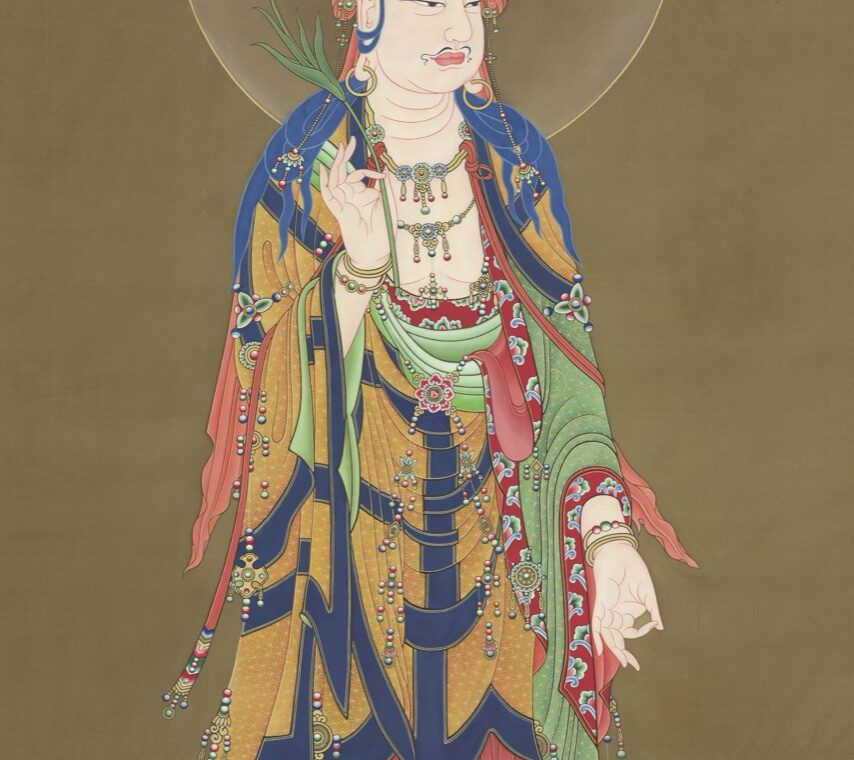
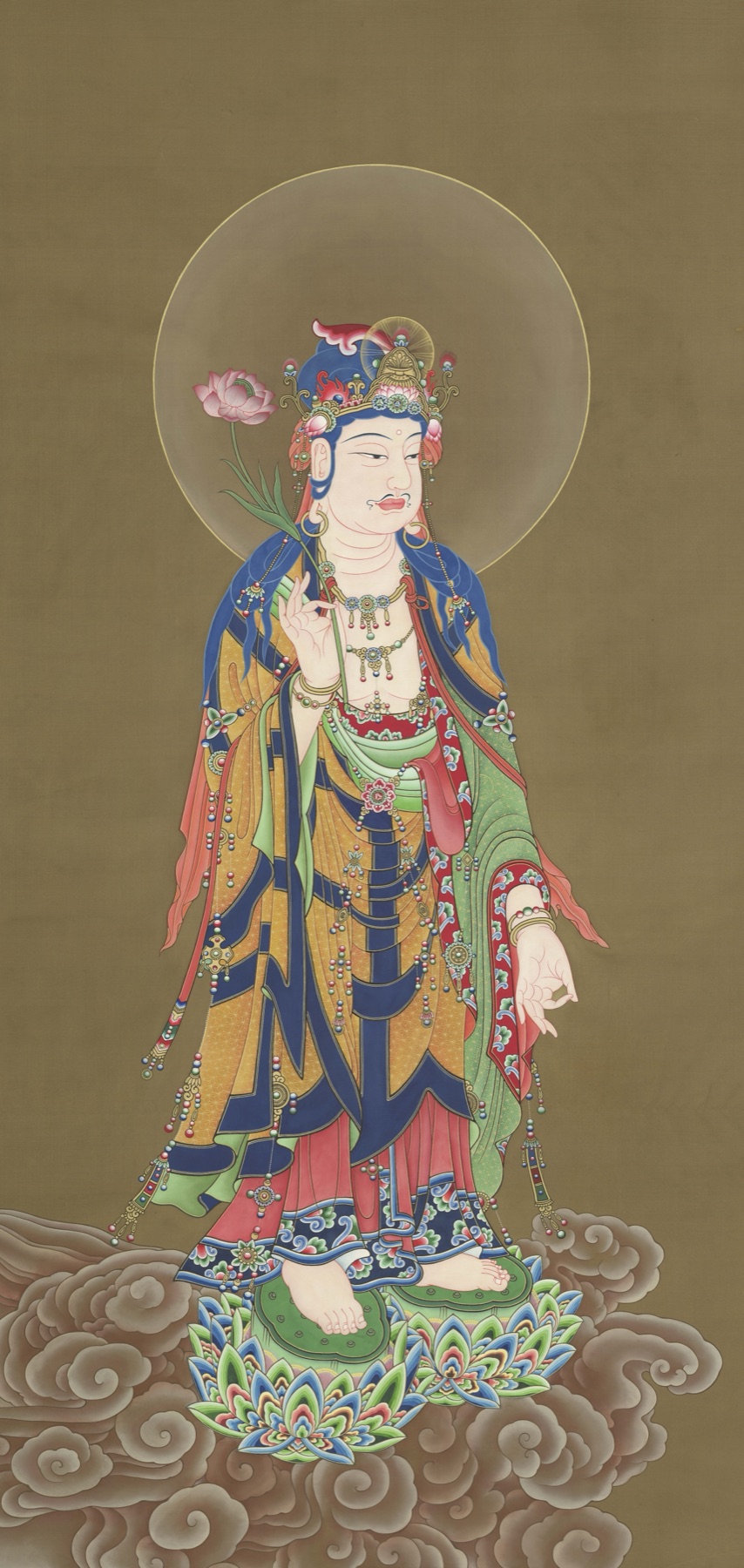
Layered garments in Buddhist art can be read as both clothing and composition. Color bands, overlapping edges, patterned panels, jewelry, and folds lead the eye over a figure’s body, but they do not by themselves identify a deity, date, school, or material. In TK1106, a standing haloed figure wears strongly contrasting blue, green, red, and gold forms, with pendant ornaments and a lotus-and-cloud base. This guide shows how to describe those visible layers carefully—without turning a painted surface into unsupported claims about historical textiles or religious identity.
What layered garments can tell you—and what they cannot
In a Buddhist painting, “layered garment” is a useful visual description when one colored form overlaps another or when several garment zones are distinguished by edges, borders, and pattern. It helps viewers map the figure: where a sleeve falls, where a sash crosses the torso, how a draped panel turns at the knee, or how an outer robe frames an inner garment.
The phrase describes what the image shows, not necessarily how a real garment was made. A painted border may suggest an edge; it does not prove a seam. A repeated pattern may look like brocade, but it cannot establish the weave, fiber, dye, or construction without material examination. Keep observation and material interpretation separate.
Garments can also contribute to iconographic reading, especially when a known figure’s dress follows a documented convention. Yet clothing rarely works as a stand-alone name tag. Compare it with posture, hand gestures, attributes, companions, inscriptions, and the full composition. For an evidence-first starting point, see our beginner’s guide to reading a Thangka.
TK1106: follow the color bands and ornament lines
TK1106 provides a practical case study. The full image shows one haloed standing figure, a large circular halo, layered colored garments, hanging jewelry, a lotus base, and clouds. The source file places the image in a “Three Saints of the West” group and includes a Great-Power label, but those catalog clues are not confirmed by the visible figure alone. Here, the subject is therefore described neutrally; identity, date, maker, school, and provenance remain uncertain.
Begin at the outer contour rather than naming the garment. In TK1106, the dark blue forms create long vertical panels through the body, while green and red areas appear between and around them. Gold and patterned edges break those larger color fields into smaller units. The necklace and hanging ornaments add another series of short, downward lines. Taken together, the bands and pendants guide the eye from the headdress toward the torso, hands, and lotus base.
That description is specific enough to compare with other images. It does not require calling each panel a robe, sash, scarf, or textile layer when the exact garment terminology is uncertain. If a label is needed, use cautious language such as “blue outer-looking panel” or “green draped area,” then note the basis for the term.
Trace overlaps from shoulder to hem
To read drapery, follow one boundary at a time. Start near the shoulder and track an edge down the torso. Does it continue in a straight fall, angle across the body, disappear behind an arm, or return at the waist? Then trace a second color area and note where it passes in front of or behind the first. This simple mapping prevents a viewer from treating every outline as a seam or every fold as a separate garment.
Next, look for changes around joints. At the elbow, wrist, hip, or knee, a line may curve or break to suggest bending fabric. A dark border can clarify the contour, while a repeated motif may remain unchanged across a fold. Record both facts. Do not infer movement, weight, or a specific tailoring method from a stylized contour unless the image provides enough evidence.
For documentation, a full-frame photograph should accompany close views of the shoulder, waist, and lower garment. The full image shows how the clothing relates to the halo, lotus seat, and surrounding space; close views preserve details of color and pattern. A Thangka condition report can also record whether fading, abrasion, creases, or losses interrupt an edge.
Read clothing as part of the figure’s vertical composition
Clothing is not isolated decoration. In TK1106, long colored bands and hanging jewelry reinforce the figure’s upright stance, while the broad halo forms a circle behind the head and the lotus-and-cloud base spreads horizontally below the feet. These contrasting directions create a legible structure: circle, vertical body, and grounded base.
Notice where the pattern becomes dense and where it opens. The torso contains several overlapping colors and ornaments; the background around the halo is comparatively plain. The difference in detail helps the figure remain distinct from its ground. This is a compositional observation, not a claim that the garments symbolize a particular doctrine.
Compare this approach with our guide to scale hierarchy in Buddhist art. That article considers how size and placement organize importance; this one focuses on garment boundaries, color, and surface rhythm within a single figure. Both methods work best when the whole painting remains in view.
Distinguish layered dress from patchwork robe patterns
Not every many-colored garment is a patchwork robe. A patchwork description is most useful when the image visibly organizes a robe into repeated rectangular units. Layered dress, by contrast, can refer more broadly to overlapping colored zones, borders, sleeves, scarves, and ornament. TK1106’s flowing color areas and pendant lines are not the same visual problem as a grid of repeated robe panels.
Our separate Buddhist patchwork robe documentation guide examines panel arrangement and garment zones in TK1147. Use that comparison when a regular grid is visible. If edges are flowing, irregular, or obscured, describe their direction and color before applying a more specific textile term.
A practical checklist for reading garment layers
- Record the full figure and the entire composition before making a close crop.
- Map each visible color zone and trace its boundary from shoulder to hem.
- Note where one edge passes over, under, or behind another form.
- Describe borders, repeated patterns, folds, and jewelry as separate features.
- Use “seam,” “brocade,” “silk,” or a garment name only when evidence supports it.
- Compare the clothing with gestures, attributes, companions, and inscriptions.
- Keep identity, date, school, maker, material, and provenance uncertain when unverified.
- Save both full-frame and detail images so later viewers can check your description.
This checklist supports catalog notes, image captions, and comparative study. It is not a substitute for conservation analysis or specialist identification. When the figure belongs to an established iconographic type, consult reliable catalogues and compare several independent attributes rather than relying on costume alone.
Conclusion: describe the visible layers first
Layered garments in Buddhist art can clarify how a painted figure is organized: color bands define zones, overlapping edges suggest depth, and jewelry adds fine vertical accents. TK1106 makes those relationships easy to observe, while leaving its exact figure identity and object history unresolved. Record what the image shows, distinguish painted pattern from physical textile evidence, and interpret the clothing only in context.
Download the full Thangka image collection
Continue browsing and downloading the complete TANGKAWORLD image collection to compare Buddhist figure garments, ornament, color, and composition across the archive.