
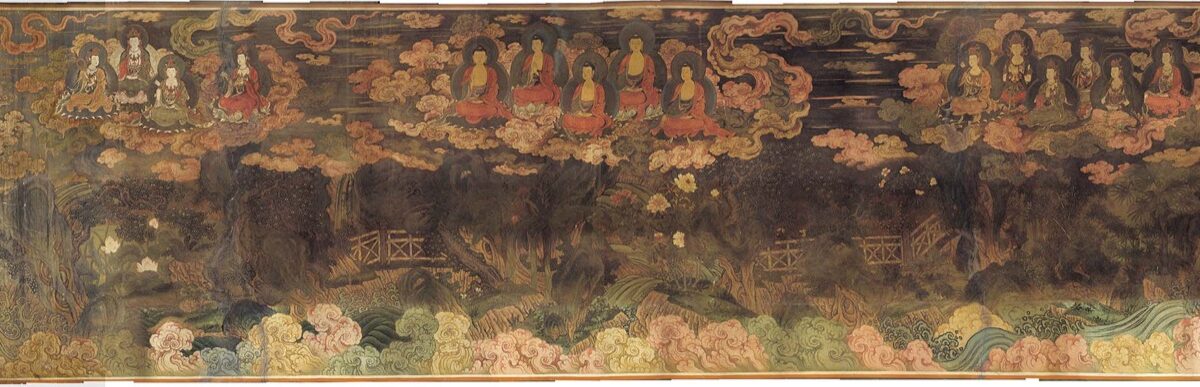
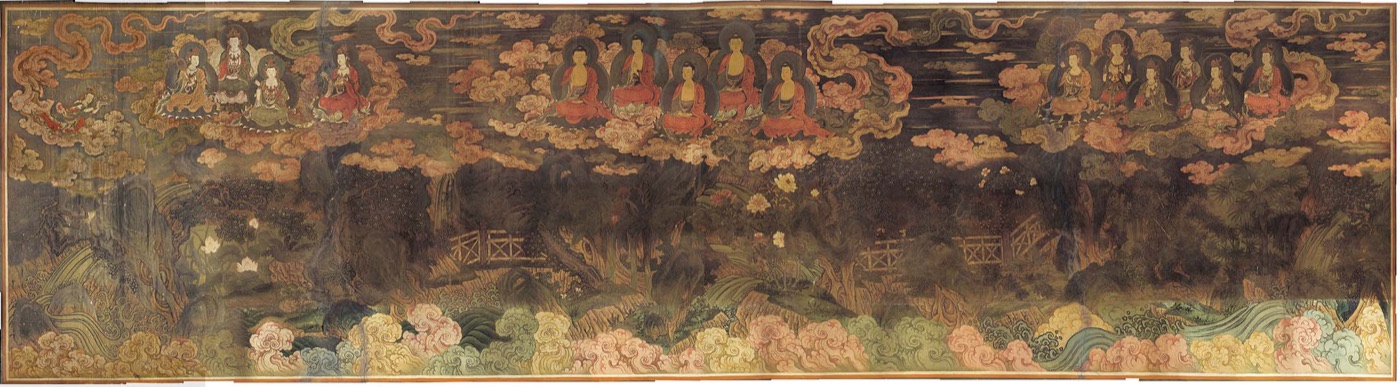
Buddhist procession in art is not simply a row of figures. A procession creates meaning through direction, spacing, scale, landscape, vehicles, garments, and the destination implied beyond the image. Before trying to name every participant, map the movement: who leads, who follows, which figures face forward or back, and what visual route joins them. This method is especially useful for mural details and handscrolls, where a scene may continue beyond a cropped photograph.
TK0763 provides a useful case. Several robed and armored figures move through a landscape in a horizontal field. Their arrangement gives the image a clear direction, but the archive grouping alone does not prove the name or role of each participant. The responsible reading is to separate visible procession structure from claims about deity identity, ritual setting, date, or attribution.
Find the direction of travel
Start by tracing every head, body, mount, banner, and garment edge. Are figures moving toward the same side of the picture? Does one form turn back toward the group? In a procession, direction is often conveyed by repeated feet, faces, gestures, and overlapping outlines rather than a painted road. Record those cues before deciding whether the movement represents arrival, departure, escort, pilgrimage, or a narrative episode.
In a long horizontal composition, the empty space before a group can be as important as the figures behind it. A broader gap may create anticipation of a destination; a cluster may slow the movement and signal hierarchy. Neither effect needs a speculative label to be useful for documentation.
Build a procession map
Divide the image into zones
Make a simple left-to-right map. Note foreground terrain, central figures, upper clouds or architecture, and any boundary at the edge of the scene. In TK0763, the landscape does not merely fill the background: it separates bodies, frames silhouettes, and establishes the horizontal path. This map is more reliable than a general note that the image contains “many figures.”
Compare scale and costume
Larger bodies, more elaborate robes, haloes, weapons, or elevated positions may indicate visual importance, but they do not automatically name a figure. Compare scale within the same painted field first. Record what is actually visible: patterned textile, armor-like surfaces, headgear, hands, banners, or a mount. If the small details are unclear, mark them uncertain rather than rebuilding them from expectation.
Look for visual links
Processions are held together by repeated forms: cloud bands, a shared garment color, grouped attendants, or a line of faces. Follow these links across the composition. They can reveal whether a small figure belongs to the traveling group, a separate landscape vignette, or a border. This is particularly important when an image has been cropped from a larger mural.
What a procession can and cannot prove
A procession can show movement, order, and relationships among figures. It may also suggest a wider assembly outside the crop. It cannot by itself establish a temple, period, workshop, ceremony, or named deity. Motifs and garments can be copied across regions and periods; an archive filename may summarize prior cataloguing rather than provide a documented attribution.
For TK0763, describe it as a Buddhist mural procession in a landscape and retain specific identities and historical details as uncertain without a dependable catalogue or inscription. This preserves the image’s research value while leaving room for later evidence.
A practical checklist
- Record the direction of each visible figure, mount, and banner.
- Map empty space, terrain, clouds, and architectural forms around the group.
- Separate leaders, attendants, guards, and bystanders only when visual evidence supports the distinction.
- Note repeated colors, costumes, gestures, and overlaps that link figures together.
- Check whether cropping may conceal the beginning or destination of the scene.
- Look for inscriptions, seals, catalogue records, and mounting context before accepting attribution.
- Keep identity, date, maker, school, collection, provenance, and ritual function uncertain when they cannot be verified.
Connect the scene to other visual guides
A procession often includes attendant figures, garments, halos, and layered spaces. For methods that support closer comparison, see Buddhist attendant figures in Thangka, Buddhist robe documentation, and How to Read a Thangka. These guides help turn a broad narrative impression into a sequence of checkable observations.
Document a mural fragment responsibly
A procession may survive only as one photographic strip from a larger wall painting. Treat the crop as a record of what is visible, not as a complete narrative. Note the image filename and TK number, the edges that interrupt figures or landscape, the orientation of the photograph, and whether a neighboring scene is implied by a cut-off road, cloud band, architectural form, or body. These observations help another reader understand both the painting and the limits of the reproduction.
Use a descriptive working caption first: “Buddhist mural procession in a landscape, figures and historical attribution uncertain.” Then add only details that can be pointed to in the image, such as a robed leader, a possible armored attendant, a banner-like form, or a group moving across terrain. A later catalogue, conservation report, inscription, or reliable museum record may refine the attribution. Until then, a careful visual record is more useful than an impressive but unsupported identification.
For comparison, keep the same order of observation across related images: direction, figure groups, costume, terrain, boundaries, and inscriptions. This makes it easier to see whether two fragments belong to a shared procession without assuming that they do. It also creates a repeatable method for students, curators, and collectors working from digital images.
Conclusion
Reading Buddhist procession in art begins with movement. Direction, spacing, scale, costume, landscape, and repeated forms make a traveling group legible before every figure is named. TK0763 shows why a wide mural fragment should be documented as a structured visual route, with identities and attribution kept uncertain until supporting evidence is found.
Download the full Thangka image collection
Continue browsing and downloading the complete TANGKAWORLD image collection to compare narrative scenes, mural fragments, figures, costumes, landscapes, and borders in greater detail.