
Negative space in Buddhist art is the area that surrounds a figure, halo, object, or group rather than the painted form itself. It can be a dark ground, an open field of color, a band of sky, a pause between attendants, or the margin around an inscription. In a Thangka, mural, or album leaf, these quiet areas are not empty in the sense of being irrelevant. They shape how the viewer finds the main figure, compares scale, and moves through a crowded sacred image.
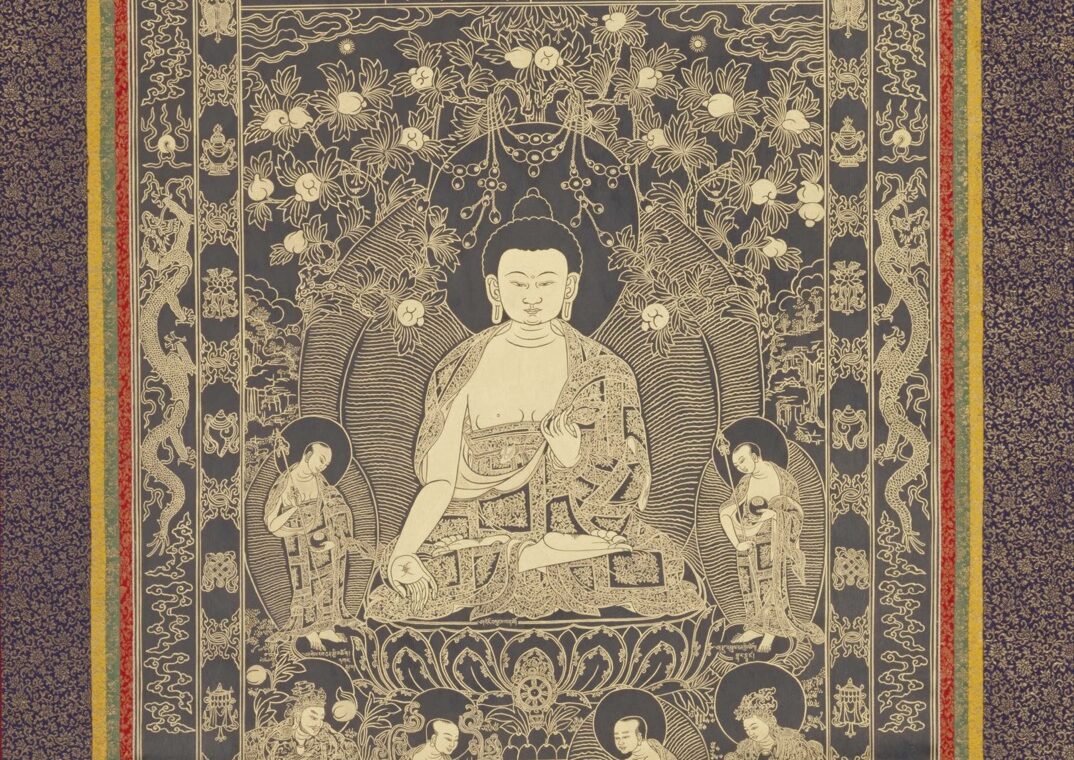
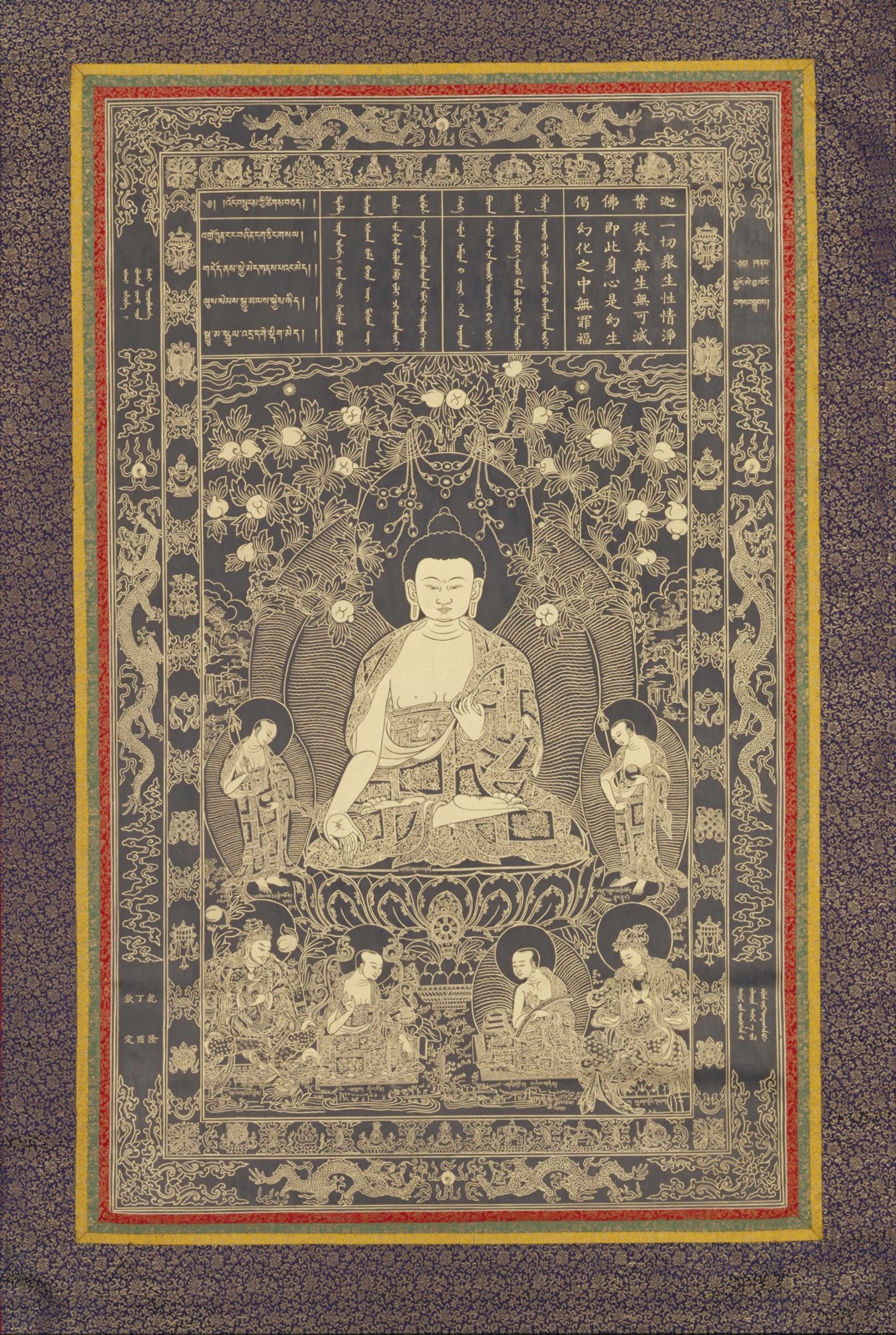
TK0382 offers a useful visual exercise. A central seated Buddha appears within a dense arrangement of figures, trees, text, and borders. Around the face and halo, darker and less detailed areas make the central form easier to locate. That observation does not identify a workshop, date, or religious function. It does show how contrast and spacing can organize attention before an iconographic reading begins.
Start by looking at what is not painted
When studying an image, resist the urge to catalogue every object immediately. First trace the spaces between forms. Where is the widest uninterrupted field? Where do outlines separate cleanly from their surroundings? Where do branches, clouds, garments, or borders close down the available space? A simple map of these intervals often explains why the eye lands on one figure before another.
Negative space is especially clear when a figure has a halo or a strongly outlined head. The area around the circle can isolate the face, while patterned robes and nearby attendants create visual density below. In a black-ground or dark-blue composition, fine gold lines can be legible because the surrounding ground supplies contrast. In a more colorful work, a pale cloud or open landscape can perform the same task.
Read contrast without turning it into a fixed symbol
Dark and open areas may feel solemn, expansive, or dramatic, but those impressions are not proof of a specific doctrine or identity. A dark field can result from a painting technique, a damaged photograph, a cropped reproduction, or a deliberate compositional decision. Describe the visible relationship first: “a dark ground frames the halo” is stronger than claiming that darkness must represent a particular cosmic realm.
Likewise, an unpainted-looking margin near a text panel may simply improve legibility. A wider interval between figures may distinguish registers, make room for a tree, or mark the edge of a scene. Record the visual function—separation, framing, contrast, or directional pause—before assigning a meaning that requires external evidence.
Map the image from center to edge
Find the focal zone
Identify the first area your eye reaches. In TK0382, the central seated Buddha is made conspicuous by scale, symmetry, halo, and the space immediately around the head. Then test that first impression: would the figure remain prominent if the nearby outlines were denser or the ground lighter? This comparison separates the work of negative space from the work of size, color, and iconographic attributes.
Follow the crowded zones
Next, note where the image becomes busiest. Fruiting trees, the six surrounding figures, multiscript text, and dragon borders produce a different rhythm from the central field. Dense zones can establish a frame, create a secondary register, or guide the gaze back toward the principal figure. They should be recorded as relationships rather than treated as decorative leftovers.
Check the edges and crop
An image file may omit mounting fabric, inscriptions, or neighboring painted sections. If an edge cuts through a branch, a dragon, or an inscription, it may be a photographic crop rather than the original painted boundary. Mark that uncertainty. A reliable condition record distinguishes the edge of the object from the edge of the digital image.
A practical checklist for negative space
- Mark the largest open or low-detail areas before naming figures.
- Compare the space around the central face, halo, hands, and throne.
- Record whether contrast comes from a dark ground, pale color, sky, cloud, or a gap between forms.
- Map crowded zones of text, trees, attendants, garments, and borders.
- Check whether open areas are original composition, damage, shadow, glare, or image cropping.
- Describe visible visual functions before assigning symbolic meanings.
- Keep date, maker, school, collection, provenance, and unverified identities uncertain.
Use negative space for comparison
Once this method is clear, compare it with other guides in the collection. Buddhist halo geometry helps separate a halo’s outline from the space around it. Overlapping forms in Buddhist art shows how dense layers affect depth. Thangka border documentation is useful for deciding where an image ends and a decorative surround begins.
These comparisons are practical because they turn an abstract design term into repeatable observations. A reader can ask the same questions of a large mural detail, a small album painting, or a digital scan: what is isolated, what is crowded, where does the eye pause, and what evidence supports that description?
Keep observation and interpretation separate
In a research note, make two short lists. The first records what the image visibly shows: a dark ground, a circular halo, a gap between attendants, a dense tree canopy, or a clear margin around text. The second records questions for later research: whether the ground belongs to a particular painting tradition, whether a border has been cropped, or whether the text identifies the scene. This division prevents a useful formal observation from being mistaken for a confirmed historical fact.
It also makes a digital image easier to revisit. A later high-resolution file may reveal an inscription, a join in the support, or details lost in a smaller reproduction. The original observation remains valid, while the interpretation can be refined as evidence improves.
Conclusion
Negative space in Buddhist art is a tool for close looking. It frames faces and halos, separates figures, gives inscriptions room to be read, and controls the route through a complex image. In TK0382, the dark and open intervals around the central figure make the composition more legible without proving historical or religious claims beyond the available evidence. Begin with those visible relationships, then use catalogues, inscriptions, and conservation records to test any further interpretation.
Download the full Thangka image collection
Continue browsing and downloading the complete TANGKAWORLD image collection to compare open fields, halos, figures, inscriptions, landscapes, and borders across Thangka images.