

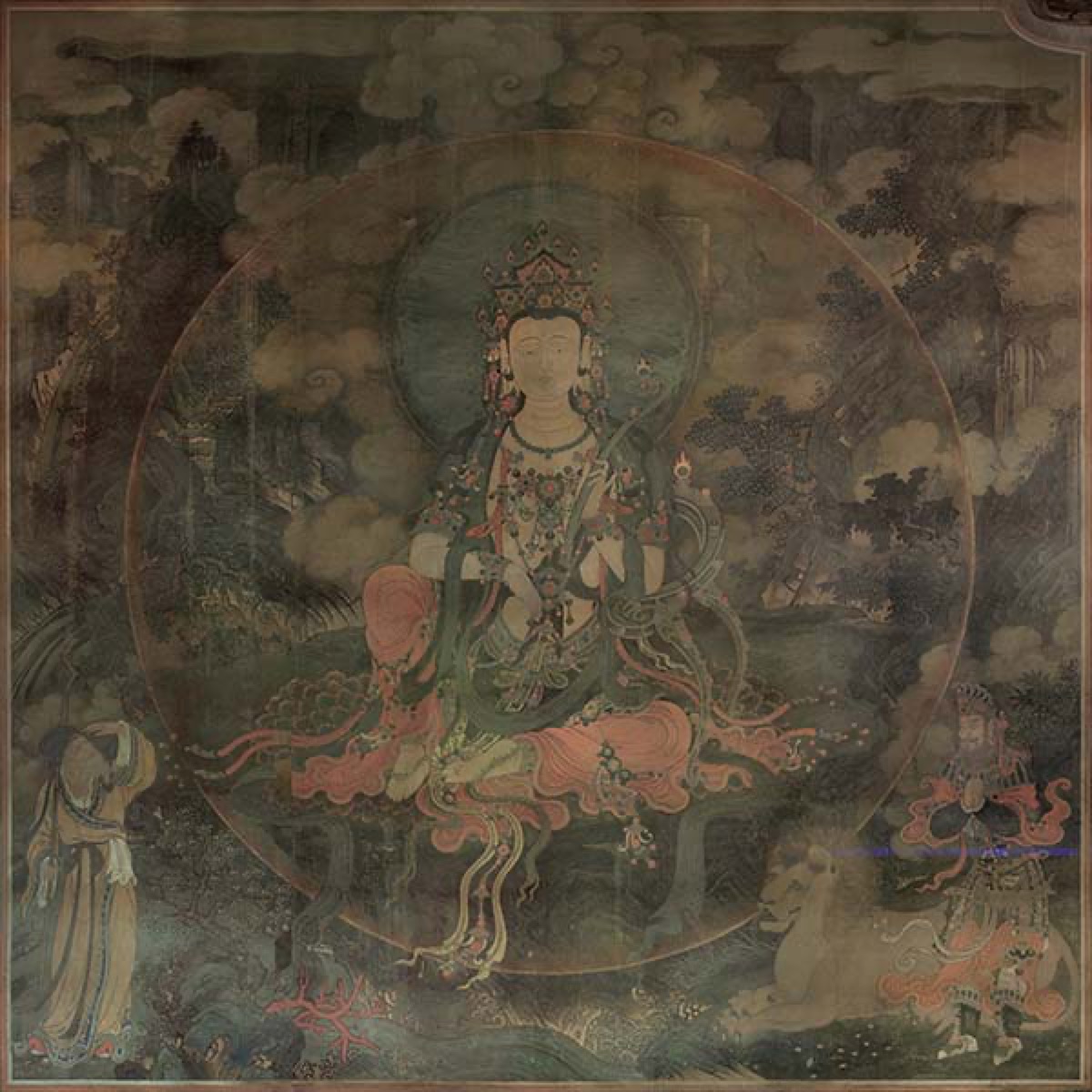
Manjushri lion symbolism is one of the most useful visual routes into Buddhist art. Manjushri, the bodhisattva of wisdom, is frequently shown with a lion, while the lion’s roar offers a powerful image for the force and clarity of Buddhist teaching. Yet a lion does not identify every figure automatically. A careful reading starts with the relation between rider and animal, then tests other visible features—posture, hands, implements, halo, attendants, and the larger setting.
TK0734 provides a focused example. A crowned bodhisattva sits above a lion in a circular halo, surrounded by cloud forms, a dark landscape, and small attendant figures. The archive name supports a Manjushri reading, but a digital image alone cannot establish every historical detail. The strongest description is therefore visual and provisional: a Manjushri-associated bodhisattva on a lion in a Buddhist mural scene.
Why the lion matters
In Buddhist visual language, a lion can communicate presence, authority, and a teaching voice that cannot easily be ignored. The association is not merely decorative. In many traditions, the “lion’s roar” describes the confident proclamation of Dharma. When Manjushri rides or is closely paired with a lion, the animal can extend the bodhisattva’s wisdom into the physical space of the composition: steady, alert, and capable of crossing a difficult landscape.
But the lion is one clue among several. Lions can accompany other sacred figures, serve as architectural supports, or appear in decorative borders. Start by observing whether the animal functions as a mount, a companion, a throne support, or an independent motif. In TK0734, the lion is directly beneath the central bodhisattva and shapes the figure’s profile, making the mount relationship visually important.
Begin with the rider, not the animal
Look at posture and dress
Manjushri is commonly presented as a bodhisattva, often with a crown, jewelry, flowing scarves, and a poised seated posture. Those features distinguish a bodhisattva form from a monastic Buddha, but they do not establish a unique name. Record what is visible before applying a label: jeweled ornaments, crown points, textile patterns, the direction of the torso, and the relationship of the feet to the lion.
Search for the sword and lotus
Manjushri is often recognized through a flaming sword of wisdom and a lotus supporting a scripture. In a mural detail, these objects may be partly hidden by wear, cloud, low resolution, or a cropped edge. Do not invent them when they cannot be seen. A safer note reads, “A possible attribute appears beside the bodhisattva, but its form is uncertain,” until close inspection or a reliable catalogue confirms it.
Use the lion as supporting evidence
Once the bodhisattva form and possible attributes are recorded, the lion becomes strong supporting evidence for Manjushri. The sequence matters: bodhisattva presentation, attribute evidence, mount relationship, then source documentation. This prevents a familiar symbol from doing too much interpretive work.
Read the mural as a complete setting
A figure on a mount never appears in isolation. In TK0734, the broad halo concentrates attention on the central bodhisattva, while clouds and landscape extend the composition outward. The small figures near the lower and side edges may be attendants, guardians, donors, or elements of a wider mural program; their exact identities are uncertain from this single image. Rather than naming them prematurely, map their position, scale, costume, and direction of gaze.
The landscape also deserves attention. Trees, rocks, cloud bands, and architecture can separate the central figure from nearby groups and may hint at movement through a sacred world. They do not necessarily depict a literal place. Describe their formal work—framing, spacing, transition, or contrast—before treating them as historical topography.
A practical Manjushri lion checklist
- Confirm that the lion is a mount or close companion rather than a border motif.
- Describe the central figure’s crown, jewelry, robe, posture, and halo.
- Look for a sword, lotus, book, or other attribute, and mark unclear details uncertain.
- Compare the rider’s position with the lion’s head, legs, and direction of travel.
- Map attendants, clouds, landscape, and architecture as separate visual zones.
- Distinguish the local archive identification from a fully documented historical attribution.
- Keep date, maker, school, original placement, and provenance uncertain without external evidence.
Compare Manjushri with related figures
Internal comparison helps turn one image into a method. Our guide to Manjushri’s sword, lotus, and book explains the most frequently cited attributes. The Samantabhadra and elephant guide offers a useful counterpoint: both are bodhisattvas with mounts, but the animal, attributes, and visual setting change the identification. For a larger view of how mounts, attendants, and boundaries work together, see How to Read a Thangka.
These links also show why a single cue should never dominate. An elephant suggests Samantabhadra in many settings, a lion supports Manjushri in many settings, and a lotus may occur with several bodhisattvas. Good identification comes from the combination and from documented context.
Document uncertainty clearly
Descriptions are most useful when they separate evidence from conclusion. Start with a plain record: “Crowned bodhisattva seated on a lion within a circular halo, with clouds and landscape.” Then add the source-led interpretation: “The local archive identifies the image as Manjushri.” Finally state the limit: “The available file does not independently verify the artist, date, school, original mural location, or provenance.”
This is not a weaker account. It keeps the image available for later research, comparison, conservation assessment, and catalogue work. A new inscription, fuller mural photograph, or institutional record can sharpen the attribution without forcing the earlier observation to be discarded.
Conclusion
Manjushri lion symbolism becomes legible when the mount is read as part of a larger visual system. The lion supports a wisdom-bodhisattva interpretation, while posture, attributes, halo, attendants, and source context test it. In TK0734, the rider-and-lion relationship is clear, while detailed historical attribution remains uncertain. That combination of close looking and careful limits is the right foundation for studying Buddhist mural imagery.
Download the full Thangka image collection
Continue browsing and downloading the complete TANGKAWORLD image collection to compare Manjushri, lions, bodhisattvas, murals, landscapes, and symbolic attributes across the archive.