

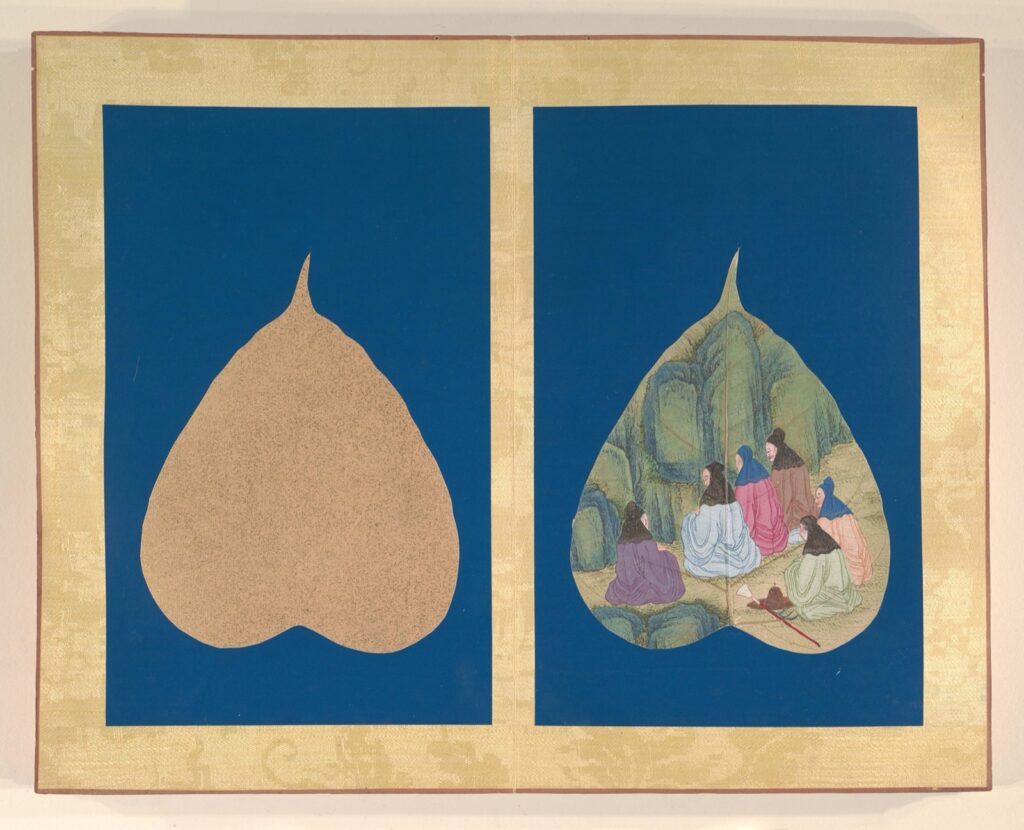
A Bodhi leaf Arhat painting asks us to study more than the figures. The shape of the leaf, the way it sits inside an album spread, and the contrast between the painted surface and its mounting all affect how the image is read. TANGKAWORLD image TK0925 is especially useful because it shows a paired arrangement: a blank leaf-shaped silhouette on the left and a painted leaf on the right, both set against deep blue rectangular fields and enclosed by a pale patterned border.
The archive filename places this object within an anonymous Qing-dynasty album of the Eighteen Arhats associated with The Met. That information is a cataloguing lead, not proof of every detail visible in the photograph. The exact individual identities, pigments, leaf preparation, date, maker, and provenance remain uncertain without the museum record and physical examination. What the image does provide is a clear case study in how material support and album design shape Buddhist visual experience.
What is visible in TK0925?
The open spread is organized with strong bilateral balance. Each page contains a tall blue rectangle, and each blue field contains a heart-shaped leaf form with a pointed tip and a rounded, indented base. The leaf on the left appears unpainted or minimally worked in this photograph. The leaf on the right contains a compact landscape scene with six seated figures arranged among green-blue rock forms. Their robes introduce muted pink, blue, brown, green, and violet accents.
A patterned cream or gold-toned surround joins the two pages visually. A thin reddish outline marks the outer edge, while a central fold separates the leaves. These framing elements matter because they show that the painted unit was intended to be encountered as part of an album, not simply as an isolated miniature. It is uncertain whether the left form is a reverse, a companion leaf, a protective element, or another part of the original sequence; the single photograph cannot settle that question.
How the leaf shape controls the composition
The pointed apex and broad lower lobes act as a ready-made frame. On the painted leaf, the rock wall rises toward the tip, leading the eye upward without requiring a conventional rectangular border. Lower figures occupy the widest part of the leaf, while smaller heads and shoulders fit into the narrowing upper zone. The result is a composition that responds directly to the support.
This differs from a rectangular Thangka composition, where figures may be organized around a central vertical axis, registers, or a throne. Here, the outer leaf edge compresses the available space. The landscape becomes both setting and structural device: rocks fill irregular gaps, separate the seated figures, and guide the eye around the curved perimeter.
Leaf veins as part of the image
Fine branching lines remain visible across the painted surface. They may be natural veins, drawn details, or a combination of material and painted marks; the photograph alone cannot distinguish them reliably. Either way, they form a second network beneath the figures and rocks. A careful reader should not treat these lines as damage automatically. Their direction, continuity, and relationship to painted forms need to be recorded before interpretation.
Blue ground and visual separation
The saturated blue rectangles create a clear interval between the leaf shapes and the album surround. This makes the edges legible and turns each leaf into an object within an object. The blue may belong to the mounting rather than the leaf itself, but that distinction is uncertain from a digital image. For cataloguing, describe the visible arrangement first: leaf-shaped forms placed on blue fields within a patterned album spread.
Reading the work as a Buddhist album leaf
Albums encourage close, sequential viewing. Unlike a large hanging image seen from across a room, a Buddhist album leaf can bring the viewer near enough to notice facial profiles, robe folds, leaf veins, and minute landscape passages. The page turn also introduces time. One scene is encountered after another, so repetition and variation become meaningful across the series.
TK0925 should therefore be compared with the other leaves in the same Eighteen Arhats album before assigning identities. Repeated robe colors, attendants, animals, inscriptions, implements, or landscape types may clarify the sequence. A single leaf can suggest group imagery, but the album as a whole provides the stronger identification context.
How to recognize Arhat imagery without overclaiming
Arhats are Buddhist elders commonly shown as individualized monastic figures in remote landscapes, accompanied by attendants, animals, books, staffs, or other objects. In TK0925, the seated group, varied profiles, simple robes, and rocky retreat are consistent with that broad visual world. The archive title strengthens the association with an Eighteen Arhats album.
However, none of the six figures should be assigned a specific Arhat name from this photograph alone. Individual attributes are small, and the lower-right object could be interpreted in several ways. Differences in hairstyle or head covering may help distinguish people, but they do not provide a secure name. For a general introduction to the elder tradition, see the related guide to Arhat paintings and Buddhist elders.
Material evidence and conservation limits
The phrase “Bodhi leaf” comes from the archive grouping, but botanical identification should remain uncertain until the support is examined or the museum documentation is consulted. A high-resolution photograph may reveal edge shape and vein patterns, yet it cannot confirm plant species, preparation method, coatings, binder, pigment composition, or later restoration.
Digital color also has limits. The blue ground, pale mount, and green rocks may shift with lighting, camera profile, and screen settings. A conservation note should separate visible facts from material hypotheses. Record cracks, losses, distortions, stains, abrasions, edge lifting, and repairs only where the image supports them. Do not diagnose instability or recommend treatment from a web image.
For a repeatable documentation method, use the Thangka condition report checklist. Although an album leaf is not mounted like a textile-bordered Thangka, the same discipline applies: identify the component, locate the observation precisely, use neutral language, and mark uncertainty.
Practical checklist for studying a Bodhi leaf painting
- Record the entire spread. Note the fold, page order, paired leaf shapes, blue fields, border, and any blank or unpainted areas.
- Describe before identifying. Count visible figures, map their positions, and list robes, gestures, objects, and landscape features without assigning names prematurely.
- Follow the support edge. Check the pointed apex, lobed base, margins, tears, joins, and areas where paint meets the leaf boundary.
- Trace the vein network. Distinguish continuous structural lines from cracks, drawn contours, stains, or compression marks when possible.
- Compare every album leaf. Look for repeated figures, attributes, captions, seals, numbering, and changes in composition across the sequence.
- Separate image from mount. Record which colors and patterns belong to the leaf, blue field, page, or later surround.
- Keep uncertain fields explicit. Artist, date, plant species, pigments, binder, individual Arhat names, collection history, and repairs require documentary or physical evidence.
Why this format matters for Buddhist art history
A Bodhi leaf painting brings sacred association, natural structure, miniature technique, and album viewing into one object. The leaf is not a neutral carrier. Its silhouette determines the placement of figures, while its veins remain part of the visible field. The album mounting then adds another layer of framing, sequence, and protection.
This material perspective complements iconographic reading. Instead of asking only “Who is depicted?”, researchers can ask “How does the support organize seeing?” That question links Arhat iconography with workshop practice, collecting history, conservation, and digital documentation. It also prevents the image from being reduced to a list of symbols detached from its physical form.
Conclusion
TK0925 demonstrates how a Bodhi leaf Arhat painting can be read through support, composition, album structure, and cautious identification. The leaf edge compresses the rocky gathering into a miniature world; the blue field isolates that world; and the paired spread reminds us that the photograph represents one moment in a larger sequence. The archive title offers a valuable starting point, while the unresolved identities and materials should remain clearly marked as uncertain.
Download the full Thangka image collection
Continue exploring material formats, Arhat imagery, and Buddhist visual culture in the complete TANGKAWORLD gallery. Browse and download the full Thangka image collection for further study and comparison.