
Buddhist Water-and-Land ritual painting is best approached as a visual system before it is treated as a fixed historical label. A central seated figure, lotus throne, halo, clouds, lamps, guardians, patterned robes, and tiered platform all organise the viewer’s attention. These elements may indicate a ritual or devotional setting, but an image alone cannot establish the precise ceremony, date, workshop, or collection history. Careful looking starts by describing what is visible and separating that record from the archive title.
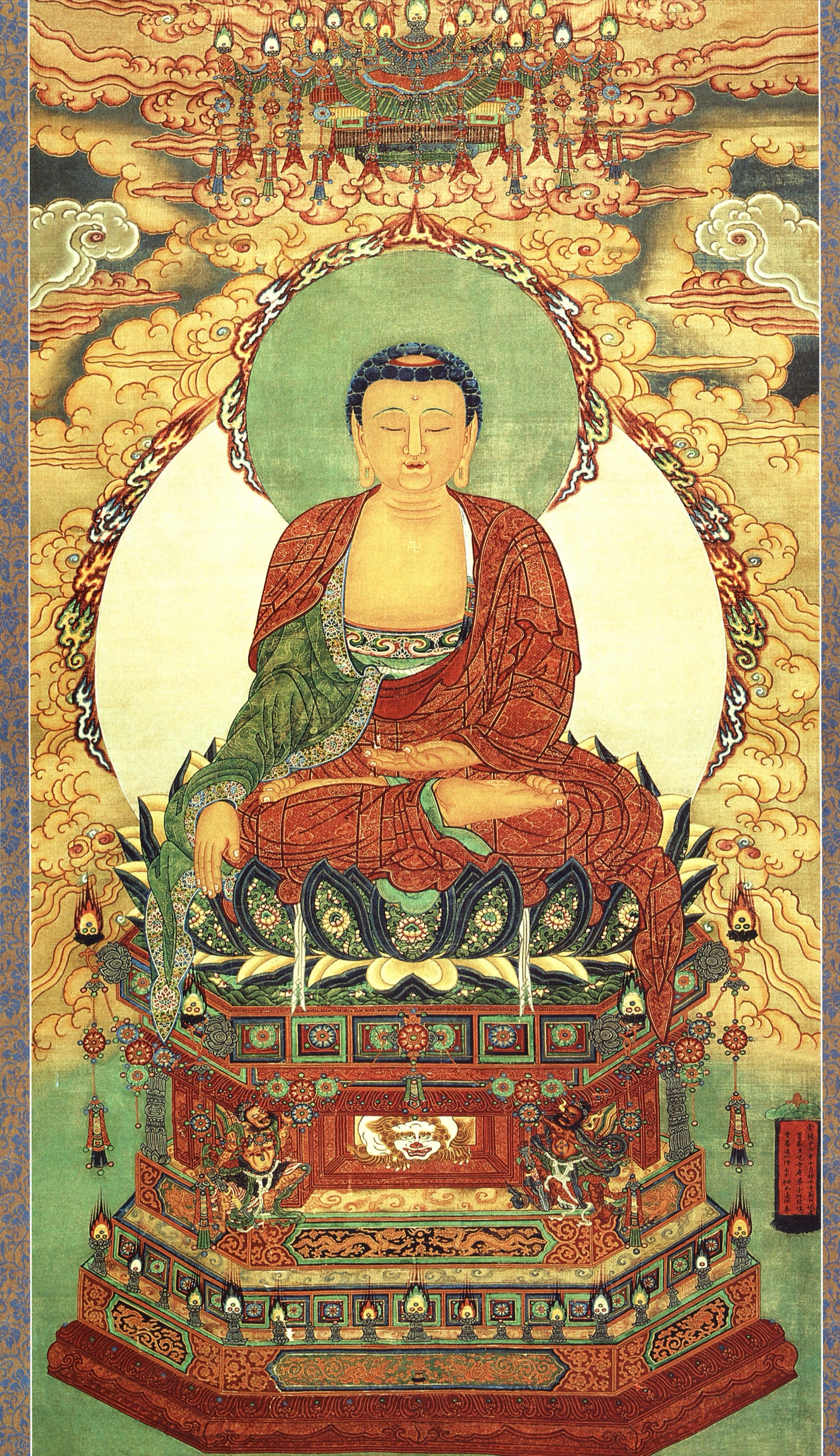
TK0187 offers a strong example of this method. A Buddha-like figure sits at the center on a flowered lotus support. The robe is densely patterned, the halo is large and circular, and the throne rises through several decorated levels. Clouds frame the central field, while lamps and guardian-like figures appear in upper and lower registers. The archive filename provides a useful lead, but it does not independently verify every identification or historical attribution.
Begin with the central figure
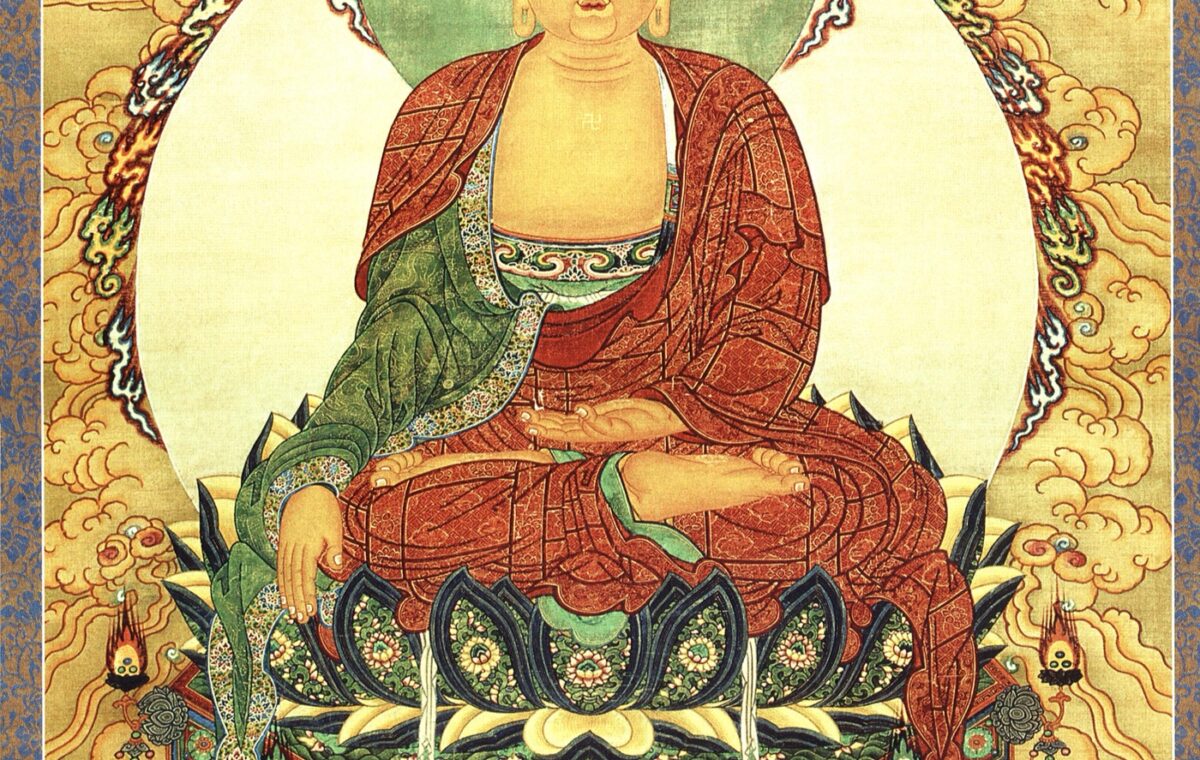
First record the body, posture, and immediate supports. In TK0187, the figure is seated on a lotus throne with one hand lowered and the other resting near the lap. The head is surrounded by a green circular halo, and the body is framed by a larger pale mandorla-like field. The exposed chest, patterned red robe, green drapery, and small brow mark are visible details. They can be documented directly without deciding whether every feature proves a particular identity.
Next, distinguish the figure from the surrounding architecture and ornament. The lotus, throne, halo, lamps, clouds, and guardians are not interchangeable symbols. Each has a different position and visual role. A reliable description notes what touches the figure, what frames it, and what appears in a separate register above or below.
How a ritual image builds hierarchy
Use the vertical axis
Water-and-Land ritual painting often feels ceremonial because the composition is vertically staged. In TK0187, the central seated figure occupies the middle; an elevated group appears above in the cloud zone; a multi-level platform, flames or lamps, and guardian forms occupy the lower area. This vertical order directs the eye from upper register to center and then down to the base. It is an observable compositional fact, even where the exact participants remain uncertain.
Read the throne as a structure
The throne is more than a seat. In TK0187, its layers include lotus petals, patterned panels, small hanging forms, and a lower platform. These components create status and distance around the central figure. When studying a related image, record the number of tiers, the decorative zones, visible animals or guardians, and the relation between the lotus and the architectural base. Avoid treating all ornate seats as the same type without comparison.
Separate halo, mandorla, and clouds
A circular halo sits immediately behind the head in TK0187, while a much larger pale field surrounds the body. Outside that field, clouds form another framing layer. Describing these zones separately helps prevent vague statements such as “a golden aura.” Note the shape, color, edge, and scale of each boundary. For a wider method of reading these forms, see our Buddhist halo visual guide.
Lamps, flames, and guardian figures
Small lamps or flame-topped forms repeat along the sides and base of TK0187. They give the throne a measured rhythm and draw attention to its edges. Guardian-like figures sit or stand near the lower platform, while an elaborate group appears in the cloud register above. These forms may be related to ritual protection or a wider divine assembly, but the image alone does not make every name secure.
The useful method is to record number, placement, posture, color, and relation to the central figure. Do not identify a guardian only from a silhouette, and do not confuse a lamp with a flame halo or a decorative finial. If facial features or attributes are too small to inspect, mark them as uncertain. This protects the visual record from becoming more definite than the evidence.
Patterned robes as visual evidence
The robe in TK0187 is unusually important because it covers much of the central body. Its red ground is filled with repeated ornamental units, and a green inner garment creates contrast near the torso and lower arm. Rather than using the robe as proof of a date or school, treat it as a set of visible materials to compare: color arrangement, border bands, repeated motifs, folds, and overlap with the lotus throne.
This kind of observation becomes more useful when paired with a consistent garment record. Our guide to Buddhist robe documentation explains how to separate panel structure, decoration, and condition from historical claims. The same discipline applies to dense patterned drapery in ritual images.
A visual checklist for Buddhist Water-and-Land ritual painting
- Locate the central figure and record posture, hand positions, robe, halo, and lotus support.
- Map upper, central, and lower registers before naming any surrounding figures.
- Describe each throne tier, including petals, panels, lamps, guardians, and hanging ornaments.
- Separate the head halo, body surround, clouds, flames, and border textiles.
- Record repeated lamps or flame forms by number and placement.
- Check for inscriptions, seals, catalogue entries, or mount details before accepting a date or attribution.
- Keep identity, ritual function, date, maker, school, collection, and provenance uncertain where documentation is absent.
From visual record to research
The title “Water-and-Land ritual painting” can be a productive starting point, not an endpoint. After making a visual inventory, look for a dependable catalogue, legible inscription, or published collection record that explains the image’s context. Only then should terms such as ritual program, historical period, or named figure become firm claims. This is particularly important for digital images whose filenames may be translated, abbreviated, or inherited from older records.
For a broader framework that joins figure, support, symbols, and composition, see How to Read a Thangka. If the image is being recorded for study or conservation, the Thangka condition report checklist provides a separate workflow for noting losses, surface change, and mounting evidence without guessing their causes.
Conclusion
Buddhist Water-and-Land ritual painting can be read through hierarchy: a central seated figure, layered throne, halo and body surround, clouds, repeating lamps, and surrounding guardians all create a ceremonial visual order. TK0187 gives a rich example of that structure. Describe the evidence carefully, compare it with documented works, and let unverified identity and attribution remain uncertain.
Download the full Thangka image collection
Continue browsing and downloading the complete TANGKAWORLD image collection to compare ritual settings, lotus thrones, halos, garments, cloud forms, and figure groups in greater detail.