
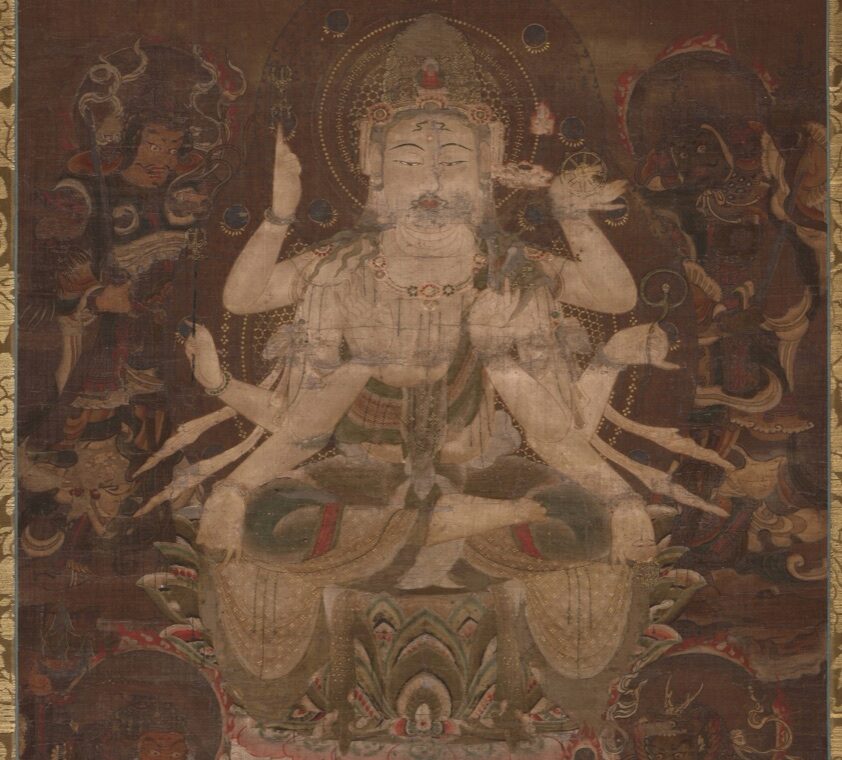
Cundi Avalokiteshvara iconography is often introduced through an image with three eyes and eighteen arms. TK0630 presents a rarer Japanese form: the pale-bodied bodhisattva has two eyes and eight arms, sits on a lotus throne, and is guarded by the Four Heavenly Kings. Those features make this painting especially useful for learning why the number of arms must be read together with the surrounding figures, ritual setting, and collection record.
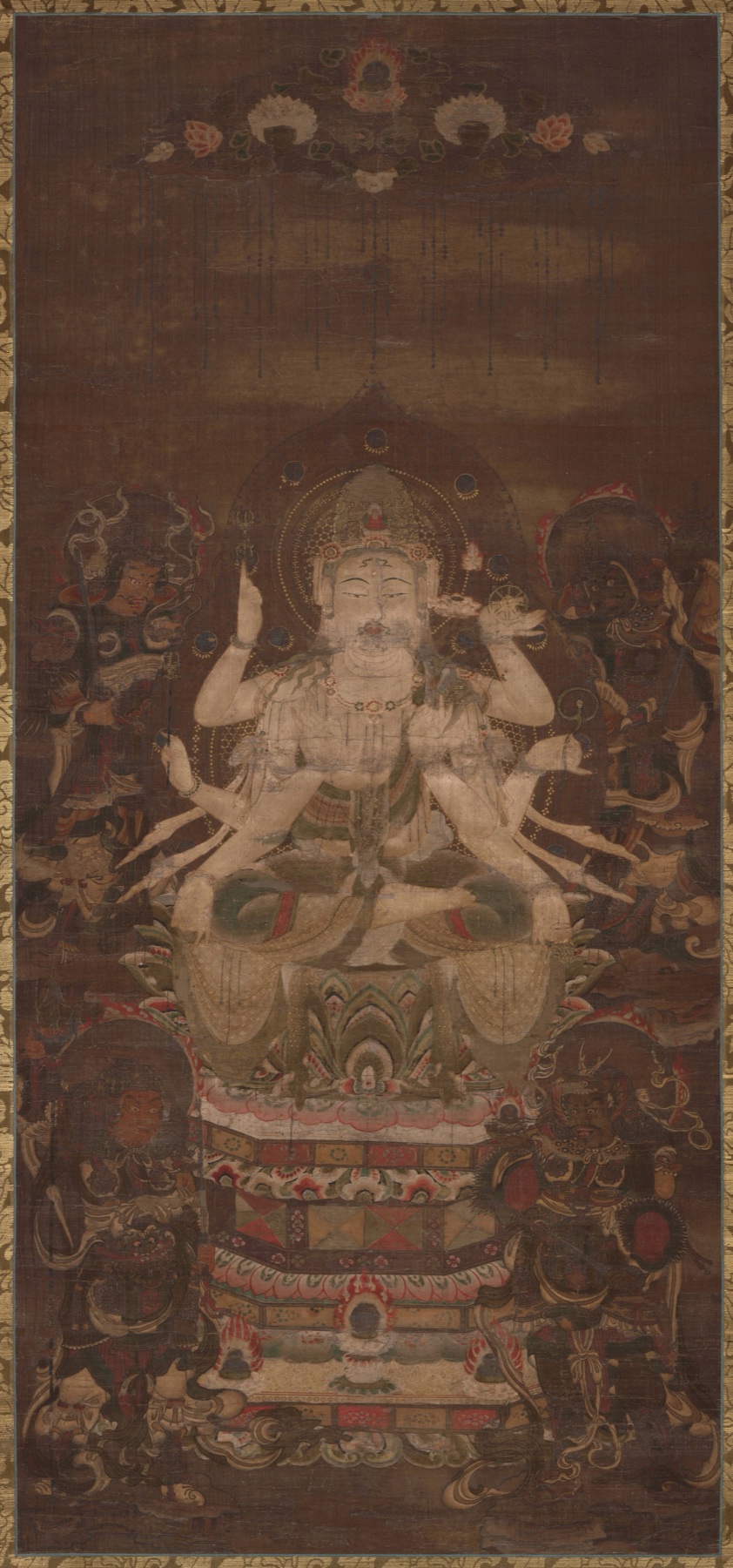
In Japan, Cundi is called Juntei Kannon and may also be described as Juntei Butsumo. The Tokyo National Museum identifies this painting as A-11796, an Important Cultural Property from the Heian period, 12th century. It is color on silk and measures 103.4 by 47.4 centimeters. The museum does not name an artist, so the maker must be recorded as uncertain.
Who is Cundi Avalokiteshvara?
Cundi belongs to the esoteric Buddhist world of multiple Kannon forms. The Tokyo National Museum explains that Juntei Kannon was honored in Shingon traditions as one of the Six Kannon, compassionate manifestations associated with relieving suffering in the six realms of rebirth. Historical records also connect Cundi devotion in the Heian period with prayers for childbirth and safe delivery among elite patrons.
The name Cundi appears across Asian Buddhist traditions, but regional images are not identical. Some present Cundi as a many-armed deity with three eyes; others, including TK0630, use a less common two-eyed, eight-armed form. A responsible identification therefore begins with documented context rather than assuming that every Cundi image must follow one fixed formula.
Why eight arms matter in TK0630
The eight arms spread around a frontal, seated body in four balanced pairs. The upper hands rise near the head, the middle hands frame the torso, and the lower hands extend toward the knees and throne. This arrangement enlarges the bodhisattva without destroying the calm symmetry of the central figure.
Several hand-held objects are now difficult to read in a web photograph because the silk has darkened and details have faded. It would be unsafe to supply a complete attribute list from visual guesswork alone. The reliable identification comes from the documented title, the two eyes, eight arms, pale body, lotus throne, and Four Heavenly Kings acting together.
Arm count is a useful first filter, not a final answer. Our guides to Four-Armed Avalokiteshvara iconography and Thousand-Armed Avalokiteshvara show how different forms use multiplied arms to express distinct ritual and symbolic programs. Matching “many arms” is never enough to identify a deity.
Six visual clues for identifying Juntei Kannon
1. A pale central body
Cundi is painted with a light body outlined in fine red. Against the darkened silk and the deeper colors of the guardians, the central form appears luminous even after centuries of material change. The pale body is a strong clue, but it must not be treated as unique to Cundi.
2. Two eyes rather than the more familiar three
The face in TK0630 has two eyes. This matters because many textual and visual descriptions of Cundi emphasize three eyes and eighteen arms. The museum explicitly identifies this two-eyed, eight-armed configuration as an unusual surviving example. That documented exception is more reliable than a simplified rule.
3. Eight arms in a symmetrical fan
The arms emerge in controlled layers rather than forming a crowded halo of hands. Their placement keeps the face and torso unobstructed. Count visible arm roots and hands carefully; do not mistake ribbons, jewelry, or a guardian’s weapon for part of the central figure.
4. A jeweled crown and circular head light
The bodhisattva wears a tall crown enriched with gold, while a dark circular halo surrounds the head. Small round ornaments or celestial disks punctuate the larger mandorla. For comparison, our guide to the Buddhist halo in Thangka explains how head lights, body halos, and mandorlas organize sacred presence.
5. A lotus throne beneath the seated figure
Layered lotus petals support the crossed legs, and a high decorated pedestal raises the deity above the surrounding guardians. The throne creates a vertical axis from the lower offering area through the hands and crown to the flowered canopy.
6. Four Heavenly Kings around the deity
Four armored guardians stand around the central bodhisattva, two above the shoulders and two near the pedestal. Their dark bodies, animated scarves, weapons, and forceful stances contrast with Cundi’s quiet frontal pose. Readers can examine their broader role in our Four Heavenly Kings visual guide.
How the composition separates compassion and protection
The painting establishes two visual registers. Cundi occupies the bright, stable center: pale skin, soft modeling, delicate jewelry, and a symmetrical lotus seat. The Four Heavenly Kings occupy the darker perimeter, where bent legs, weapons, windblown fabric, and emphatic outlines create movement. Compassion and protection are presented as complementary rather than competing forces.
The large empty zone above the figures also has a function. A flowered canopy hangs near the top, but much of the silk remains quiet and dark. This breathing space prevents the eight arms and four guardians from overwhelming the image. It also draws the eye upward from the crowded pedestal to the central face.
Materials, color, and the effect of age
The e-Museum record describes a sophisticated palette and technique. The white body is edged with red lines; the crown uses gold leaf and ink drawing; pale blue, green, brown, and gray-white tones shape the robes and lotus. Fine cut-gold patterns decorate the clothing. Silver details once contributed a restrained glow to the halo and hanging ornaments.
Today, parts of the silver have darkened, and the overall surface looks much dimmer than it originally did. That change is not merely a photographic problem. Metal leaf, silk, pigments, previous mounting, light exposure, and environmental history all influence the present appearance. When cataloguing a similar work, separate observed condition from reconstructed original color. The Thangka condition report checklist provides a practical structure for recording abrasion, loss, creases, darkening, and later repairs.
How to distinguish Cundi from other multi-armed forms
Start with a sequence of questions rather than a single emblem:
- Count eyes and arms. Record what is actually visible before consulting a label.
- Check the body and posture. Note color, seated or standing position, and the type of throne.
- Map the surrounding figures. Four armored guardians provide a different context from attendants, lineage teachers, or a Mandala retinue.
- Read each hand cautiously. Mark damaged or hidden attributes as uncertain instead of inventing an object.
- Look for an inscription or institutional record. A verified catalogue title carries more weight than resemblance alone.
- Keep regional terminology. Cundi, Juntei Kannon, and Juntei Butsumo may overlap, but the original catalogue language should remain visible.
This method prevents confusion with other forms of Avalokiteshvara and with unrelated multi-armed deities. It also respects variations that arose through different scriptures, workshops, regions, and ritual communities.
A practical cataloguing checklist
- Photograph the full painting, mounting, edges, and any inscriptions.
- Record the visible eye and arm count without restoring missing details mentally.
- Describe the crown, halo, body color, seat, canopy, and guardian figures.
- List only clearly legible hand attributes; label ambiguous forms uncertain.
- Separate the object’s documented date from a date inferred by style.
- Preserve the museum accession number, dimensions, material, and donor history when available.
- Compare the object with trusted records before assigning a Sanskrit, Chinese, Tibetan, or Japanese name.
For TK0630, the local filename, visual structure, and museum record align with A-11796. The identification, material, dimensions, Heian-period date, and Tokyo National Museum collection are documented. The artist remains uncertain.
Why this image matters for comparative Thangka study
TK0630 is a Japanese hanging-scroll painting, not a Tibetan Thangka. Including it in a comparative image archive is still valuable because it shows how gesture, multiple arms, halo, lotus, guardians, and precious materials can organize esoteric Buddhist imagery across regions. The comparison works only when the original medium and cultural context are stated accurately.
The rare two-eyed, eight-armed form also warns against treating iconographic guides as rigid templates. Documented exceptions are not errors; they are evidence of living traditions and regional transmission.
Conclusion
Cundi Avalokiteshvara iconography in TK0630 is identified through a complete visual system: two eyes, eight arms, a pale jeweled body, circular head light, lotus throne, flowered canopy, and four armored Heavenly Kings. The museum record establishes the work as a 12th-century Japanese painting on silk, while the artist is uncertain. Careful counting, contextual comparison, and honest condition notes make the identification stronger than any single symbol.
Download the full Thangka image collection
Continue browsing Buddhist iconography and download the complete TANGKAWORLD image library from our free downloads page. The collection supports comparative study of Thangka, Mandala, Avalokiteshvara forms, Japanese Buddhist painting, and museum-held sacred art.