
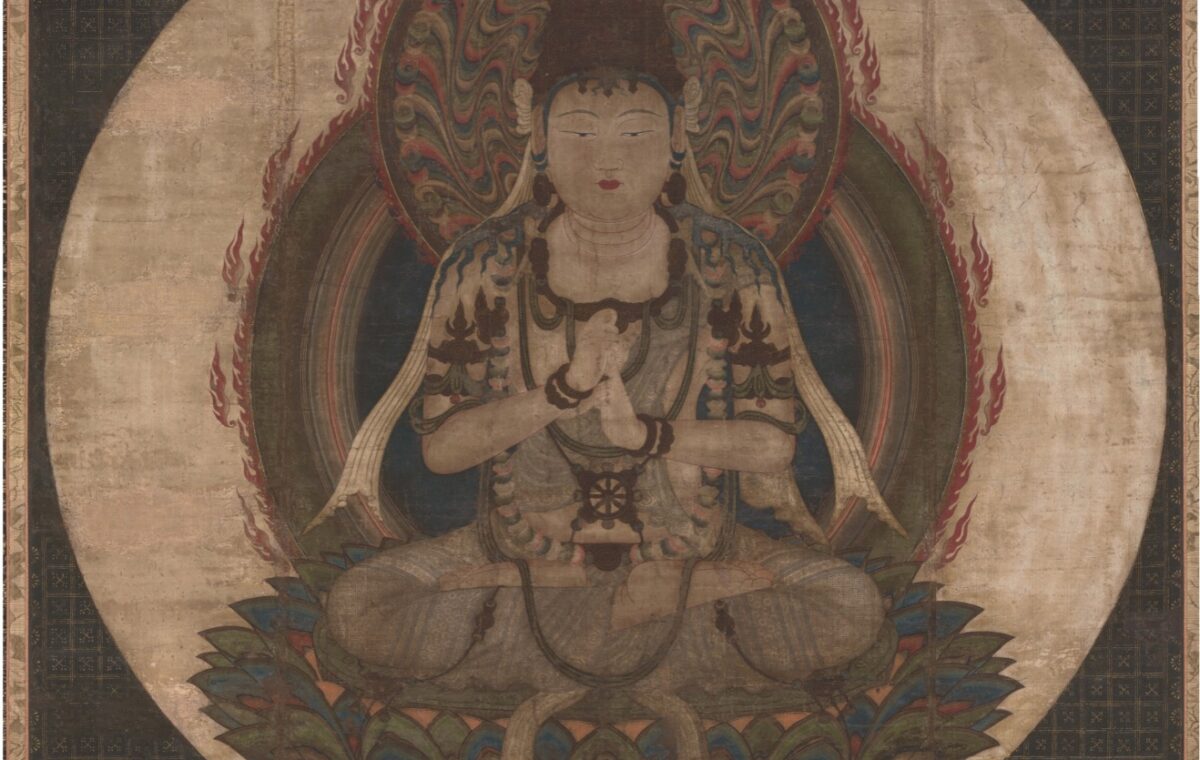
One-Syllable Golden Wheel Buddhist art can be difficult to identify because its central figure resembles Vairocana: a crowned, jeweled Buddha sits frontally and forms a distinctive hand gesture before the chest. The painting becomes clearer when the hands are read together with the immense circular mandorla, the pale body, the lotus seat, and the controlled symmetry of the composition. This guide examines those clues in TK0666, a Japanese esoteric Buddhist painting associated with the Tokyo National Museum.
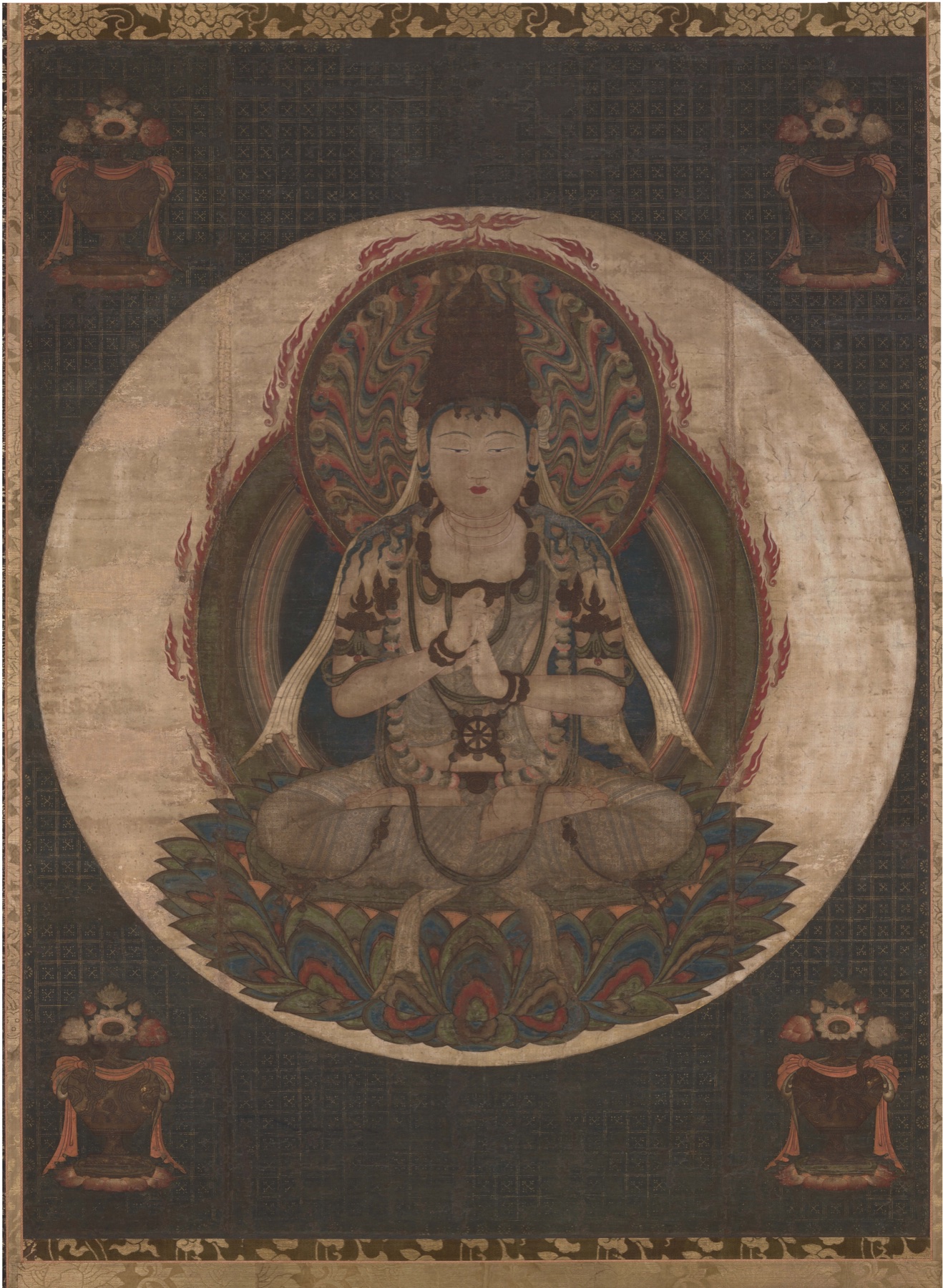
The work is not a Tibetan Thangka. It belongs to Japanese Buddhist painting, but it is valuable for comparative study because it shows how esoteric iconography travels across media and regional traditions. The Tokyo National Museum identifies the object as A-10601, an Important Cultural Property made in the Kamakura period, in the 13th century. The artist is not recorded, so any attribution to a named painter would be uncertain.
Who is the One-Syllable Golden Wheel deity?
The Japanese name Ichiji Kinrin refers to the One-Syllable Golden Wheel, also translated by the museum as the Cosmic Buddha of the Golden Wheel. In esoteric Buddhist thought, the deity embodies the powers or virtues of buddhas and bodhisattvas. Historical ritual use emphasized protection, health, and longevity, and the image could be treated as a secret or rarely displayed icon.
The figure is closely connected visually with Dainichi Nyorai, or Vairocana. That resemblance is intentional rather than accidental. Both may be shown crowned, richly ornamented, and forming the wisdom-fist mudra. For a useful comparison, see our guide to Vairocana Buddha and the meaning of his mudra. A viewer should not identify either deity from the crown alone; the complete iconographic program matters.
Five visual clues in Ichiji Kinrin iconography
1. The wisdom-fist mudra at the center
The hands meet vertically in front of the chest. One hand encloses the raised finger of the other, producing the compact gesture commonly called the wisdom-fist mudra. Because the gesture is also associated with Vairocana, it narrows the field but does not settle the identity by itself. Its central placement makes it the compositional and doctrinal focus of the image.
2. A crown and ornaments on a Buddha-like body
The deity wears a tall crown, earrings, necklaces, arm ornaments, and patterned garments. These details present awakened authority in a royal mode. The calm face, seated meditation posture, and symmetrical body remain Buddha-like, while the jewelry distinguishes the figure from an unadorned monastic Buddha. The result is neither an ordinary king nor a generic bodhisattva.
3. The enormous circular mandorla
A pale disk surrounds almost the entire seated figure. Inside it, nested colored rings and a flame-edged head halo concentrate attention around the crown and face. The visual effect is more expansive than a small head halo: light becomes an architectural enclosure. Readers interested in this device can compare our broader guide to the Buddhist halo and circular fields of light.
4. A multicolored lotus seat
The figure sits cross-legged on a broad lotus whose blue-green and red petals create a stable base. The lotus separates sacred presence from the dark patterned ground without turning the scene into a landscape. Its color also links the cooler central image to the small offerings in the corners.
5. Four corner offerings and a patterned field
Ritual vessels or offering arrangements occupy all four corners. They balance the powerful central circle and reinforce the painting’s ceremonial character. The dark background is not empty: a fine repeating grid covers it, making the pale mandorla appear brighter. These subsidiary motifs support the identification, but a damaged or cropped photograph may omit them.
How the painting organizes attention
The composition is built from nested zones. First comes the rectangular textile-like field; next, the huge pale disk; then the darker inner rings; finally, the face, hands, and small wheel emblem near the waist. Each zone reduces visual noise as the eye moves inward. The frontal pose and bilateral symmetry slow the reading, while the flames around the inner halo add controlled movement.
This structure differs from a densely populated Mandala. A formal One-Syllable Golden Wheel Mandala may include the central deity, a wheel treasure, and an expanded retinue or group of symbolic treasures. TK0666 instead presents a single monumental deity with corner offerings. For comparison with a multi-assembly esoteric plan, read the Vajra Realm Mandala guide.
Color, silk, and Kamakura-period style
The museum records the work as color on silk, measuring 113.9 by 86.0 centimeters. Its cool whites, greens, blues, and touches of silver-toned detail give the deity a restrained luminosity. Fine red shading remains visible on the pale body, while graded color in the halo recalls the elegance of earlier Heian Buddhist painting.
At the same time, the alert facial expression and crisp, disciplined contours fit the museum’s description of Kamakura-period painting. Rather than treating period style as a single checklist, it is safer to observe how older courtly refinement and newer clarity coexist here. Surface wear, darkening, and small losses also affect how modern photographs render the original palette.
One-Syllable Golden Wheel or Vairocana?
Confusion is understandable because both figures can display the wisdom-fist mudra and an ornamented cosmic form. Use a sequence of evidence instead of one isolated sign:
- Read the museum record or inscription first. A reliable object label outweighs visual guesswork.
- Check the surrounding program. An unusually dominant wheel-like mandorla and ritual context may support Ichiji Kinrin.
- Look for a Mandala structure. A retinue, treasures, or palace plan changes the identification problem.
- Compare related works cautiously. Similar mudras do not prove that two images represent the same deity.
- Keep uncertainty visible. If provenance, date, or title is absent, record those fields as uncertain rather than borrowing data from a similar painting.
For TK0666, the filename, visual match, and museum object record align. That combination supports the identification as the One-Syllable Golden Wheel deity and the date as Kamakura period, 13th century. The maker remains unknown.
A practical identification checklist
When cataloguing a possible example of One-Syllable Golden Wheel Buddhist art, work through the following questions:
- Is the central figure a crowned, jeweled Buddha rather than an unadorned monk?
- Do the hands form the wisdom-fist mudra directly before the chest?
- Does a large circular mandorla dominate the composition?
- Is the figure seated on a lotus or another explicitly sacred support?
- Are ritual offerings, wheel symbols, or a wider esoteric program present?
- Does an institutional record use Ichiji Kinrin, One-Syllable Golden Wheel, Cosmic Buddha of the Golden Wheel, or a related title?
- Are the date, artist, origin, and provenance documented independently?
Do not force an identification when only two or three generic features survive. A crown, lotus, and halo occur across many Buddhist images. The hand gesture and documented context carry more weight, and a condition report may reveal whether key attributes were cropped, overpainted, or lost. Our Thangka condition report checklist offers a useful recording method even when the object is not technically a Thangka.
Why this Japanese painting belongs in a Thangka study archive
Cross-regional comparison helps distinguish shared esoteric vocabulary from local artistic choices. Tibetan Thangka, Chinese Buddhist painting, and Japanese hanging scrolls may all organize sacred bodies through gesture, color, halo, throne, and hierarchy. Yet their formats, ritual histories, inscriptions, and stylistic conventions are not interchangeable.
TK0666 therefore works best as a comparative object. It expands the archive beyond Tibet while preserving an accurate label: Japanese esoteric Buddhist painting, not Tibetan Thangka. That distinction protects both traditions and makes visual identification more precise.
Conclusion
The most reliable reading of One-Syllable Golden Wheel Buddhist art combines the wisdom-fist mudra, crowned Buddha form, immense circular mandorla, lotus seat, ritual setting, and an authoritative catalogue record. In TK0666, those features converge in a controlled 13th-century Japanese composition. The date and museum identity are documented; the artist is uncertain. Reading the whole image, rather than one familiar symbol, is the key to separating Ichiji Kinrin from related forms of Vairocana.
Download the full Thangka image collection
Continue exploring Buddhist iconography and download the complete TANGKAWORLD image library from our free downloads page. The collection supports comparative study across Thangka, Mandala, deity painting, and museum-held Buddhist art.