

Repeated Buddha figures can look like a sequence of events, yet repetition and narrative do different visual work. A narrative usually changes figures, settings, gestures, or actions as the story advances. Serial iconography instead repeats a sacred form to create rhythm, hierarchy, multiplicity, or a structured field of presence. The distinction matters when cataloguing a Thangka, describing a mural, or studying a digital image without a complete inscription or reliable provenance.
Quick answer: repetition or narrative?
Begin by asking whether the surrounding figures change enough to imply successive moments. Repeated Buddha figures normally keep the same basic seat, halo, robe, scale, and spacing. Small variations may still occur, especially in hand gestures, robe lines, or color, but the overall system remains regular. A narrative sequence more often introduces events: a figure travels, teaches, receives an offering, meets another person, enters a building, or appears in a new landscape.
Do not decide from one detail. Read the whole composition. Rows, grids, repeated lotus seats, and consistent halos usually favor serial imagery. Paths, architecture, mountains, inscriptions, and interacting groups may favor narrative. Some paintings combine both systems, so the best description can be “a central icon with serial and narrative elements” rather than forcing the work into a single category.
Start with visual hierarchy
Find the principal image
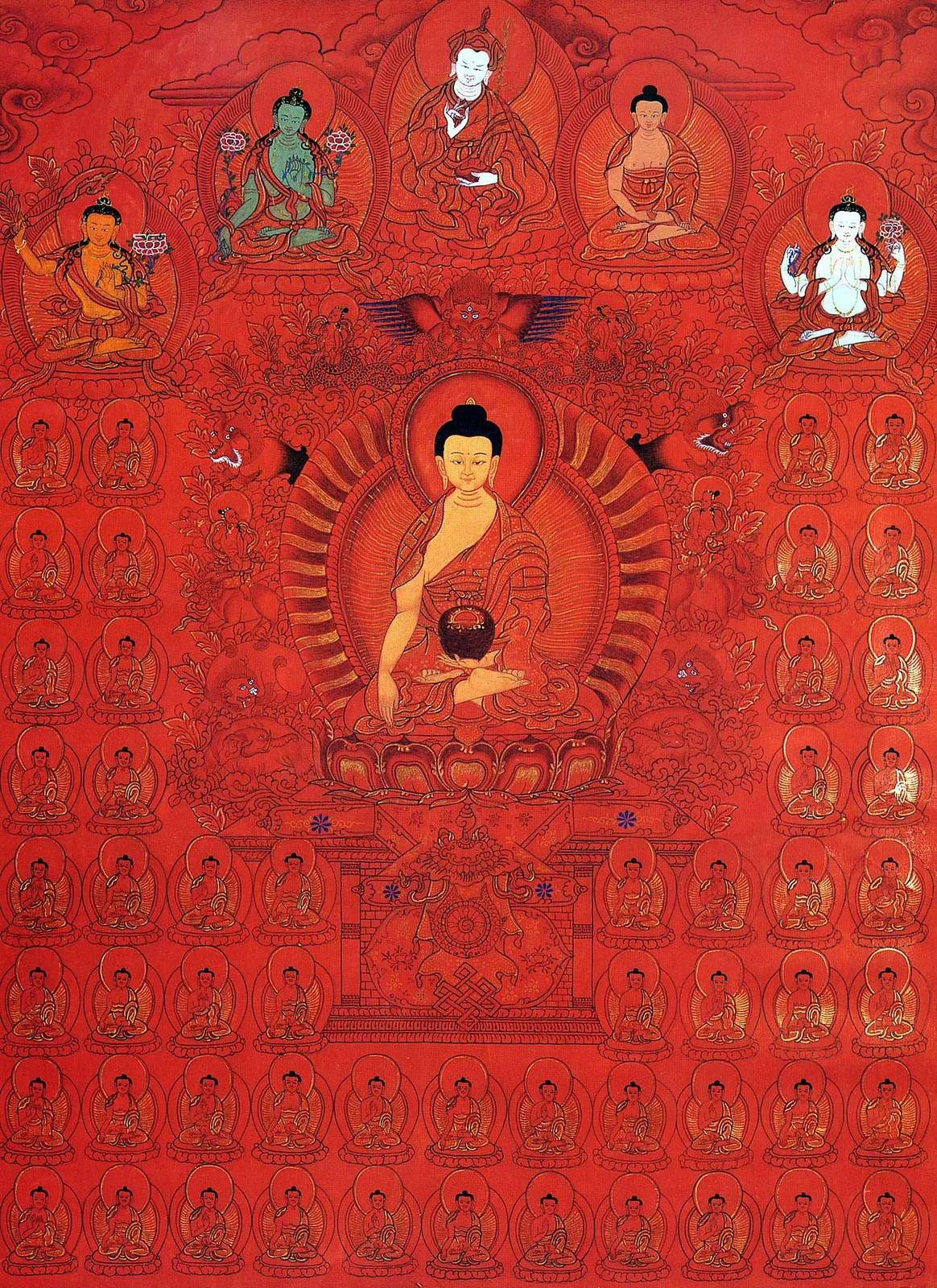
Scale is the fastest guide. In TK0578, one seated figure dominates the middle of the painting. The large halo, layered mandorla, lotus throne, dark bowl, and lowered right hand establish this figure as the visual anchor. The source filename identifies the figure as Shakyamuni Buddha, and the lowered hand is consistent with an earth-touching gesture. However, a filename is not the same as a complete scholarly attribution, so the broader program should remain uncertain unless an inscription or reliable catalogue confirms it.
For the basic attributes of this pose, compare our guide to the Shakyamuni Buddha earth-touching gesture. That comparison helps identify visual evidence without assuming that every surrounding figure belongs to a known story.
Separate the surrounding fields
Next divide the painting into zones. TK0578 has a central icon, regular side and lower rows of small seated Buddhas, a group of five larger figures across the top, guardian-like animals near the center, and a decorated lower pedestal. Each zone follows a different scale and rhythm. This is more informative than counting figures immediately because it reveals which forms belong to the same visual system.
How repeated Buddha figures create meaning
Repetition does not mean that the painter simply copied a figure to fill space. Serial imagery can make a sacred presence appear extensive, ordered, and difficult to contain within a single body. It can also guide recitation, commemoration, visualization, or the recognition of a group. Without a secure inscription, it is safest to describe these as possible functions rather than declaring one specific ritual use.
Museum comparisons show why the distinction matters. A British Museum Dunhuang painting explains that repeated preaching groups could suggest the Buddha’s omnipresence. A Metropolitan Museum publication likewise discusses massed Buddhist images as expressions of multiplicity. These parallels establish a useful visual principle, but they do not prove that TK0578 came from the same region, period, school, or textual tradition.
Rhythm, scale, and interval
Look at the spaces between figures. In the lower half of TK0578, the small Buddhas sit at nearly regular intervals. Their round halos and lotus seats create a beat across each row. The eye reads the pattern horizontally before returning to the much larger central figure. This contrast between a repeated field and a dominant icon is one of the clearest signs of serial iconography.
Also compare scale within the repetition. If one small figure suddenly becomes larger, faces a different direction, or occupies a special throne, it may mark a subgroup or transition. If all figures remain equivalent, the field may emphasize multiplicity more than sequence.
When repetition may become a narrative sequence
A narrative needs evidence of change. Check whether the same protagonist appears in different actions, whether figures interact, or whether environmental dividers establish distinct episodes. Mountains, clouds, buildings, riverbanks, and inscribed cartouches often organize stories, although none of these elements alone guarantees a narrative.
Our guide to Buddhist narrative painting shows the opposite problem: numerous episodes surround a main icon, but each scene contains different actions and relationships. In TK0578, the rows of small Buddhas are far more regular. The upper five figures, by contrast, differ in color, pose, or attributes and should be recorded as a separate assembly rather than automatically treated as part of the repeated rows.
Gesture variation deserves special care. Different mudras can indicate distinct identities, teachings, directions, or moments, but minor differences can also result from condition, restoration, workshop practice, or the limits of the image resolution. Record what is visible first. Interpret only after checking other evidence.
A step-by-step reading of TK0578
1. Describe the center before naming it
Write down the observable features: a seated Buddha-like figure, lotus throne, large circular halo, striped mandorla, dark bowl, lowered right hand, layered robes, and symmetrical placement. Then add the cautious identification: the source filename identifies Shakyamuni, and the pose is consistent with that reading.
2. Map the repeated rows
Note how many horizontal bands are visible and where the pattern is interrupted. Do not assume that every small figure is identical. Compare hand positions, robe openings, halo shapes, and lotus bases. A high-resolution image helps distinguish meaningful differences from compression artifacts; see our guide to studying Thangka iconography with high-resolution images.
3. Isolate exceptional figures
The upper register contains five larger figures, including seated Buddha-like and bodhisattva-like forms. Their greater scale and varied colors separate them from the rows below. Because no secure inscription has been established here, their exact identities are uncertain. Describe their attributes individually instead of assigning a collective name from appearance alone.
4. Record framing and protective motifs
Dragon-like heads, lion-like animals, cloud bands, foliage, and a richly decorated pedestal animate the space around the main icon. These details may frame, protect, or elevate the central presence. They do not automatically turn the composition into a story. The distinction between principal figures and supporting motifs is also discussed in our guide to Buddhist attendant figures in Thangka.
Practical checklist for cataloguing serial imagery
- Hierarchy: Which figure is largest, most central, or most elaborately framed?
- Grid: Are smaller figures arranged in regular rows, rings, or balanced groups?
- Consistency: Do posture, halo, throne, and robe repeat?
- Variation: Which mudras, colors, attributes, or directions change?
- Sequence: Is there evidence that one action leads to another?
- Dividers: Do landscape, architecture, clouds, or inscriptions separate episodes?
- Condition: Could abrasion, repainting, cropping, or low resolution create false differences?
- Evidence level: Which statements are visible facts, plausible interpretations, or still uncertain?
How to write uncertainty accurately
Good documentation separates observation from identification. “Thirty or more small seated Buddha figures appear in regular rows” is an observation. “They represent a particular named group” is an identification that needs textual, inscriptional, or comparative support. If the evidence is incomplete, use phrases such as “possibly,” “consistent with,” or “uncertain.” This is more useful than an overconfident label because later research can build on a clear record of what was actually visible.
For a broader method, start with How to Read a Thangka. Its figure-symbol-composition sequence works especially well when repeated forms make a painting look more uniform than it really is.
Conclusion
Repeated Buddha figures should be read as a structured visual field before they are interpreted as a story. Begin with hierarchy, map the rows, compare attributes, isolate exceptional figures, and test whether any real sequence of actions exists. In TK0578, the regular small Buddhas create serial rhythm around a dominant central icon, while the upper assembly and guardian motifs form distinct zones. The filename supports a Shakyamuni reading for the center, but the exact identities of the surrounding figures, ritual purpose, date, maker, school, collection, and provenance remain uncertain.
Download the full Thangka image collection
Continue exploring repeated Buddha figures, narrative paintings, Mandala compositions, deities, and visual details in the complete TANGKAWORLD archive. Browse and download the full Thangka image collection for close study and comparison.