

A Gu embroidery Arhat album rewards two kinds of looking at once. From a distance, it reads like a restrained ink painting: an elder sits beneath an old tree while an attendant stands nearby and a peacock bends across the foreground. At closer scale, the image raises material questions about how contour, shading, texture, and empty space may have been translated into thread.
TANGKAWORLD image TK0870 is filed in the local archive with a Gu embroidery album of the Sixteen Arhats and carries the English title “Sixteen Arhats, Ming Dynasty.” Those labels are valuable starting points, but they do not confirm every attribution. The exact Arhat identity, stitch types, fibers, workshop, date, collection, and provenance remain uncertain without an authoritative object record and physical examination. This guide therefore concentrates on visible evidence and a practical method for studying pictorial embroidery.
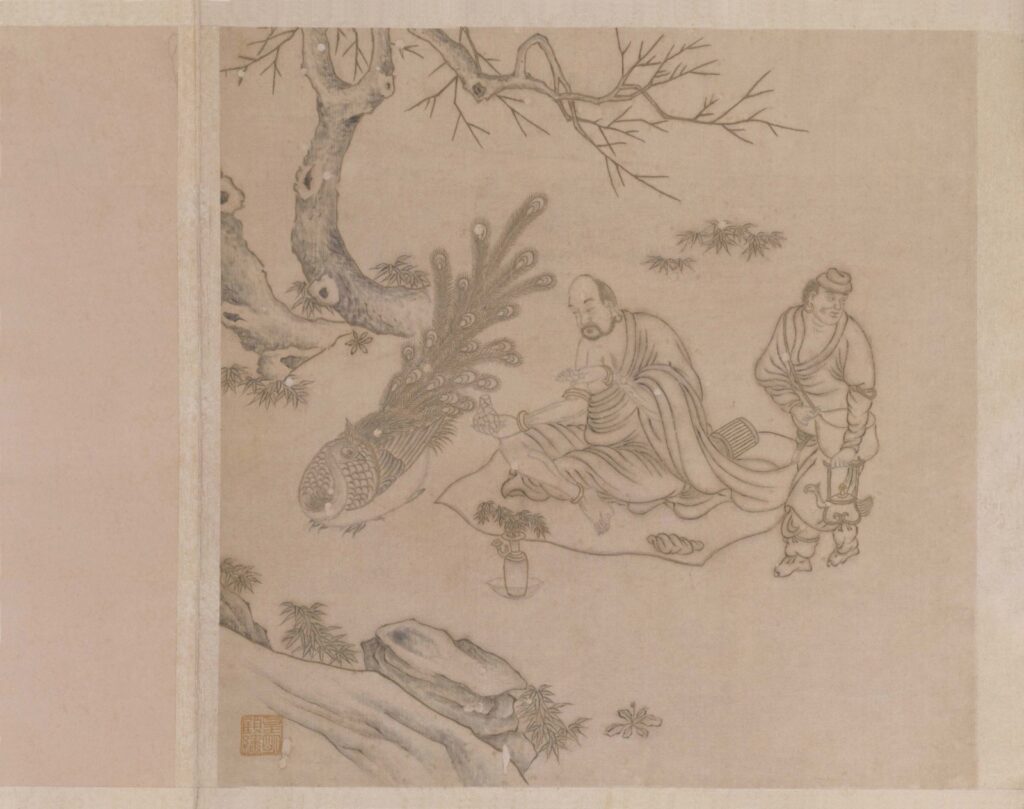
What is visible in TK0870?
The scene is horizontally organized. A large, gnarled tree anchors the left side and sends bare branches across the upper field. Near the center, a peacock lowers its head while its long tail rises in a fan of repeated feather shapes. To the right, a seated elder extends one arm toward a small object or vessel. A standing attendant occupies the outer edge of the group, and a cylindrical container rests behind the elder.
Rocks, bamboo-like leaves, a small potted plant, a pair of shoes, and a red seal complete the lower area. The background is mostly unfilled, allowing thin lines and pale tonal passages to remain legible. A vertical strip near the left edge suggests a boundary, join, or mounting feature, but its exact function is uncertain from this photograph. Small pale spots appear across the field; they should be recorded, not automatically diagnosed as losses.
How to examine a Gu embroidery Arhat album
The first step is to separate image structure from assumed technique. A digital photograph can make embroidery resemble drawing, especially when threads are fine and the image is displayed below full resolution. Before naming a stitch, look for directional units, repeated short marks, changes in sheen, raised edges, thread crossings, and places where a contour seems built from parallel segments rather than one continuous brushstroke.
Contour: where thread behaves like drawn line
The elder’s robe is defined by long, controlled folds. Around the sleeve and knees, several lines run in parallel, creating weight without strong color. The tree branches use a different rhythm: they divide into angular, tapering offshoots. The peacock feathers introduce repeated curved forms and dense internal marks. Comparing these zones helps reveal how one medium may imitate several kinds of brushwork.
Do not assume every visible gray line is thread. Photography, later retouching, painted additions, and compression can conceal construction. A reliable material description requires magnification, raking light, front and reverse examination, and preferably conservation documentation. At web-image level, “thread-like contour” is safer than a specific stitch name.
Direction and density: how shading is built
Pale gray modeling appears in the tree trunk, rocks, robes, and bird. Some areas are densely worked, while others rely on widely spaced lines and the natural tone of the ground. The contrast creates volume without a broad painted wash. In the peacock, close repeated marks differentiate the scaly body, striped wing, and eye-like tail patterns. On the elder, smoother tonal transitions keep attention on the face and gesture.
Direction matters as much as darkness. Lines that follow the curve of a sleeve make the cloth appear rounded; lines running along a feather reinforce its length. When documenting an embroidered Buddhist art image, map direction changes rather than describing the entire surface simply as “shaded.”
Reading the Arhat, attendant, and peacock
The elder is shown with individualized facial features, a partially bare chest, layered robes, and a seated posture in a landscape retreat. These elements fit the broad visual language of Arhat paintings, where Buddhist elders often appear as distinctive personalities rather than idealized, symmetrical deities. The attendant’s different clothing, smaller visual role, and standing pose establish a relationship without requiring a precise name.
The peacock is the most prominent nonhuman figure. Its scale and intricate tail give it nearly equal visual weight to the people. Yet the bird alone does not identify the Arhat. Peacock imagery also appears in other Buddhist contexts, including Mahamayuri; compare the separate guide to Mahamayuri and peacock iconography. Similar animals can serve different narrative, symbolic, decorative, or compositional purposes.
In TK0870, the relationship among the elder’s extended hand, the small object, and the bird deserves close inspection. Their proximity may be meaningful, but the photograph does not prove a specific action. A useful catalogue note would state that the elder extends a hand toward an object near the peacock, leaving the object and gesture uncertain.
Why album format changes the viewing experience
An Arhat album leaf is encountered at intimate scale and usually as part of a sequence. Page turning encourages comparison: one can track changes in landscape, attendants, animals, robes, gestures, seals, and technical handling across the set. A single photographed leaf may be visually complete, but it is only one unit within that larger structure.
This is why TK0870 should not be used alone to assign the elder a name. Neighboring leaves might contain inscriptions, numbered order, recurring attendants, or attributes that clarify the sequence. The method parallels the material reading of the Bodhi leaf Arhat album: support and sequence are part of the evidence, not neutral containers.
Condition clues and the limits of a digital image
Several pale dots and irregular marks are visible in the photographed field. They could represent surface loss, abrasion, dust, light reflection, image processing, or features of the textile and mount. The digital file cannot resolve the cause. Record each mark by location, size, shape, and relationship to the image before proposing an interpretation.
Color and sheen are also unstable in reproduction. Fine silk threads may change appearance with lighting angle, and a photograph can flatten their relief. Monitor calibration affects the warm ground and gray-brown lines. For a conservation workflow, consult the visual condition report checklist, while adapting its categories to an album leaf rather than assuming a traditional Thangka mounting.
Practical checklist for pictorial embroidery research
- Record the whole leaf. Include margins, mounting strips, folds, seals, blank areas, and cropped edges before studying the figures.
- Map visual zones. Separate the elder, attendant, peacock, tree, rocks, plants, vessels, shoes, and open ground.
- Compare line behavior. Note whether contours appear continuous, segmented, doubled, parallel, or densely packed.
- Trace direction changes. Follow marks around robe folds, faces, bark, feathers, rock planes, and foliage.
- Look for surface relief. Use high-resolution detail, raking light, and reverse images when available; do not infer stitch structure from a thumbnail.
- Separate technique from attribution. Archive titles can guide research, but maker, workshop, period, and school require documentary support.
- Compare the complete album. Check sequencing, repeated motifs, inscriptions, seals, dimensions, and technical consistency across every leaf.
- Keep uncertain observations explicit. Name what is visible and state what cannot be verified.
From brush-like image to textile object
TK0870 demonstrates why pictorial embroidery should not be treated as painting with a different label. Its quiet palette, fine contours, and large areas of open ground may recall ink drawing, yet the material logic can be different. Thread direction, density, surface reflection, and tension all affect how a line is seen. Even where the technique cannot be confirmed from the photograph, asking material questions changes the reading.
For researchers using digital collections, the best approach is layered: begin with composition and iconography, examine high-resolution surface evidence, compare the full series, consult the object record, and then separate confirmed facts from plausible hypotheses. This preserves the value of the image without turning archive metadata into certainty.
Conclusion
A Gu embroidery Arhat album can be studied through the relationship between thread-like line, tonal density, figure grouping, animal imagery, landscape, and album sequence. TK0870 offers clear visible anchors—the seated elder, attendant, peacock, old tree, rocks, bamboo, vessel, shoes, and seal—while leaving individual identity and material specifics uncertain. Careful description makes the image useful for art history, iconography, and conservation research without overstating what one digital photograph can prove.
Download the full Thangka image collection
Continue comparing Arhat albums, embroidery, Thangka images, and Buddhist visual traditions in the complete TANGKAWORLD gallery. Browse and download the full Thangka image collection for research and close visual study.