
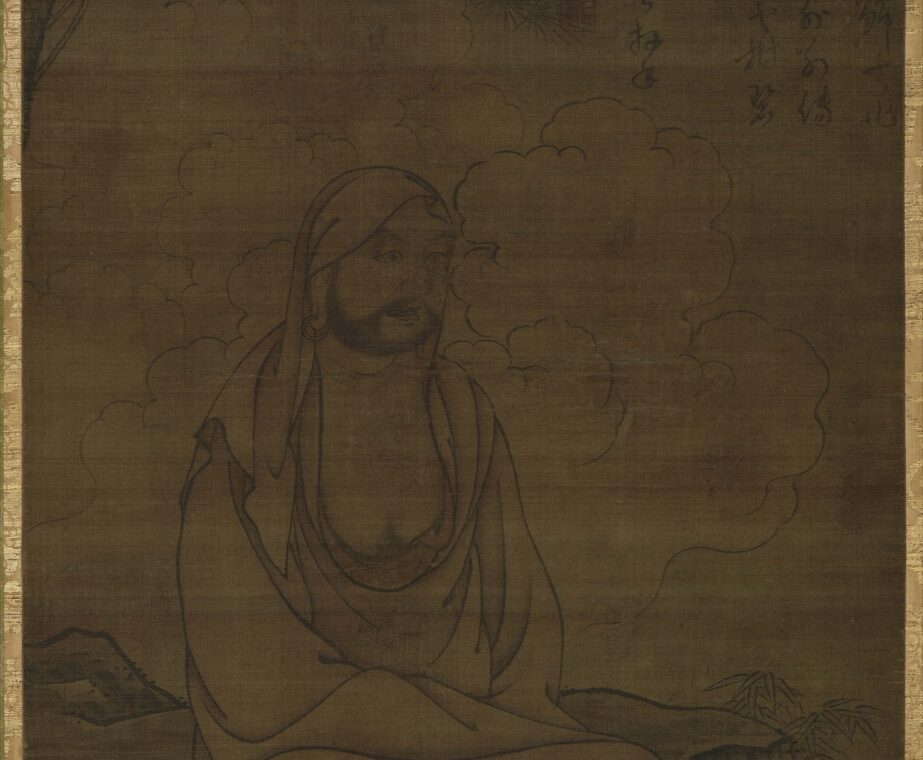
Bodhidharma painting iconography often begins with a striking human presence: a foreign-looking monk, intense eyes, heavy robes, and a body isolated against rock, mist, or empty paper. Yet these features are not a universal formula. Artists in China and Japan represented Bodhidharma in meditation, facing a wall, crossing a river on a reed, or as a confrontational bust. Identification is strongest when pose, setting, inscription, catalogue history, and comparison all support the same reading.
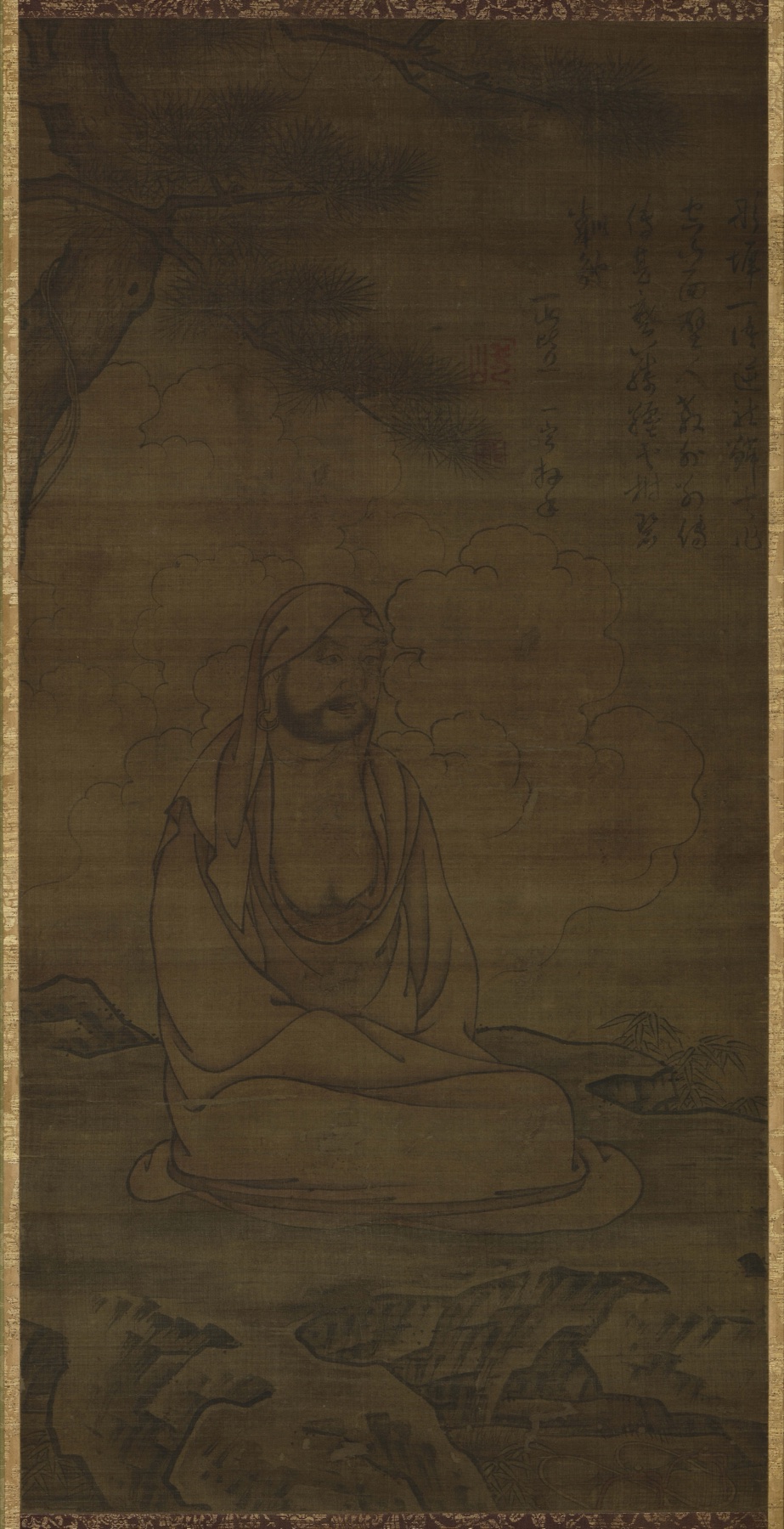
This guide uses TANGKAWORLD image TK0668 as a case study. The archive calls the seated monk Bodhidharma and suggests a Japanese context. The visible painting supports a meditation or retreat reading, but its exact title, date, artist, school, inscription, collection history, and provenance are uncertain. The goal is to show how to separate what the image reveals from what a filename merely proposes.
Who is Bodhidharma in Buddhist art?
Bodhidharma is traditionally associated with the transmission of Chan Buddhism to China; Chan later developed as Zen in Japan. Images present him as a patriarch and teacher rather than a Buddha or bodhisattva. He therefore lacks the ushnisha, lotus throne, elaborate crown, and multi-armed attributes used to identify many sacred figures in Thangka art.
Names change by language and catalogue. English records use Bodhidharma, Chinese sources use Damo, and Japanese sources often use Daruma. A collection search should include all three, but the name alone does not define a single visual type. The Metropolitan Museum of Art, for example, catalogues Chinese and Japanese Bodhidharma works in porcelain, iron, lacquer, ink, and color. Medium and regional style must be recorded separately from identity.
Start with the figure, not the legend
Begin with neutral description. In TK0668, a bald or hooded monk sits cross-legged on a low mat. The hands appear folded or concealed within the robe near the lap. The head turns slightly upward and to the right. Strong outlines define the face and drapery, while much of the surface remains dark and tonally restrained.
These observations establish a meditating monastic figure, but they do not prove Bodhidharma by themselves. Many Arhats and Chan masters are shown seated in landscapes. Compare the differences in our guide to Arhat paintings: individualized faces, monastic robes, attendants, books, animals, and landscape settings can overlap with patriarch portraits.
Reading the robe and seated posture
The robe creates a single visual mass
Bodhidharma is frequently represented in a voluminous robe that encloses the body. In TK0668, the garment forms a broad triangular mass around the torso and crossed legs. Its long contours stabilize the figure against the irregular tree, cloud, and rock forms. The dark palette makes the face and outer silhouette more important than textile pattern.
Color should be used cautiously. A famous late fifteenth-century Japanese work in the Met is catalogued as Bodhidharma in Red Robes, but other paintings use monochrome ink or subdued pigments. Red can strengthen a comparison; it is not an exclusive attribute and cannot identify a figure without context.
Crossed legs suggest stillness, not a specific episode
The cross-legged posture supports meditation or seated contemplation. It does not automatically prove the wall-gazing episode. A securely catalogued work titled Bodhidharma Facing the Rock Wall shows that “wall-gazing” is a recognized subject, but the title of that particular work depends on its own catalogue and composition.
TK0668 includes rocky forms and a quiet, enclosed landscape, yet no literal wall can be isolated with confidence. The safest caption is therefore “Bodhidharma seated beneath a pine,” while “wall-gazing” remains a possible thematic comparison rather than a confirmed event.
How landscape supports the portrait
A spreading pine branch crosses the upper field of TK0668. Rounded mist or cloud bands gather behind the monk, and rocks anchor the lower edge. Small plant forms appear near the right side. Together, these elements create a secluded environment suited to retreat and sustained attention.
The landscape is not merely scenery. The horizontal pine branch lowers the visual ceiling, while the rock and mat hold the figure near the center. Curving cloud outlines soften the hard edges of the head and robe. Dark surrounding tones make the monk emerge slowly, rewarding close viewing instead of immediate recognition.
This use of quiet space relates to the principles discussed in our negative space in Buddhist art guide. Empty or low-detail areas can isolate a face, direct the gaze, and establish contemplative rhythm. They should not be treated as unfinished sections without examining the whole composition.
The face, gaze, and “foreign monk” type
Bodhidharma portraits often emphasize a bearded face, prominent nose, wide or penetrating eyes, and heavy brows. These conventional traits mark him as a foreign monk within East Asian visual culture. TK0668 shows a bearded face with a strongly projected nose and an upward-directed gaze, which supports the archive identification.
Physiognomy is still supporting evidence, not a biometric signature. Artists exaggerate, simplify, or transform inherited models. Damage and dark photography can also alter the eyes, mouth, and beard. When the face is unclear, use “monk identified by the archive as Bodhidharma” instead of claiming that facial type alone settles the question.
Inscriptions and seals: evidence that needs expertise
Vertical writing occupies the upper-right area of TK0668, with a red seal nearby. These features may contain a poem, dedication, signature, date, ownership mark, or later annotation. Their presence is important, but a low-resolution photograph does not justify a transcription or translation.
First record placement, line count, ink tone, and relation to the image. Then seek a specialist reading from a high-resolution file. Determine whether the seal belongs to the artist, a collector, or a later owner. Our article on Buddhist painting seals and collector marks explains why a red mark should never be equated automatically with authorship.
For TK0668, the inscription’s content and the seal’s identity remain uncertain. The archive filename suggests a period and collection, but those claims require an independent museum record or publication before they enter a formal catalogue entry.
Compare different Bodhidharma narrative types
Seated meditation and wall-gazing
These images emphasize stillness, enclosed space, and a concentrated gaze. The body may be wrapped tightly in a robe and placed near a rock surface or cave-like setting. TK0668 belongs most comfortably near this family, although the exact wall-gazing episode is uncertain.
Crossing the river on a reed
Another type shows Bodhidharma standing above water on a reed or narrow plant. A Met hanging scroll titled Bodhidharma crossing the Yangzi River on a reed demonstrates how water, standing posture, and the reed transform the same figure into a narrative scene. Those attributes are absent from TK0668.
Close-up encounter portraits
Some paintings crop the body and enlarge the face, making brushwork and expression the main event. The Met’s early seventeenth-century Japanese Bodhidharma is an ink hanging scroll and provides a useful medium and format comparison. A portrait may identify the patriarch without landscape or narrative action, but its catalogue evidence remains essential.
Bodhidharma painting iconography checklist
- Figure type: Is the subject a monk, Arhat, patriarch, bodhisattva, or Buddha?
- Face: Record beard, brows, eyes, nose, and head covering without treating stereotypes as proof.
- Robe: Note color, volume, fold pattern, and whether the hands are visible or enclosed.
- Posture: Is the figure seated, standing, walking, or crossing water?
- Gaze: Does the head face a rock surface, another figure, open space, or the viewer?
- Setting: Identify pine, cave, wall, mist, water, reed, mat, and rocks only when visible.
- Inscription: Separate legible text from unverified archive labels and later notes.
- Seals: Distinguish possible artist, collector, and institutional marks.
- Condition: Check darkening, abrasion, creases, cropping, restoration, and photographic exposure.
- Documentation: Confirm date, artist, school, title, medium, collection, and provenance independently.
A responsible workflow for TK0668
Record the archive title and TK number first. Next, describe the seated monk, robe, gaze, pine, clouds, rocks, inscription, seal, and mounting. Compare the combination with securely catalogued Bodhidharma works, including seated, wall-facing, and river-crossing types. Finally, divide notes into visible, archive-stated, comparative, and uncertain claims.
Condition can change interpretation. The very dark middle tones in TK0668 may belong to the painting, age-related change, photography, or a combination of factors. Review the original at full resolution and use the Thangka condition report checklist before describing faded pigment, soot, staining, or retouching.
Conclusion
Bodhidharma painting iconography is recognized through a network of evidence: monastic dress, forceful facial type, seated or narrative posture, landscape, gaze, inscriptions, and reliable catalogue history. TK0668 supports a Bodhidharma identification and a meditation setting beneath a pine. Its exact wall-gazing subject, date, artist, school, inscription, medium, collection history, and provenance remain uncertain.
Download the full Thangka image collection
Continue browsing and download the complete TANGKAWORLD image library at Free Downloads. The full collection supports side-by-side study of Bodhidharma, Arhats, Buddhist ink painting, inscriptions, landscape symbolism, and preservation details.