
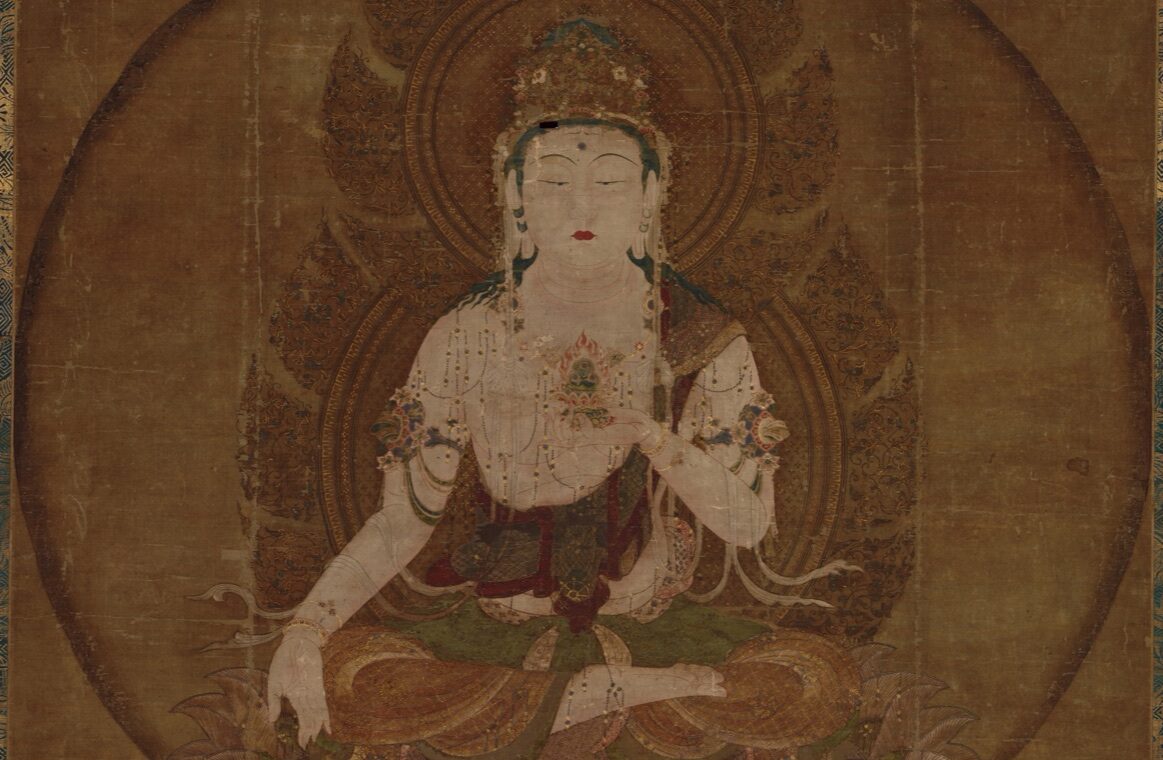
Akashagarbha Buddhist art is often recognized through a constellation of details rather than one isolated symbol: a bodhisattva seated on a lotus, a luminous circular field, a wish-granting jewel, and a hand lowered in a gesture of generosity or fulfilled wishes. In Japan, Akashagarbha is known as Kokūzō Bosatsu. The name connects the figure with a “storehouse of space,” an image of merit and wisdom described as immeasurable.
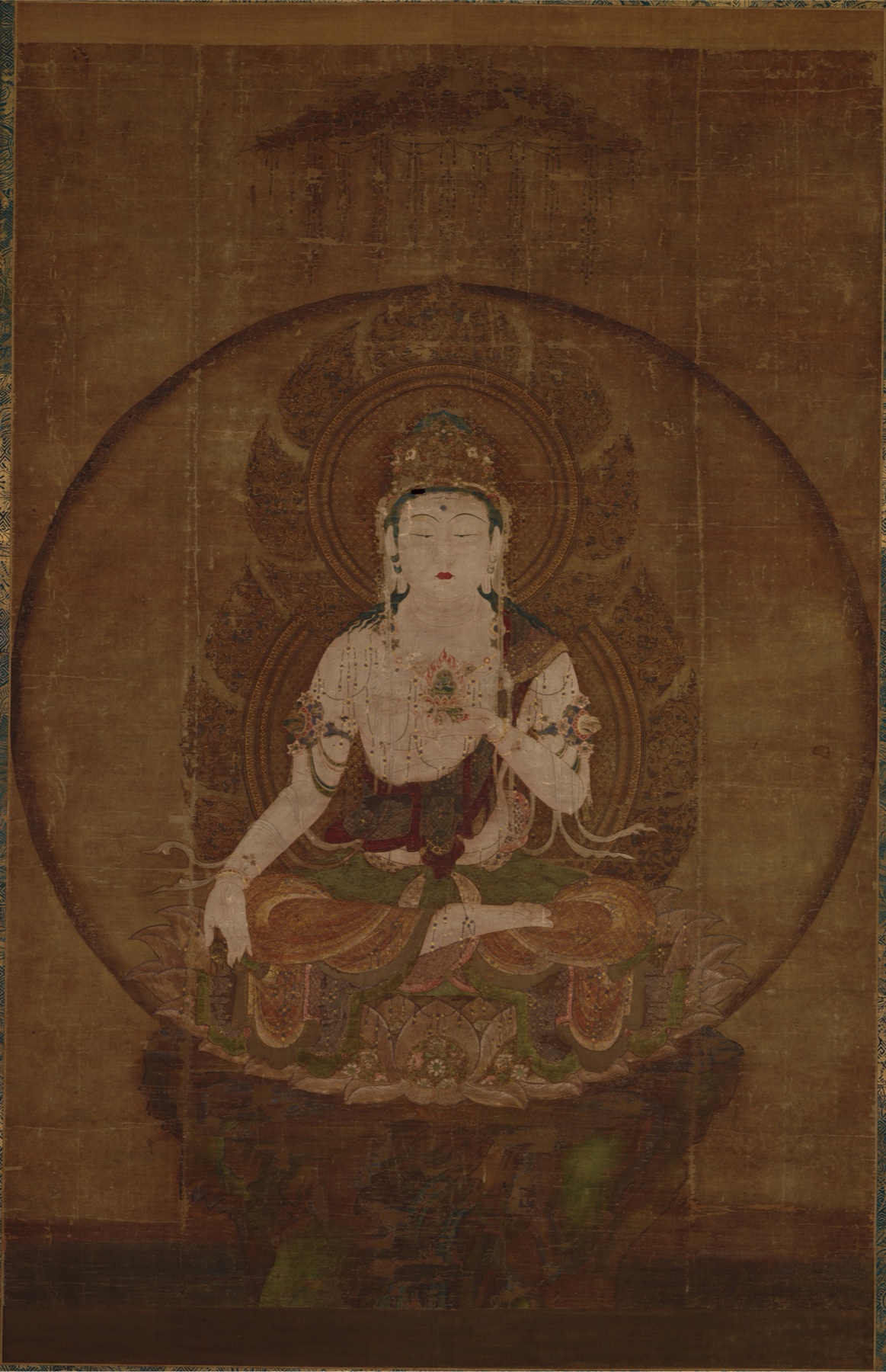
TK0664 offers a particularly clear study image. A pale-bodied bodhisattva sits frontally within a broad circular disc, holds a jewel before the chest, lowers the opposite hand, and rests on a lotus above a dark landform. These visible markers support the archive identification, but the exact date, artist, workshop, ritual setting, collection history, and provenance of this local file remain uncertain.
Quick answer: how to recognize Akashagarbha
Begin with five linked observations: a bodhisattva appearance rather than a monastic or plain Buddha form; a jewel held near the chest or placed on a lotus; a lowered right hand; a lotus seat; and a large circle of light that may represent the moon. No single feature is exclusive to Akashagarbha. The identification becomes persuasive when the attributes, pose, crown, and surrounding structure agree.
This evidence-first approach follows the same method used in our beginner’s guide to reading a Thangka: describe what is visible, compare the full group of attributes, and separate identification from unsupported claims about date or origin.
Akashagarbha, Ākāśagarbha, and Kokūzō
Akashagarbha is a common English spelling of the Sanskrit Ākāśagarbha. Japanese sources usually use Kokūzō or Kokūzō Bosatsu. These names refer to the same bodhisattva across different linguistic and artistic settings, but the visual forms are not identical in every region or ritual tradition.
That variation matters. A viewer should not expect every Akashagarbha image to repeat TK0664 exactly. Some examples emphasize a flaming jewel on a lotus; others place the jewel directly in the hand. Body color, radiating lines, landscape, crown structure, and the treatment of the surrounding disc can differ. The stable task is to identify a coherent iconographic system, not to demand a photographic template.
Read the central figure before the surrounding decoration
The seated bodhisattva form
TK0664 shows a jeweled, crowned figure seated cross-legged on a lotus. The necklaces, arm ornaments, patterned garments, and crown establish a bodhisattva type. This helps distinguish the figure from a simply robed Buddha and from Kshitigarbha, who is frequently presented in East Asian art with a shaved head and monastic clothing.
The calm face and frontal axis
The face is symmetrical and quiet, with lowered eyes. The jewel, torso, seat, and upper canopy align along a strong vertical axis. This stillness is important: the image does not rely on narrative action. It presents the deity for sustained contemplation, with the attributes arranged for recognition.
The wish-granting jewel is the key attribute
The most useful identifying feature is the jewel held before the chest. In TK0664 it appears as a small green form surrounded by a red, flame-like contour and supported near a flower or ornamental base. Because abrasion and darkened color reduce detail, it is safer to describe the visible shape as a jewel-like emblem than to overstate every component.
Official Japanese e-Museum records provide strong comparisons. A Tokyo National Museum Kokūzō painting is described with a jewel held before the chest, a lowered right hand, a lotus dais, and a large moon circle. A Nara National Museum example places three flaming jewels on a lotus held in the left hand. Together, these records show why the jewel must be read with the pose and surrounding light.
What the lowered hand communicates
The right hand descends toward the knee with the palm presented outward and the fingers relaxed. Museum descriptions identify comparable gestures as wish-granting or wish-fulfilling mudras. Visually, the downward direction balances the upward presentation of the jewel: one hand displays the central attribute while the other opens toward the viewer.
Do not identify the gesture by direction alone. A downward hand also appears in earth-touching and gift-bestowing contexts elsewhere in Buddhist art. Check whether the fingers reach toward the ground, whether the palm faces outward, and what the opposite hand holds. Gesture and attribute should be interpreted together.
The moon disc and nested halos
A broad circle surrounds most of the figure in TK0664. Inside it, smaller rings frame the head and body. The official Kokūzō comparisons interpret the largest luminous circle as the moon. It is therefore more precise to distinguish three layers: the broad moon-like field, the body mandorla, and the head halo.
This nested structure concentrates attention on the jewel and face while separating the sacred figure from the plain brown ground. Readers interested in these visual functions can compare our guide to the Buddhist halo in Thangka. The comparison is formal rather than a claim that Japanese hanging-scroll conventions and Tibetan Thangka conventions are identical.
The lotus seat, canopy, and landscape
Lotus support
The lotus petals beneath the crossed legs mark a purified support and help stabilize the frontal composition. Their tiers are worn but still legible. Our lotus throne visual guide explains how to record petal direction, tiers, color, and the transition between the deity and the lower support.
Canopy above and landform below
A suspended canopy occupies the upper register, while a dark rocky or watery landform anchors the bottom. Comparable Japanese Kokūzō paintings sometimes include a canopy and a mountain setting. In TK0664, however, the identity of the specific landform is uncertain. It should not be named as Mount Sumeru, Mount Asama, or another site without an object record tied to this file.
How not to confuse Akashagarbha with similar figures
- Kshitigarbha: often has a monk’s head, robes, staff, and jewel. TK0664 instead shows a crowned bodhisattva with an elaborate moon-disc setting.
- Akshobhya: usually appears as a Buddha making the earth-touching gesture. He does not normally present this Kokūzō combination of crowned bodhisattva form, chest-level jewel, and moon field.
- Avalokiteshvara: may hold a lotus or jewel in some forms, so look for the complete attribute set rather than a generic compassionate expression.
- Manjushri: commonly carries a sword and book or lotus. Those decisive attributes are absent here; compare the Manjushri identification guide.
Akashagarbha identification checklist
- Confirm a crowned and ornamented bodhisattva, not a monastic figure.
- Locate a jewel held at the chest or supported on a lotus.
- Record the direction and palm orientation of the lowered hand.
- Separate the broad moon disc from the head halo and body mandorla.
- Check the lotus seat, crown, canopy, and lower landscape as supporting evidence.
- Compare several museum records because Akashagarbha iconography varies.
- Mark the date, maker, collection, provenance, and exact ritual function as uncertain unless documentation confirms them.
Condition affects what we can identify
TK0664 has visible abrasion, horizontal and vertical creases, losses in the crown and face, faded textile patterns, and broad tonal darkening. These changes can obscure the number of small figures in the crown, the jewel’s flame contour, and fine lines within the mandorla. A digital image supports preliminary study, not a complete conservation diagnosis. Use the condition-report checklist to distinguish direct observation from proposed causes.
Conclusion
Akashagarbha Buddhist art becomes readable when jewel, lowered hand, bodhisattva ornaments, lotus seat, and moon disc are treated as a coordinated system. TK0664 strongly supports a Kokūzō identification through that visual cluster. At the same time, responsible cataloging leaves the precise date, artist, workshop, ritual use, collection history, and provenance uncertain until a reliable object record is connected to the file.
Download the full Thangka image collection
Continue exploring comparative Buddhist art and download the full TANGKAWORLD image collection. The archive makes it easier to compare deities, gestures, jewels, halos, lotus seats, and regional painting traditions across high-resolution study images.