
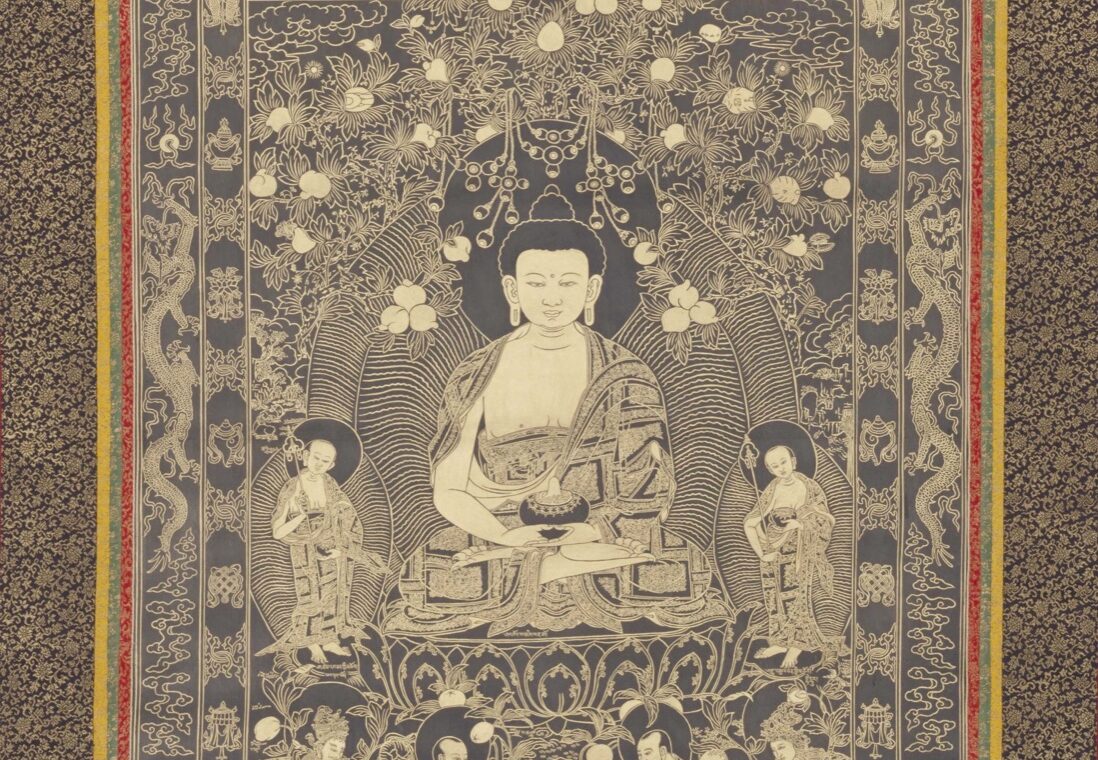
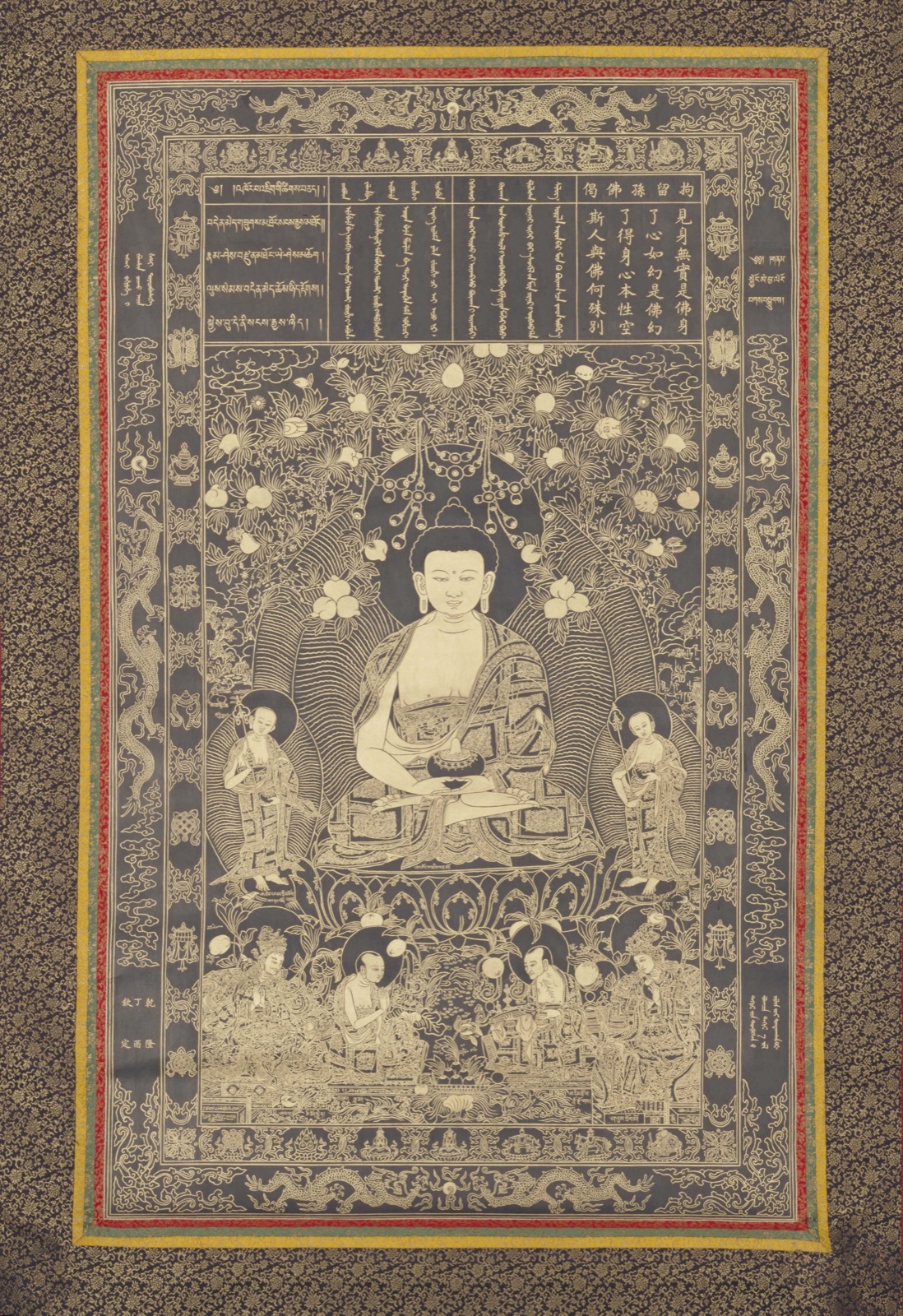
Dragon pairs in Buddhist art can organise a painting long before a viewer identifies a single figure. Dragons may flank a text panel, face one another above a central field, run vertically along the sides, or repeat near the lower edge. Their placement creates symmetry, protects visual boundaries, and links distant parts of a composition. The most useful approach is to describe where each dragon appears and how it relates to the frame before assigning a specific symbolism, region, date, or workshop.
TK0378 provides a detailed example. A central seated Buddha is surrounded by attendants, a lotus throne, a flowering canopy, multiscript panels, and several dragon pairs: one near the top, one near the lower border, and vertical dragons along the sides. This visible arrangement supports a study of framing and repetition. It does not independently establish the identity in the archive filename or the historical meaning of every dragon; those points remain uncertain without a reliable inscription, catalogue, or documented comparison.
Start with the paired arrangement
First locate the pair rather than trying to name the dragon style. Are two dragons facing inward, moving in opposite directions, or mirroring one another across a central emblem? In TK0378, the upper pair creates a horizontal band above the text field, while the lower pair repeats that enclosing rhythm near the base. This is clear compositional evidence. It says nothing by itself about a fixed narrative or date.
Then note whether the dragons are part of the painting’s inner scene or part of a frame. A dragon surrounding a central Buddha may be close to the main iconographic field; a dragon at the outer edge may be a border device. Keeping these zones separate avoids a common error: treating every dragon in a dense Thangka as a direct attendant of the central figure.
How to read dragon pairs in Buddhist art
Map the axes
Use the vertical and horizontal axes of the painting. Record dragons at the top, bottom, left, right, or inner corners. In TK0378, upper and lower pairs form horizontal anchors, while the tall side dragons create a vertical enclosure. This simple map reveals why the image feels balanced even when the central field contains many smaller forms.
Compare direction and posture
Describe the visible direction of each body, head, claw, and tail. A pair may turn toward a central emblem, turn outward, or curl in parallel. Direction is a reliable observation; an interpretation of blessing, authority, water, weather, or guardianship requires additional evidence. If details are damaged or reduced in a digital image, state that they are uncertain rather than reconstructing them.
Separate dragons from clouds and floral ornament
Gold-line imagery can make dragons, clouds, flames, leaves, and scrolling ornament appear continuous. Trace the head, body, limbs, and tail before calling a motif a dragon. In TK0378, the dragon forms can be distinguished from the cloud bands and floral canopy by their long bodies and repeated paired placement. This distinction is especially useful for cataloguing cropped or low-detail reproductions.
What dragon pairs can and cannot prove
Pairs of dragons can show a deliberate visual system: bilateral balance, a frame around text, or a connection between upper and lower registers. They do not by themselves prove a geographic origin, school, imperial commission, or exact religious identity. Motifs travel, are copied, and are adapted. The same visual form may perform different roles in different works.
For TK0378, the responsible observation is that paired dragons surround a central Buddhist assembly and multiscript field. The archive filename is an association that may guide research, but it is not a complete identification. Separate visible dragon placement from claims about date, artist, site, collection history, provenance, or ritual setting.
A documentation checklist
- Photograph the whole painting before taking dragon details.
- Mark each dragon’s position along the top, bottom, sides, or inner field.
- Record direction, symmetry, overlap, and relation to text or figures.
- Describe head, body, claws, and tail only where visible.
- Separate dragons from clouds, flames, leaves, and border scrolls.
- Note losses, cropping, or repainting without guessing their cause.
- Keep stylistic origin, date, maker, and provenance uncertain without evidence.
This method works with our Thangka border documentation guide and condition report checklist. For a wider approach to reading figures, symbols, and composition together, see How to Read a Thangka.
Dragons, text panels, and the central figure
Dragon pairs often guide the eye toward other evidence. In TK0378, the top pair sits near the multiscript panel, while the lower pair echoes the central figure’s lotus throne and lower assembly. The motifs create a visual route between border, text, and image. They do not make the text legible automatically. A reliable transcription requires sufficient resolution and relevant language expertise, so text and dragon observations should be recorded separately until both can be connected by evidence.
Comparing the central Buddha, attendants, and dragons is still useful. The dragons establish the perimeter; the halo and throne establish the central focus; the attendants populate the surrounding field. Our guides to the Buddhist halo in Thangka and Buddhist attendant figures offer complementary methods.
From ornament to visual structure
Reading dragon pairs in Buddhist art means treating ornament as evidence of composition. In TK0378, upper, lower, and side dragons create repeated boundaries around the central assembly, text, flowers, and throne. Describe that structure carefully, compare it with documented works, and allow historical details to remain uncertain where the evidence ends. This produces a clearer visual record and a more cautious interpretation.
Use repetition as evidence
Repeated dragon pairs are especially useful when comparing images. Record whether the same body direction, scale, and central gap recur at the top and bottom of a painting. In TK0378, the repeated placement makes a visual frame that can be described even if small facial or claw details are unclear. When comparing another work, note what changes: a pair may be replaced by a single dragon, shifted to a textile surround, or interrupted by an inscription. Such changes can support careful comparison, but they do not by themselves establish a shared workshop, date, or region.
For image records, make one entry for each pair rather than one general note about “dragons.” Include location, facing direction, visible overlap, and condition. This creates a record that another researcher can check against the same image or a higher-resolution version later.
Download the full Thangka image collection
Continue browsing and downloading the complete TANGKAWORLD image collection for close comparison of dragon motifs, borders, figure groups, inscriptions, and painting details.